So, I was determined not to blog about this because it would make me so much less cool. But I'm just not really all that cool.
Saturday night I found myself at an awesome party in NYC--a highly unusual occurrence in itself--and, even more startlingly, found myself talking to Heath Ledger and Michelle Williams while stuffing my face with a cupcake.
I didn't faint, or babble, or go speechless. I didn't mention Brokeback Mountain (although Brent and I had finally just watched it two days before). Instead, Heath asked how we knew Joe & Laura, and Michelle asked me how the pregnancy was going and we talked about how great prenatal yoga is.
And that's it; it was small talk and not something I expect was all that earth-shattering for anyone. But I have this enormous appreciation for the fact that people who do extraordinary things like brilliantly act in socially significant movies are also, in all other contexts, ordinary people who do things like go to birthday parties and make small talk about babies and yoga. But it seems like very often people who do extraordinary things forget that they are also ordinary people in all other contexts, and the rest of us let them forget that in our own starstruck adoration of them. And that makes my little five minutes of talking with my mouth full and licking buttercream icing off my fingers while chatting with Heath and Michelle all the more precious to me. Now I can admire them on both counts: as extraordinary actors, and wonderful, ordinary people.
Tuesday, April 11, 2006


Thursday, April 06, 2006
P.S.
In one of my Vagina Monologues posts back in February I mentioned that Notre Dame had banned the production of the play on school grounds. A friend from the cast sent this link to a NY Times article today: Notre Dame's President Allows 'Monologues' and Gay Films.
Wednesday, April 05, 2006
Sludge Lives!
 Everyone knows by now that Brent and I are expecting a little addition to the household around the first of June.
What we haven't told anyone is, we've already been living with a third presence in our apartment, for over a year now. Not the cat, you know about her. I'm talking about The Sludge.
We have Sludge. Here's how it came to us.
 A year and half ago, or so (memory is a bit fuzzy) our dishwasher developed chronic incontinence and started peeing on the floor. So we called maintenance, who showed up promptly, diagnosed this condition as terminal, and installed a new dishwasher. This new dishwasher is a bit smaller than the original one, and of course the racks are arranged differently, but these minor complaints are inconsequential; besides, I'm overjoyed simply to have a dishwasher at all, as we spent the first half of our marriage without this luxury.
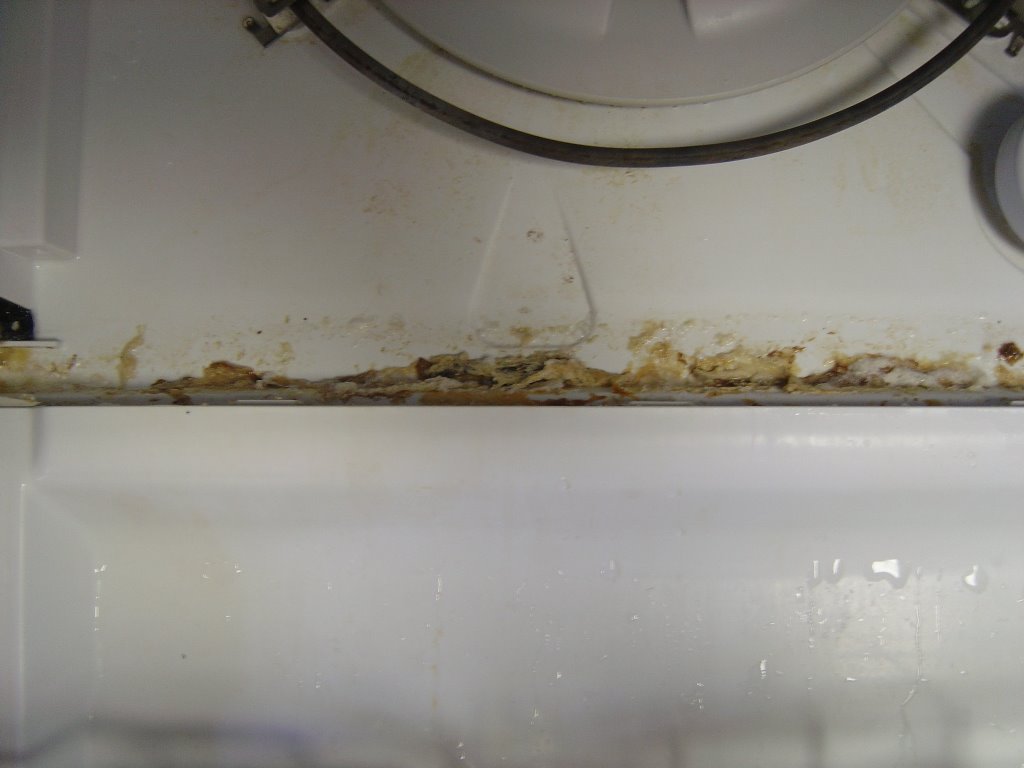
And then we discovered Sludge was living with us. Under the door at the bottom of the dishwasher, just camping out under the little lip where, apparently, rinse water never ventures. Sludge is a collection of soap scum, food particles and greasiness that just sits there beneath our clean dishes and grows and grows, a silent but menacing presence that gives lie to the bright green button on the outside of the new dishwasher that proudly proclaims, "sanitized."
So we called maintenance and told them, we have Sludge.The problem is, they can't find anything obviously wrong with the stupid dishwasher. There's nothing missing. There's nothing out of place. There's nothing broken. So, because they can't find anything actually wrong, the verdict came back: live with Sludge.
We tried. Oh, we've tried valiantly. We clean out our dishwasher periodically (gross!) but within 2 wash cycles, Sludge is back. It can't be dislodged. Someday, I expect, I'll be unloading the dishes and it will sit up, blink at me, start beating a drum and chanting, "We're Filth! We're Filth! We come from filth, we're going to filth!" (Obviously at that point maintenance will not be who I call. Where oh where is that apotheosis of cool, the Sewer Urchin, when I desperately need him???)
Anyhow, we managed to make it so far by just ignoring it most of the time and cleaning it when necessary. (For those of you who have dined at our house, I hope you're not feeling traumatized at this point.) But now...well, it's funny how having a kid changes your perspective all the way down. Brent and I can live with the indignity and questionable sanitariness of Sludge, but should Baby _______? So Friday morning, after unloading the dishwasher and feeling mightily disgusted with Sludge, I decided enough was enough. I got out the digital camera and took several pics of our offensive house un-guest, and emailed them to the head of the maintenance dept., with an explanation that I simply can't imagine trying to sanitize bottles in a dishwasher with Sludge living in it (I'm planning to breastfeed, anyway, but the point is, why should Baby ____'s first companion be Sludge?).
I received a prompt reply and Monday someone came out to look at it. They want to try cleaning it with some kind of mighty cleaner and see if that helps (it won't), but we've been promised: if they can't get rid of Sludge, we will get a new dishwasher. Again.
YAY!
Thursday, March 30, 2006
new post!
Brent has a new post over at Pilgrimage to Canterbury: his first sermon in an Episcopal church.
Monday, March 13, 2006
terrain change
This week I read in Your Pregnancy Week-by-Week that sometimes growth seems gradual, and sometimes it seems to happen suddenly, virtually overnight.
No kidding.
Last Friday morning I still recognized my bellybutton. Friday night when I got ready for bed, I looked down at my belly and didn't recognize the terrain. Last night at church I caught a glimpse of myself in one of the mirror "panells" and thought, my word, I'm huge! I know, I know...with another almost 3 months to go, I ain't seen nothin' yet. Frankly, at this point, I'm a little frightened.
I'm also leaking. I didn't think that happened this early. And it's only on one side. It's very distracting and I guess I ought to go get some nursing pads because stuffing one side of the bra with toilet paper is just not a permanent solution.
That's it for rude truth about pregnancy today. I just had to chug a bottle of the most disgustingly over-sweet fake Kool-Aid crap I've ever had to ingest and off we go to the doctor's office for the Glucose Tolerance Test. Yay, fun. But we don't dare be late because I'm not drinking that mess again. Blech.
If you're looking for something edifying to read you obviously came to the wrong place, but try looking here.
No kidding.
Last Friday morning I still recognized my bellybutton. Friday night when I got ready for bed, I looked down at my belly and didn't recognize the terrain. Last night at church I caught a glimpse of myself in one of the mirror "panells" and thought, my word, I'm huge! I know, I know...with another almost 3 months to go, I ain't seen nothin' yet. Frankly, at this point, I'm a little frightened.
I'm also leaking. I didn't think that happened this early. And it's only on one side. It's very distracting and I guess I ought to go get some nursing pads because stuffing one side of the bra with toilet paper is just not a permanent solution.
That's it for rude truth about pregnancy today. I just had to chug a bottle of the most disgustingly over-sweet fake Kool-Aid crap I've ever had to ingest and off we go to the doctor's office for the Glucose Tolerance Test. Yay, fun. But we don't dare be late because I'm not drinking that mess again. Blech.
If you're looking for something edifying to read you obviously came to the wrong place, but try looking here.
Tuesday, March 07, 2006
The Diaper Dilemma
Diaper rash. The environment. What's in those scary disposable things anyway? Laundry, mounds and mounds of laundry and the communal washer & dryer. Diaper pails. Where have all the diaper services gone? Why isn't there some way to combine convenience & ethical consumption???
Yes, friends. The question of what we'll be putting on our daughter's butt is fraught with morally problematic consequences. It is one dark deep morass of ethical quandary.
Here's what we've figured out so far. There are three basic options. No, really, there are three. Surprisingly. First, we can be evil and use disposable diapers. We can try to mitigate our evilness by using Seventh Generation diapers such as one finds at the Whole Foods down the street. (Although we'd order them online and save $$$.) But these are not any more biodegradable than your average Huggies; the difference seems to be a health-related concern about the effects of chlorine on your baby's bum. Or, we could be brave and use cloth. This breaks down into 2 sub-options, at least theoretically, because we could 1) use a diaper service, or 2) launder them ourselves.
Or, the amazing third option: gDiapers. These nifty little things are disposable, flushable, and biodegradable. No diaper service. No laundry. No diaper pail. And they won't be the last thing left on earth after the nuclear blast along with the cockroaches.
Yes, I'm in love with option #3. The problem is, these wonderful little innovations are twice as expensive as normal disposables, and significantly more than what a diaper service would cost, even. Here's how the numbers crunched out (oh, yes, we crunched the numbers, we're serious about our dilemma): Seventh Generation disposables, $700/year; cloth (diaper service), $800-900/year; cloth (self-laundered), $200/year; gdiapers, $1500/year.
Now, seriously, the problem breaks down like this. Laundering our own diapers? Stinky and a lot of effort, but these things are not hurdles for me personally. I'm stoic. But the communal washer/dryer situation? Not only is this massively inconvenient in terms of flights of stairs and possible usage conflicts, but how many neighbors are likely to look upon the usage of their washer for loads of diapers without resentment, fear of contagion, and downright hostility? So...diaper service? So far all our searching has led us to about three defunct services, one private residence and two fax numbers. You'd think Princeton would have a diaper service--all these rich and supposedly liberal, educated, care for the environment types--but apparently not. So...it comes down to, do we cave and start shopping at Sam's for the cheapest Huggies around, or do we start waiting tables to afford ethical diapers for the kid?
Seriously, those of you who have already braved the terrifying unknown of parenthood, any advice? Anything we've overlooked? Those of you with masterful research skills, have we missed a fourth option? Those of you also facing the prospect of imminent parenthood, what are you doing?
Yes, friends. The question of what we'll be putting on our daughter's butt is fraught with morally problematic consequences. It is one dark deep morass of ethical quandary.
Here's what we've figured out so far. There are three basic options. No, really, there are three. Surprisingly. First, we can be evil and use disposable diapers. We can try to mitigate our evilness by using Seventh Generation diapers such as one finds at the Whole Foods down the street. (Although we'd order them online and save $$$.) But these are not any more biodegradable than your average Huggies; the difference seems to be a health-related concern about the effects of chlorine on your baby's bum. Or, we could be brave and use cloth. This breaks down into 2 sub-options, at least theoretically, because we could 1) use a diaper service, or 2) launder them ourselves.
Or, the amazing third option: gDiapers. These nifty little things are disposable, flushable, and biodegradable. No diaper service. No laundry. No diaper pail. And they won't be the last thing left on earth after the nuclear blast along with the cockroaches.
Yes, I'm in love with option #3. The problem is, these wonderful little innovations are twice as expensive as normal disposables, and significantly more than what a diaper service would cost, even. Here's how the numbers crunched out (oh, yes, we crunched the numbers, we're serious about our dilemma): Seventh Generation disposables, $700/year; cloth (diaper service), $800-900/year; cloth (self-laundered), $200/year; gdiapers, $1500/year.
Now, seriously, the problem breaks down like this. Laundering our own diapers? Stinky and a lot of effort, but these things are not hurdles for me personally. I'm stoic. But the communal washer/dryer situation? Not only is this massively inconvenient in terms of flights of stairs and possible usage conflicts, but how many neighbors are likely to look upon the usage of their washer for loads of diapers without resentment, fear of contagion, and downright hostility? So...diaper service? So far all our searching has led us to about three defunct services, one private residence and two fax numbers. You'd think Princeton would have a diaper service--all these rich and supposedly liberal, educated, care for the environment types--but apparently not. So...it comes down to, do we cave and start shopping at Sam's for the cheapest Huggies around, or do we start waiting tables to afford ethical diapers for the kid?
Seriously, those of you who have already braved the terrifying unknown of parenthood, any advice? Anything we've overlooked? Those of you with masterful research skills, have we missed a fourth option? Those of you also facing the prospect of imminent parenthood, what are you doing?
Thursday, March 02, 2006
CofC tag
We used to play tag out on the front lawn & steps of North Boulevard Church of Christ when I was a girl. It was the best part of church. This grown-up tag is a little less fun and not so cardiovascular, but it's good exercise anyway. Thanks, Chad.
Three reasons you stay in Churches of Christ:
1. It's "home." Beyond social networks, the comfortable feeling of being known, the family roots that stretch back, the missionary grandparents and the preacher dad, it's the church which nurtured me from Cradle Roll up. I owe a debt of gratitude to the women and men who taught me in the faith, and who have played their own parts in landing me where I am now. (Which I think is a good place...)
2. I like to think I have something to contribute.
3. There's nowhere else, yet, that I would rather be, when it comes right down to it.
You may notice these are all personal reasons, rather than doctrinal or theological. That's how it is.
Three reasons you would leave Churches of Christ:
1. If I should become so unwelcome that every word I speak/write is counterproductive, I would consider it a sign that my usefulness is all used up. Since I can't imagine (now) being a part of a church without expressing and discussing my theological convictions, it would be inevitable that I would end up elsewhere.
2. If I found myself in a situation where my husband or child was not accepted as fully belonging to God's people, I would go.
3. If it became--in some way I can't quite imagine--clear that there was necessary and astonishingly good work to be done elsewhere that I was uniquely fitted to do, I would go do it.
Three professors and/or courses who have influenced your thinking:
1. At Harding: Tom Eddins, John Fortner, and Pat Garner. I hope this humble mention doesn't get them all fired.
2. At ACU: Fred Aquino, Jeff Childers...really, who am I going to leave out here? Every single prof I ever took a class with, and even those I didn't.
3. AT PTS: my advisor, Wentzel van Huyssteen; Mark Taylor; Ellen Charry.
Three academic books which have shaped your thinking:
I find it difficult to define my own "personal canon," so to speak. So I'm going to just toss out some titles. Limiting this to three at this point in my academic endeavors makes this completely impossible, or nearly completely arbitrary. So I'm going with the latter.
1. Daniel Migliore, Faith Seeking Understanding: An Introduction to Christian Theology. This was my first taste of systematic theology; I found it addictive...
2. John Zizioulas, Being as Communion
3. Gustavo Gutierrez, A Theology of Liberation
Three CofC/Stone-Campbell books which have shaped your thinking:
1. Richard Hughes, Reviving the Ancient Faith and Myths America Lives By
2. Leonard Allen, Distant Voices
3. Jeff Childers, Doug Foster & Jack Reese, Crux of the Matter
Three hopes you have for the future of Churches of Christ:
1. That our daughters will be able to take for granted the freedom to serve Christ in any way they experience a call to.
2. That we will find a way to search scripture for guidance, wisdom, and truth without the assumption that getting it right means all others have gotten it wrong, and that this somehow is a "salvation issue." In fact, I hope the phrase "salvation issue" becomes so archaic among us that my kids won't even understand what it means.
3. That we will resist the temptation to withdraw into ourselves as a denomination, ignoring both the wider Christian church and the world we are called to serve.
Three fears you have for Churches of Christ:
That we continue to think in binary terms:
1. Regarding faith and politics: that our only options are nationalism or complete withdrawal.
2. Regarding worship: that our only options are "traditional" and "contemporary." (Liturgy, people! Liturgy!)
3. Regarding doctrine generally. How did we ever convince ourselves in the first place that anything Jesus said or Paul wrote is that simple? Read the parables!
Three challenges we will face in Churches of Christ in our generation:
Learning to read the Bible with an integrity that takes into account the testimony of human experience :
1. on the issues of gender & sexuality,
2. on the relationship of theology & science,
3. and in interfaith dialogue.
Three bloggers you tag:
1. Brent
2. em*
3. MOM
explanation: Maybe I broke the rules and tagged some innocent bystanders. But 1) it's high time Brent updated his blog, so take a hint, babe!!! and 2) I think the perspective of those who have "left" about why they stayed as long as they did, why they left, what our challenges are, etc., is just as valuable as that of those who stay. (For instance, these posts on Scribere Orare Est, or these on Hermit's Rock ). Part of our problem, as Chad's tag post points out, is that we do not engage in conversation with anyone but ourselves. So let those who are of us, but no longer a part of us (to parody John, heh heh) speak to us about something which they may, perhaps, have wrestled with much more deeply and intimately than we have yet ourselves. There is wisdom to be shared here. And then there are those who are still frankly searching for a place to be, who may identify as being "from" Churches of Christ in the sense of possessing that heritage, but not fully identifying with it. Also, there's a sort of liminal space which can be created and inhabited in which, perhaps, one may self-identify as CofC but would not necessarily be validated in that identification by some churches, perhaps even "mainstream" churches, in the CofC. I originally went to the mission field in search of something like that sort of interstitial existence, hoping to find the space to do ministry. (I didn't find it, but that may not always be the case for people.) And there's the liminal space of the community church, in which people may self-identify as being from one tradition or another and yet find their spiritual community in a church which does not. I think these perspectives are valuable, perhaps especially valuable, as they represent a desire to stay such that a third option between leaving and staying is carved out by sheer determination not to give up too fast. Perhaps one might also think of academia as such a liminal space for some...
Three reasons you stay in Churches of Christ:
1. It's "home." Beyond social networks, the comfortable feeling of being known, the family roots that stretch back, the missionary grandparents and the preacher dad, it's the church which nurtured me from Cradle Roll up. I owe a debt of gratitude to the women and men who taught me in the faith, and who have played their own parts in landing me where I am now. (Which I think is a good place...)
2. I like to think I have something to contribute.
3. There's nowhere else, yet, that I would rather be, when it comes right down to it.
You may notice these are all personal reasons, rather than doctrinal or theological. That's how it is.
Three reasons you would leave Churches of Christ:
1. If I should become so unwelcome that every word I speak/write is counterproductive, I would consider it a sign that my usefulness is all used up. Since I can't imagine (now) being a part of a church without expressing and discussing my theological convictions, it would be inevitable that I would end up elsewhere.
2. If I found myself in a situation where my husband or child was not accepted as fully belonging to God's people, I would go.
3. If it became--in some way I can't quite imagine--clear that there was necessary and astonishingly good work to be done elsewhere that I was uniquely fitted to do, I would go do it.
Three professors and/or courses who have influenced your thinking:
1. At Harding: Tom Eddins, John Fortner, and Pat Garner. I hope this humble mention doesn't get them all fired.
2. At ACU: Fred Aquino, Jeff Childers...really, who am I going to leave out here? Every single prof I ever took a class with, and even those I didn't.
3. AT PTS: my advisor, Wentzel van Huyssteen; Mark Taylor; Ellen Charry.
Three academic books which have shaped your thinking:
I find it difficult to define my own "personal canon," so to speak. So I'm going to just toss out some titles. Limiting this to three at this point in my academic endeavors makes this completely impossible, or nearly completely arbitrary. So I'm going with the latter.
1. Daniel Migliore, Faith Seeking Understanding: An Introduction to Christian Theology. This was my first taste of systematic theology; I found it addictive...
2. John Zizioulas, Being as Communion
3. Gustavo Gutierrez, A Theology of Liberation
Three CofC/Stone-Campbell books which have shaped your thinking:
1. Richard Hughes, Reviving the Ancient Faith and Myths America Lives By
2. Leonard Allen, Distant Voices
3. Jeff Childers, Doug Foster & Jack Reese, Crux of the Matter
Three hopes you have for the future of Churches of Christ:
1. That our daughters will be able to take for granted the freedom to serve Christ in any way they experience a call to.
2. That we will find a way to search scripture for guidance, wisdom, and truth without the assumption that getting it right means all others have gotten it wrong, and that this somehow is a "salvation issue." In fact, I hope the phrase "salvation issue" becomes so archaic among us that my kids won't even understand what it means.
3. That we will resist the temptation to withdraw into ourselves as a denomination, ignoring both the wider Christian church and the world we are called to serve.
Three fears you have for Churches of Christ:
That we continue to think in binary terms:
1. Regarding faith and politics: that our only options are nationalism or complete withdrawal.
2. Regarding worship: that our only options are "traditional" and "contemporary." (Liturgy, people! Liturgy!)
3. Regarding doctrine generally. How did we ever convince ourselves in the first place that anything Jesus said or Paul wrote is that simple? Read the parables!
Three challenges we will face in Churches of Christ in our generation:
Learning to read the Bible with an integrity that takes into account the testimony of human experience :
1. on the issues of gender & sexuality,
2. on the relationship of theology & science,
3. and in interfaith dialogue.
Three bloggers you tag:
1. Brent
2. em*
3. MOM
explanation: Maybe I broke the rules and tagged some innocent bystanders. But 1) it's high time Brent updated his blog, so take a hint, babe!!! and 2) I think the perspective of those who have "left" about why they stayed as long as they did, why they left, what our challenges are, etc., is just as valuable as that of those who stay. (For instance, these posts on Scribere Orare Est, or these on Hermit's Rock ). Part of our problem, as Chad's tag post points out, is that we do not engage in conversation with anyone but ourselves. So let those who are of us, but no longer a part of us (to parody John, heh heh) speak to us about something which they may, perhaps, have wrestled with much more deeply and intimately than we have yet ourselves. There is wisdom to be shared here. And then there are those who are still frankly searching for a place to be, who may identify as being "from" Churches of Christ in the sense of possessing that heritage, but not fully identifying with it. Also, there's a sort of liminal space which can be created and inhabited in which, perhaps, one may self-identify as CofC but would not necessarily be validated in that identification by some churches, perhaps even "mainstream" churches, in the CofC. I originally went to the mission field in search of something like that sort of interstitial existence, hoping to find the space to do ministry. (I didn't find it, but that may not always be the case for people.) And there's the liminal space of the community church, in which people may self-identify as being from one tradition or another and yet find their spiritual community in a church which does not. I think these perspectives are valuable, perhaps especially valuable, as they represent a desire to stay such that a third option between leaving and staying is carved out by sheer determination not to give up too fast. Perhaps one might also think of academia as such a liminal space for some...
Monday, February 27, 2006
Transfiguration Sermon
Hello all. Brent here. I just wanted to let you know that Jennifer has a new sermon about the transfiguration online at rudesermons.blogspot.com. This was preached yesterday at a Church of Christ in the Northeast.
Thursday, February 23, 2006
making space
These days I'm making space. Inside and out. For the kid, you know.
The project started with Readerware, and Brent cataloguing and labeling with Library of Congress numbers all the books currently in our possession. This began months ago. We own about a thousand books. So, now they're all, or at least all of them except for the ones most recently acquired (these are stacked up in Brent's "reading chair," waiting) properly labeled. The second step: choosing which ones we can box up and store. The third step: boxing, sealing, labeling the boxes and carrying them down to our storage cage in the basement. Thanks to my periodic but quite determined nagging, we got all this accomplished a week or so ago.
We have a lot more space now. A full 10 boxes of books are now down in the basement. We've moved a now-empty bookcase out of the bedroom and found it a new spot in the living room. Pretty soon, we'll move the furniture around a bit in the bedroom, and Baby ______ will have her own little nook in the corner with a changing table and a couple of cross-stitches from MOM to mark her space.
A couple days ago I decided to tackle clearing out the top shelf of my side of the bedroom closet. I've been storing all my pictures and memorabilia up there--mainly because the basement floods regularly and I didn't want my pictures ruined. But now we need the space.
So I began excavating. Things were semi-organized. I have a couple of scrapbooks, which I had every intention of filling with the best and most amusing pictures, labeled and dated, etc. One of them is completely empty (the leatherbound scrapbook with the fleur de lis, bought in Florence), and the other is partially full, but I haven't touched it in years. My pictures are still in stacks inside the envelopes of whatever drugstore developed them: Wal-Mart, Walgreens, the little Chinese envelopes. Some of them were just loose, and had little scraps of paper folded around them with topical labels: J & A, Ally's wedding, etc. And there were ziplocks full of old papers. Letters, mostly, which I found myself unable to throw away when going through the last of my things at the house in TN.
It became an archaeological project: digging through the layers of my past, organizing them, deciding which parts were golden and which were worthless. I didn't throw much away. Even the recorded history of the bleak times--the journal in the John Boy Walton-style Indian Chief tablet from Wal-Mart from the last year at Harding--was valuable, in its own way. I imagined someday that Baby _______ will find this box of dusty relics, and imagined her wide-eyed discovery that her mom is a person with hidden depths and angsts and who used to write bad poetry, and once thought she would never get married, and once thought she'd convinced herself she was okay with that. I imagined her astonishment at seeing so many pictures of mom on various dates through the years. Who would have thought that so many different guys would have found her interesting? I imagined her laughing at my hair and my funny clothes and at pictures of Aunt Ally and Auntie Em as children. I imagined her not even recognizing the grandparents--is this Nana really? Wow, when did Pop have hair?
It was cleansing, this taking stock of oneself, from a sort of distance. There's a lot in there I still wish hadn't happened and that I still remember feeling, even. But I own it. It's a recorded progress of me through time: the deadends and the bleak stretches of featureless highway, and the mountain peaks and far vistas of foreign lands, too. It's all of that. Maybe when Baby ______ discovers it I'll regret her knowing that I used to curse in my journal, that I dated, or whatever...but it will mean that in some measure she gets to know me, in retrospect, in a way that I can take for granted that I will get to know her, as a human being in motion through time, from the very beginning.
The project started with Readerware, and Brent cataloguing and labeling with Library of Congress numbers all the books currently in our possession. This began months ago. We own about a thousand books. So, now they're all, or at least all of them except for the ones most recently acquired (these are stacked up in Brent's "reading chair," waiting) properly labeled. The second step: choosing which ones we can box up and store. The third step: boxing, sealing, labeling the boxes and carrying them down to our storage cage in the basement. Thanks to my periodic but quite determined nagging, we got all this accomplished a week or so ago.
We have a lot more space now. A full 10 boxes of books are now down in the basement. We've moved a now-empty bookcase out of the bedroom and found it a new spot in the living room. Pretty soon, we'll move the furniture around a bit in the bedroom, and Baby ______ will have her own little nook in the corner with a changing table and a couple of cross-stitches from MOM to mark her space.
A couple days ago I decided to tackle clearing out the top shelf of my side of the bedroom closet. I've been storing all my pictures and memorabilia up there--mainly because the basement floods regularly and I didn't want my pictures ruined. But now we need the space.
So I began excavating. Things were semi-organized. I have a couple of scrapbooks, which I had every intention of filling with the best and most amusing pictures, labeled and dated, etc. One of them is completely empty (the leatherbound scrapbook with the fleur de lis, bought in Florence), and the other is partially full, but I haven't touched it in years. My pictures are still in stacks inside the envelopes of whatever drugstore developed them: Wal-Mart, Walgreens, the little Chinese envelopes. Some of them were just loose, and had little scraps of paper folded around them with topical labels: J & A, Ally's wedding, etc. And there were ziplocks full of old papers. Letters, mostly, which I found myself unable to throw away when going through the last of my things at the house in TN.
It became an archaeological project: digging through the layers of my past, organizing them, deciding which parts were golden and which were worthless. I didn't throw much away. Even the recorded history of the bleak times--the journal in the John Boy Walton-style Indian Chief tablet from Wal-Mart from the last year at Harding--was valuable, in its own way. I imagined someday that Baby _______ will find this box of dusty relics, and imagined her wide-eyed discovery that her mom is a person with hidden depths and angsts and who used to write bad poetry, and once thought she would never get married, and once thought she'd convinced herself she was okay with that. I imagined her astonishment at seeing so many pictures of mom on various dates through the years. Who would have thought that so many different guys would have found her interesting? I imagined her laughing at my hair and my funny clothes and at pictures of Aunt Ally and Auntie Em as children. I imagined her not even recognizing the grandparents--is this Nana really? Wow, when did Pop have hair?
It was cleansing, this taking stock of oneself, from a sort of distance. There's a lot in there I still wish hadn't happened and that I still remember feeling, even. But I own it. It's a recorded progress of me through time: the deadends and the bleak stretches of featureless highway, and the mountain peaks and far vistas of foreign lands, too. It's all of that. Maybe when Baby ______ discovers it I'll regret her knowing that I used to curse in my journal, that I dated, or whatever...but it will mean that in some measure she gets to know me, in retrospect, in a way that I can take for granted that I will get to know her, as a human being in motion through time, from the very beginning.
Monday, February 20, 2006
FINE
The Cast
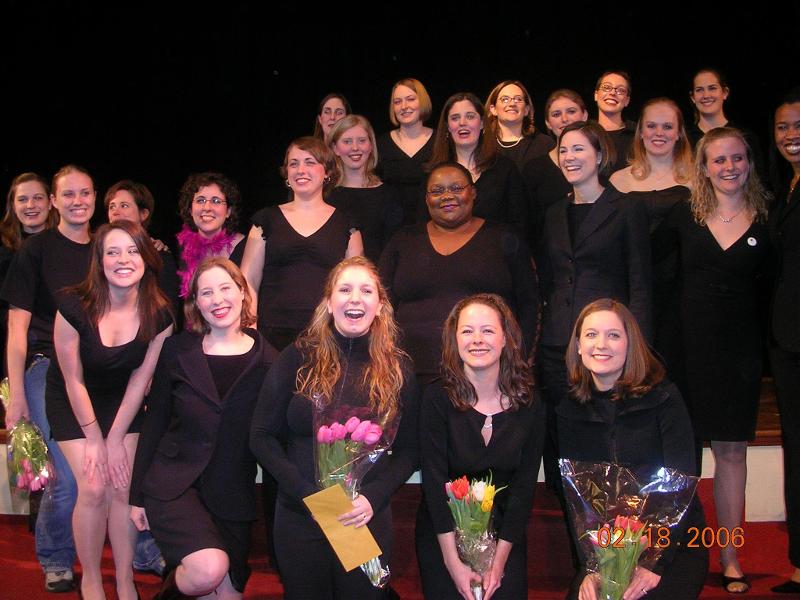
My favorite line (in "If your vagina could talk, what would it say?"): "remember me?" (thanks for the inspiration, MOM)
My favorite monologue overall: "I was there in the room."
Brent's favorite monologue(s): "My Angry Vagina," "Because he liked to look at it," "The Vagina Workshop."
Most gutwrenching line: In "For the Comfort Women," under "what we couldn't do": "keep my baby."
We raised $700 Friday night; I think we matched it or better Saturday although I don't know the figures.
The Vulva Choir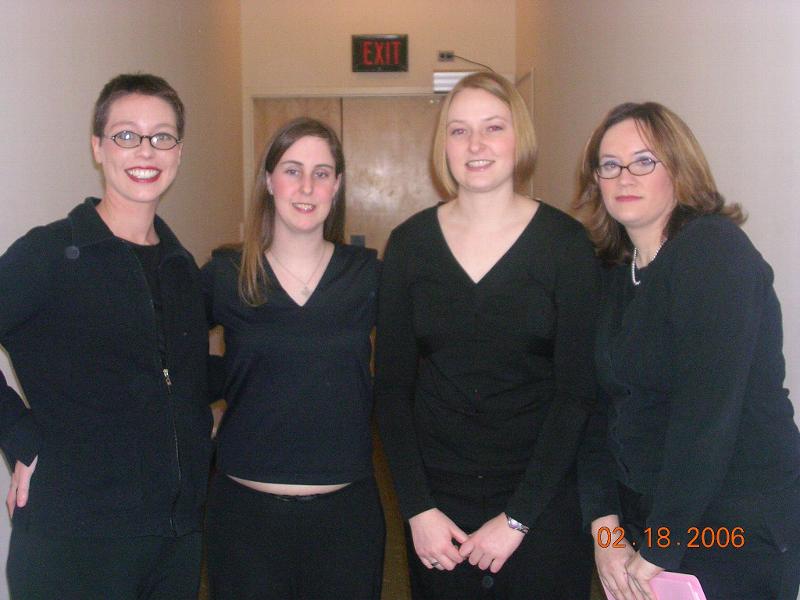
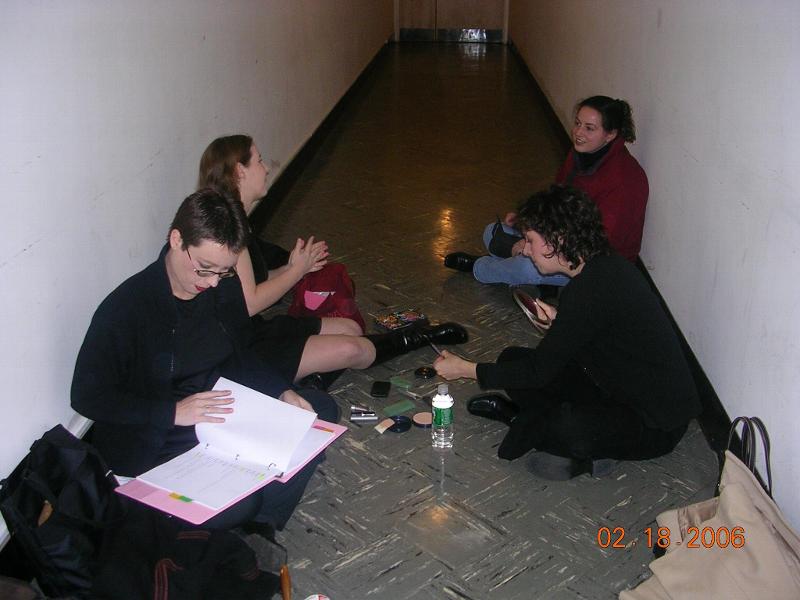
pre-show review
Friday, February 17, 2006
in media res
Some of the reservations a professor of mine expressed about the Vagina Monologues during the panel discussion Wednesday evening seem warranted. There is, for example, a fairly consistent identification of women with vaginas, so that the message almost seems to be that woman=vagina. This, clearly, is an ambivalent sentiment: one that is used to oppress and reduce and harm, as well as being a path of affirmation for women who have studiously ignored this part of who they are. This didn't get discussed fully during the panel--mainly because I had so many questions to write on notecards and turn in to the panelists that I simply didn't get to this one. My feeling about it at the moment is, while I don't want to make the move woman=vagina, I think the play represents a necessary dialectical moment in the redemption of the body part for women. Before I can realize myself as a whole being (vagina and more), first there must a valuing of that part of me that's been previously ignored, squelched, not thought about or looked at, off limits to the conscious self. Once that happens, then it is possible to move beyond identifying oneself with the vagina and understand that there is much more to a person than any singular body part.
Other thoughts: among the cast there has been the constant question, how is the seminary at large responding to the production of "The Vagina Monologues" on campus? I myself have heard no negative sentiment, but then again, I'm relatively isolated from the social world in which most PTS students live and move and have their social being. (This isn't just me being socially inept; it's a PhD student problem generally, I think.) Since this is the second time for the play to be performed at PTS (first was 2004), I kindof assumed that criticism might be more muted, or that unenlightened people would have accepted it with the attitude of "well you can't make me go see it and my $5 is buying me lunch, not going to Womanspace." But apparently this is just a product of my isolation and misplaced optimism. I haven't seen anything written contra "The Vagina Monologues" here, but Brent shared this with me from the NY Times this morning: At Religious Universities, Disputes Over Faith and Academic Freedom.
The article focuses on University of Notre Dame's recent statement that "that staging the events on campus implies an endorsement of values that conflict with Roman Catholicism." What I find entirely incomprehensible is that, though the objection is based on the assumption that allowing these performances implies endorsement of values unacceptable to the powers that be, "The Vagina Monologues" was allowed to be performed--just not allowed to raise money to be donated to the cause of prevention of violence against women: "'The Vagina Monologues' was performed in a classroom, not a theater, by a group that was not allowed to sell tickets to raise money for women's groups as it once had." So apparently the monologue "The Woman Who Loved to Make Vaginas Happy" can be performed--as long as no good comes of it. Forgive me if my ire leads me astray here, but it seems to me that now, instead of endorsing the production of a play which stands for the prevention of violence against women, Notre Dame has now endorsed the performance of apparently entirely gratuitous orgasm scenes with no greater purpose than sheer entertainment value. Does this seem weird to anyone else???
Last night's performance here, though, was wonderfully affirming. People laughed when it was funny--which it is, loud and often. And people gasped when it was shocking, and sobered when it was sad. Despite whatever lingering puritanical sentiment there may be around here, there are enough people who understand the real point of the Monologues. It's not endorsement of a libertine sexual ethic, it's not in-your-face feminist bullying, it's not simply there for the glorious shock value of it all. It's about women trying to reclaim a part of themselves that has for too long been something that means only hurt and vulnerability and the ever present possibility of terror. (Yes, terror. I used the GW word, and I meant it. In a way that I suspect he doesn't and can't when he uses it.)
I don't understand what there is about that that any Christian institution couldn't endorse. To refuse to do so is simply misogyny dressed up in puritanical clothing.
I'm glad PTS can be the counterexample to Notre Dame. Tonight should be even better.
Other thoughts: among the cast there has been the constant question, how is the seminary at large responding to the production of "The Vagina Monologues" on campus? I myself have heard no negative sentiment, but then again, I'm relatively isolated from the social world in which most PTS students live and move and have their social being. (This isn't just me being socially inept; it's a PhD student problem generally, I think.) Since this is the second time for the play to be performed at PTS (first was 2004), I kindof assumed that criticism might be more muted, or that unenlightened people would have accepted it with the attitude of "well you can't make me go see it and my $5 is buying me lunch, not going to Womanspace." But apparently this is just a product of my isolation and misplaced optimism. I haven't seen anything written contra "The Vagina Monologues" here, but Brent shared this with me from the NY Times this morning: At Religious Universities, Disputes Over Faith and Academic Freedom.
The article focuses on University of Notre Dame's recent statement that "that staging the events on campus implies an endorsement of values that conflict with Roman Catholicism." What I find entirely incomprehensible is that, though the objection is based on the assumption that allowing these performances implies endorsement of values unacceptable to the powers that be, "The Vagina Monologues" was allowed to be performed--just not allowed to raise money to be donated to the cause of prevention of violence against women: "'The Vagina Monologues' was performed in a classroom, not a theater, by a group that was not allowed to sell tickets to raise money for women's groups as it once had." So apparently the monologue "The Woman Who Loved to Make Vaginas Happy" can be performed--as long as no good comes of it. Forgive me if my ire leads me astray here, but it seems to me that now, instead of endorsing the production of a play which stands for the prevention of violence against women, Notre Dame has now endorsed the performance of apparently entirely gratuitous orgasm scenes with no greater purpose than sheer entertainment value. Does this seem weird to anyone else???
Last night's performance here, though, was wonderfully affirming. People laughed when it was funny--which it is, loud and often. And people gasped when it was shocking, and sobered when it was sad. Despite whatever lingering puritanical sentiment there may be around here, there are enough people who understand the real point of the Monologues. It's not endorsement of a libertine sexual ethic, it's not in-your-face feminist bullying, it's not simply there for the glorious shock value of it all. It's about women trying to reclaim a part of themselves that has for too long been something that means only hurt and vulnerability and the ever present possibility of terror. (Yes, terror. I used the GW word, and I meant it. In a way that I suspect he doesn't and can't when he uses it.)
I don't understand what there is about that that any Christian institution couldn't endorse. To refuse to do so is simply misogyny dressed up in puritanical clothing.
I'm glad PTS can be the counterexample to Notre Dame. Tonight should be even better.
Thursday, February 16, 2006
Tuesday, February 14, 2006
mug shots


Brent and I bought some new coffee mugs this week. Since you can't see all of the message on the mug at right, here is what it says: "The Diocese of New Jersey: resisting simplistic theology since 1785."
We have a nice mug collection. It occurred to me in surveying it that mugs really say quite a lot about a person, or a household. They're as expressive as T-shirts, or perhaps even more so, since you feel less inhibited about something written on a mug than something emblazoned on your chest with your face above it, walking around all day.
There are the mugs that match our everyday china: lovely curvy ones whose shape retains heat and keeps your coffee warm longer. They're pretty. We use them when we invite people to dinner. Then there's the pair of Hull pattern mugs picked up at a flea market because it reminded me of grandparents, which I always use for hot chocolate, because they're so nice and warm and brown. Then the set of three plain white diner-type mugs that actually are inherited from grandparents, Brent's grandfather, to be exact. Then there are the random single mugs: a free one picked up at the TBA with a picture of Miller Chapel on it; a black one declaring "stolen from the City Cafe, Murfreesboro, TN" although my dad bought it for me for $2; the one Brent picked up for me a while back just for fun with Rosie the Riveter on it. I used to have a John Deere mug, but I think I must have left it in the Grad Commons at ACU...
My travel mugs are especially precious to me although some of them are so old and well-used now that the ink has worn completely off in spots, so that you can no longer immediately tell that they're all Coffee People mugs supplied by my favorite Harding roommate, from Portland, Oregon. I also have this confounded inability to hold on to them, so that what should be a collection of at least 7 is down to three, and two lids between them. Mostly I've lost them by leaving them in various classrooms over the years, or on the roofs of cars.
My mom and dad's mug collection is probably unsurpassed in all the world for breadth and deapth and overall randomness as well as quirky personal expression. Of course, it helps to know that when my dad used to work for Webb's, he brought home free mugs nearly by the truckload from annual coffee conventions during my childhood.
These new mugs register the latest installment of the evolution of our life together here, as Brent moves into the ordination process and embraces life as an Episcopalian. Maybe in a few months we'll acquire yet another mug registering the major upheaval of "Baby _____'s" arrival.
So I'm curious: what do you drink your coffee out of in the morning? What does your mug say and what does it say about you? Some of you people, I've seen your mugs, I know how weird you are. I dare you to share with all the supposedly normal people who might be reading this.
Sunday, February 12, 2006
why, part 3
Once there was a boy, a boy I thought I liked very much. My roommate set us up. He wanted to go live in another country where they speak another language and preach. I thought I might want to do this too. I thought I might want to do it with him.
But the problem was, in this boy's world, girls were beautiful virgins in white dresses with long dark hair, or they were whores. And because I wanted to be honest, I told him all about me.
It took him three days and being yelled at by someone else to speak to me again. When he did, he said that he would try to understand.
But he never did understand.
Eventually, he dumped me. It was hard. I thought I liked him a lot. I thought I even loved him, even though, to be honest (which I can be now to a degree I was unable to then), we had an awful relationship. I knew why he was dumping me. I wanted to make him say it. I tried for hours to make him say it. He never did.
I was messed up for a long time after this. I was vulnerable enough to wonder if he might be right about me. It took me a long time to undo that damage, and it didn't get undone by me alone. A long time after I met a boy who saw me differently, and who, wonder of wonders, saw something even I didn't see in me, something fascinating, something compelling, something worth holding on to from then on. Something which couldn't be reduced to the status of a body part. And we got married.
And here we are.
But the problem was, in this boy's world, girls were beautiful virgins in white dresses with long dark hair, or they were whores. And because I wanted to be honest, I told him all about me.
It took him three days and being yelled at by someone else to speak to me again. When he did, he said that he would try to understand.
But he never did understand.
Eventually, he dumped me. It was hard. I thought I liked him a lot. I thought I even loved him, even though, to be honest (which I can be now to a degree I was unable to then), we had an awful relationship. I knew why he was dumping me. I wanted to make him say it. I tried for hours to make him say it. He never did.
I was messed up for a long time after this. I was vulnerable enough to wonder if he might be right about me. It took me a long time to undo that damage, and it didn't get undone by me alone. A long time after I met a boy who saw me differently, and who, wonder of wonders, saw something even I didn't see in me, something fascinating, something compelling, something worth holding on to from then on. Something which couldn't be reduced to the status of a body part. And we got married.
And here we are.
Friday, February 10, 2006
some half-assed empirical research
It's hard, you know, this baby-naming business. Long before we were even actually pregnant, back when we were just thinking about it, Brent and I bought the new version of Beyond Jennifer and Jason (now with the updated title, Beyond Jennifer and Jason, Madison and Montana). Having grown up with a name that at least one other person in every classroom I have ever been in has also possessed--and I mean this quite literally, I have never been the only Jennifer in any school setting; even now, I am one of a pair!--I am determined to find a name for this kid that she can consider to be all hers, so that if she should happen to run into someone of the same name it's kind of exciting and unusual instead of routine and very, very annoying...and sometimes just plain depressing. It's hard to feel so unique and yet have the same name as every other female child born in 1976.
(Sorry, MOM. I know you tried. You just tapped into the Zeitgeist and it didn't let you go, or something.)
So Brent and I have looked on the US Census Bureau website at name statistics and trends over like the last 20 years. And that was somewhat reassuring. The name we like for the kid has made it only so far as the top 100 names. But lately we've been hearing it a lot on TV: random characters on prime-time TV series like CSI have this name, or minor characters in a movie, or main characters in really bad movies. But it's there. And it's worrisome.
So I decided to put my Harding alum magazine to use this morning while I sipped my tea--a poor substitute for coffee, alas, but hell, I'm drinking decaf these days anyway so what does it even matter--and looked through the birth announcements solely for the purposes of discovering what I should definitely NOT be naming this baby.
First, the prize for the only really different-sounding and yet not totally freakish name out of the whole bunch goes to "Stella Allison." I'm proud to say, too, that this was the only couple I actually knew out of the list of those who've recently procreated. Yay!
Other names I kinda liked were "Sarah Nell" and "Nora Mae" although I'm a little less keen on the second. (Liked Nora, not so much the Mae with-an-e.)
But here's the breakdown: out of 27 names, there were,
2 Avery's
2 Rose's
3 Anne's and one Anniston
2 Emma's
3 Grace's
4 Caroline's (one spelled with a 'K')
4 Elizabeth's
2 Sarah's
2 Lee's and 1 Lily
and the usual run of made-up or unisexish names: Ashton, Ashlyn, Ayden, Campbell, Murphy, Mackinley
Abby, Alexis, Katelyn, Kaylie, Lindsay, Emily, Laura and Jane also made an appearance but were not (surpisingly, for some of these) duplicated. Oh, and there was one "Aria Tuscany," so I suppose those alums definitely went to HUF at some point.
So, and this is a relief, our name didn't appear on the list. But now that I'm all paranoid about it I'm keeping this to myself, so family types: quit referring to the kid as "Baby _______" at least on the blogs, okay? There's probably some other desperate Jennifers out there looking for the perfect as-yet-unrediscovered moniker for their precious unique little girl bundle of joy (Joy! That's it! Go for "Joy"!) and I'm not giving this one away.
And one last unrelated and somewhat strident point: are these the names good Harding alumni are giving to the next generation of women we expect to remain silent in our churches? Somehow "Murphy" in particular strikes me as a name with the potential to encourage the expression of personal opinion and thoughts...why might that be?... Perhaps Dr. Burks should work on providing procreating alums with a list of acceptably feminine names that don't challenge the status quo, ahem, I mean, the "core beliefs" of our churches.
Update: Thanks to mph's tip I found a whole 'nother page of birth announcements, upping the "Ann family" total to 4 Annes, 1 Anniston, 2 Hannahs and 1 Savannah; there are 4 Graces, 1 Joy & 1 Faith (apparently this generation is Hopeless); 3 Ashlyns; and the peerless Vail Blue. Added to unisex names: Emmerson, Sidney, & Madison, Briley and Riley.
(Sorry, MOM. I know you tried. You just tapped into the Zeitgeist and it didn't let you go, or something.)
So Brent and I have looked on the US Census Bureau website at name statistics and trends over like the last 20 years. And that was somewhat reassuring. The name we like for the kid has made it only so far as the top 100 names. But lately we've been hearing it a lot on TV: random characters on prime-time TV series like CSI have this name, or minor characters in a movie, or main characters in really bad movies. But it's there. And it's worrisome.
So I decided to put my Harding alum magazine to use this morning while I sipped my tea--a poor substitute for coffee, alas, but hell, I'm drinking decaf these days anyway so what does it even matter--and looked through the birth announcements solely for the purposes of discovering what I should definitely NOT be naming this baby.
First, the prize for the only really different-sounding and yet not totally freakish name out of the whole bunch goes to "Stella Allison." I'm proud to say, too, that this was the only couple I actually knew out of the list of those who've recently procreated. Yay!
Other names I kinda liked were "Sarah Nell" and "Nora Mae" although I'm a little less keen on the second. (Liked Nora, not so much the Mae with-an-e.)
But here's the breakdown: out of 27 names, there were,
2 Avery's
2 Rose's
3 Anne's and one Anniston
2 Emma's
3 Grace's
4 Caroline's (one spelled with a 'K')
4 Elizabeth's
2 Sarah's
2 Lee's and 1 Lily
and the usual run of made-up or unisexish names: Ashton, Ashlyn, Ayden, Campbell, Murphy, Mackinley
Abby, Alexis, Katelyn, Kaylie, Lindsay, Emily, Laura and Jane also made an appearance but were not (surpisingly, for some of these) duplicated. Oh, and there was one "Aria Tuscany," so I suppose those alums definitely went to HUF at some point.
So, and this is a relief, our name didn't appear on the list. But now that I'm all paranoid about it I'm keeping this to myself, so family types: quit referring to the kid as "Baby _______" at least on the blogs, okay? There's probably some other desperate Jennifers out there looking for the perfect as-yet-unrediscovered moniker for their precious unique little girl bundle of joy (Joy! That's it! Go for "Joy"!) and I'm not giving this one away.
And one last unrelated and somewhat strident point: are these the names good Harding alumni are giving to the next generation of women we expect to remain silent in our churches? Somehow "Murphy" in particular strikes me as a name with the potential to encourage the expression of personal opinion and thoughts...why might that be?... Perhaps Dr. Burks should work on providing procreating alums with a list of acceptably feminine names that don't challenge the status quo, ahem, I mean, the "core beliefs" of our churches.
Update: Thanks to mph's tip I found a whole 'nother page of birth announcements, upping the "Ann family" total to 4 Annes, 1 Anniston, 2 Hannahs and 1 Savannah; there are 4 Graces, 1 Joy & 1 Faith (apparently this generation is Hopeless); 3 Ashlyns; and the peerless Vail Blue. Added to unisex names: Emmerson, Sidney, & Madison, Briley and Riley.
Thursday, February 09, 2006
why, part 2
So, I was thinking about landmark incidents/iconic happenings in my life regarding the evolution of my view of my own sexuality.
There was Barbie.
There was high school.
There was college--basically, a huge step backward, all things considered.
There was this time in Italy.
--when I was at HUF, when we got an unexpected day off from classes. Most people spent the day in Florence, but I was determined to get out, go somewhere, anywhere, as long as I could be on my own. Living with 40 people in a villa can get a little crowded, and I felt the need for some space. I borrowed a Rick Steves Backdoor from someone and picked a destination. The day went just as I planned. I was deliberately alone and enjoyed it. Until it was time to go home: the plan went decidedly off the rails. Making it to the train by sheer luck and the kindness of one very nice mustachioed Italian man, I settled down in an empty compartment. Empty, that is, until one old, mostly toothless, grizzled guy with two younger men came in and sat down. Despite there only being 4 of us in a 6-seat compartment, it was suddenly very crowded. Rather than space themselves out, they sat as near me as possible--I ended up crammed against the window, rubbing shoulders with one of the younger guys, who was definitely closer than he needed to be, while the leering old man sat across from me. And my serene day of silent solitude was interrupted by the garrulity of the old guy: having introduced himself and his two "nephews," he proceeded to engage me in conversation that quickly went beyond my Italian conversing ability and comprehension--until I finally (oh so innocent!) grasped the import of the crude hand gestures. Deciding I was done with this conversation, I decided to get my journal from my backpack and look occupied. As I sat back down in my seat, I sat down right on top Nephew #1's hand. And had to pummel him in the shoulder to get him to move it--he just sat with it right there under my butt like he meant it to stay. And they laughed and laughed. I started to leave, but being by the window and furthest from the door left me at a disadvantage. It was immediately blocked. The old man made the nephews switch places, promising that nothing more would happen. Nephew #2 is a nice boy, he said. Not at all reassured, but unable to see any way to force my exit--it was one against three--I grudgingly sat down and hoped for the best. Conversation ceased. I found myself struggling to even maintain a pretense of writing in my journal; somehow, the ceaseless flow of words that has characterized my lifelong experience of myself had dried up, been dammed up by the filthiness of the situation, the absurdity of the situation, the realization that despite how utterly ridiculous I found it all, nevertheless I was physically at these three mens' mercy. Pulling into Florence, I got ready to go long before the train actually stopped: backpack ready, muscles tensed to GO as soon as possible. But it didn't matter: the old guy made sure he was between me and the door. Grabbing me in a huge bear hug, he nuzzled my neck in a grotesque goodbye kiss before I was allowed out.
And that's what happened.
It happened because I was a woman, and because I was alone. Because there was no one to stop them, and nothing that I could do about it. It could have been worse. I knew that at the time, and I know it now. But it doesn't make what did happen any better, the fact that it could have been worse.
I didn't tell anyone when I got home past curfew that night back at the villa. No one knew I was late, so no explanations were necessary. I'm not sure many people had noticed I was gone at all. There was no one to tell.
There was Barbie.
There was high school.
There was college--basically, a huge step backward, all things considered.
There was this time in Italy.
--when I was at HUF, when we got an unexpected day off from classes. Most people spent the day in Florence, but I was determined to get out, go somewhere, anywhere, as long as I could be on my own. Living with 40 people in a villa can get a little crowded, and I felt the need for some space. I borrowed a Rick Steves Backdoor from someone and picked a destination. The day went just as I planned. I was deliberately alone and enjoyed it. Until it was time to go home: the plan went decidedly off the rails. Making it to the train by sheer luck and the kindness of one very nice mustachioed Italian man, I settled down in an empty compartment. Empty, that is, until one old, mostly toothless, grizzled guy with two younger men came in and sat down. Despite there only being 4 of us in a 6-seat compartment, it was suddenly very crowded. Rather than space themselves out, they sat as near me as possible--I ended up crammed against the window, rubbing shoulders with one of the younger guys, who was definitely closer than he needed to be, while the leering old man sat across from me. And my serene day of silent solitude was interrupted by the garrulity of the old guy: having introduced himself and his two "nephews," he proceeded to engage me in conversation that quickly went beyond my Italian conversing ability and comprehension--until I finally (oh so innocent!) grasped the import of the crude hand gestures. Deciding I was done with this conversation, I decided to get my journal from my backpack and look occupied. As I sat back down in my seat, I sat down right on top Nephew #1's hand. And had to pummel him in the shoulder to get him to move it--he just sat with it right there under my butt like he meant it to stay. And they laughed and laughed. I started to leave, but being by the window and furthest from the door left me at a disadvantage. It was immediately blocked. The old man made the nephews switch places, promising that nothing more would happen. Nephew #2 is a nice boy, he said. Not at all reassured, but unable to see any way to force my exit--it was one against three--I grudgingly sat down and hoped for the best. Conversation ceased. I found myself struggling to even maintain a pretense of writing in my journal; somehow, the ceaseless flow of words that has characterized my lifelong experience of myself had dried up, been dammed up by the filthiness of the situation, the absurdity of the situation, the realization that despite how utterly ridiculous I found it all, nevertheless I was physically at these three mens' mercy. Pulling into Florence, I got ready to go long before the train actually stopped: backpack ready, muscles tensed to GO as soon as possible. But it didn't matter: the old guy made sure he was between me and the door. Grabbing me in a huge bear hug, he nuzzled my neck in a grotesque goodbye kiss before I was allowed out.
And that's what happened.
It happened because I was a woman, and because I was alone. Because there was no one to stop them, and nothing that I could do about it. It could have been worse. I knew that at the time, and I know it now. But it doesn't make what did happen any better, the fact that it could have been worse.
I didn't tell anyone when I got home past curfew that night back at the villa. No one knew I was late, so no explanations were necessary. I'm not sure many people had noticed I was gone at all. There was no one to tell.
Thursday, February 02, 2006
tagged
This was a great anxiety reliever. Thanks, Krister!
Four Jobs I’ve Had
1) first job: soccer referee
2) waitress
3) switchboard operator
4) "foreign expert"
Four Movies I Could Watch Over and Over
1) Cool Hand Luke
2) Dancer in the Dark
3) Legally Blonde
4) Star Wars (the old ones)
Four Books I Could Read Over and Over
1) The Moon is a Harsh Mistress, Robert A. Heinlein
2) Harry Potter. We'll count that as one book, shall we.
3) Confessions, Augustine.
4) Lord of the Rings Trilogy.
Four Places I've Lived
1) Griffin, GA
2) Murfreesboro, TN
3) Albuquerque, NM
4) Wuhan, Hubei Province, PR China
Four TV Shows I Watch
1) Gilmore Girls
2) 7th Heaven reruns on ABC Family Channel (provides a daily opportunity for censorable expressions of disgust)
3) CSI's
4) The Daily Show and the "word" segment of The Colbert Report (the other night there was reference to Robert Johnson and an off-the-cuff allusion to Little Feat!!!)
Four Places I've Been On Vacation
1) Taipei, Taiwan
2) Mexico Beach, FL
3) that beach in NC where we had the family reunion
4) Abilene, TX (long story)
Four Websites I Visit Daily
1) brooklyn and beyond
2) The Revealer
3) Feminary
4) the CofC seminarians' blogs
and of course my mom's and sisters' blogs
Four Favorite Foods
1) Herrera's Bean Soup
2) Mom's chicken n' dumplins
3) Thweatt rolls
4) Mimi's Thanksgiving dressing
Four Places I'd Like to Be Right Now
1) about two hours from now with the comprehensive exam's oral defense done with
2) China
3) Italy
4) lazing in a hammock in Honduras
Four Bloggers I'm Tagging
1) MOM
2) grooved pavement/emily&elliott
3) demasiada
4) TKP
Four Jobs I’ve Had
1) first job: soccer referee
2) waitress
3) switchboard operator
4) "foreign expert"
Four Movies I Could Watch Over and Over
1) Cool Hand Luke
2) Dancer in the Dark
3) Legally Blonde
4) Star Wars (the old ones)
Four Books I Could Read Over and Over
1) The Moon is a Harsh Mistress, Robert A. Heinlein
2) Harry Potter. We'll count that as one book, shall we.
3) Confessions, Augustine.
4) Lord of the Rings Trilogy.
Four Places I've Lived
1) Griffin, GA
2) Murfreesboro, TN
3) Albuquerque, NM
4) Wuhan, Hubei Province, PR China
Four TV Shows I Watch
1) Gilmore Girls
2) 7th Heaven reruns on ABC Family Channel (provides a daily opportunity for censorable expressions of disgust)
3) CSI's
4) The Daily Show and the "word" segment of The Colbert Report (the other night there was reference to Robert Johnson and an off-the-cuff allusion to Little Feat!!!)
Four Places I've Been On Vacation
1) Taipei, Taiwan
2) Mexico Beach, FL
3) that beach in NC where we had the family reunion
4) Abilene, TX (long story)
Four Websites I Visit Daily
1) brooklyn and beyond
2) The Revealer
3) Feminary
4) the CofC seminarians' blogs
and of course my mom's and sisters' blogs
Four Favorite Foods
1) Herrera's Bean Soup
2) Mom's chicken n' dumplins
3) Thweatt rolls
4) Mimi's Thanksgiving dressing
Four Places I'd Like to Be Right Now
1) about two hours from now with the comprehensive exam's oral defense done with
2) China
3) Italy
4) lazing in a hammock in Honduras
Four Bloggers I'm Tagging
1) MOM
2) grooved pavement/emily&elliott
3) demasiada
4) TKP
Wednesday, February 01, 2006
why, part 1.5
This was the first picture of a vagina I ever saw in a book: a line drawing of a "beaver" in Breakfast of Champions by Kurt Vonnegut, Jr.

When I told my mother, she said, "Good grief." When I told my sister, she said, "Cool."
I don't guess I really ever told my dad.
So what do I want to tell you?
Maybe it's because I'm pregnant, and my vagina, for the first time, is going to be center stage pretty soon anyway. So why not.
Maybe it's because, despite the purchase of David Schnarch's Passionate Marriage and a whole host of other marriage-related books prior to my wedding, I never did do what they told me to and sit in front of a full-length mirror naked and try to see what it looked like. Maybe it's because now I'm curious and try to get my husband to describe it.
Maybe it's because, when I learned my baby is a girl, the technician told us, "See those little lines right there? Those are her labia," and I was so, so happy that my little girl was not identified as a little girl simply because of the absence of a penis.
Maybe these things are relevant. Maybe they're simply ways to say, I know my vagina is a part of me in a way that has defined who I am, and what I've done, and what I've wanted to do, my whole life, in a way that I have never explicitly acknowledged. Until now.
But it's more that that, more than just the fact that I want to be honest with myself about this part of me. It's also that as I discover this about myself as something to cherish and celebrate, other women still experience their vaginas as a source of vulnerability and oppression and anxiety. And that, too, is what the Vagina Monologues is about.
This is the most recent picture of a vagina I've seen in a book: from Hildegard of Bingen’s Scivias (Book One, Vision Three), the Rupertsberg manuscript.
 These two pictures bookend this statement. They bookend my experience with vaginas. First they were dirty and illicit and something that only men talked about--and not in ways that a nice girl like me should know about, anyway. But ever so slowly, the vagina has become a metaphor for the divine, of creation, of love, of faithfulness: the universe.
Saturday, January 28, 2006
why, part 1
This afternoon was the first read-through for the Vagina Monologues. I had a lot of fun. It really is liberating to say "vagina" out loud in front of people, and find that you're not blushing.
One of the things we were supposed to do for today was put together some kind of more-or-less creative statement about why we're involved in the Vagina Monologues. I am on the lesser side of creative...as well as the lesser side of punctuality. I'll post my statement here in a few days, when it's done.
In the meantime, there's some really fascinating stuff about Christianity and sexuality to be read in the archives of the Feminarian's blog: http://feminary.blogspot.com/2005_01_01_feminary_archive.html.
One of the things we were supposed to do for today was put together some kind of more-or-less creative statement about why we're involved in the Vagina Monologues. I am on the lesser side of creative...as well as the lesser side of punctuality. I'll post my statement here in a few days, when it's done.
In the meantime, there's some really fascinating stuff about Christianity and sexuality to be read in the archives of the Feminarian's blog: http://feminary.blogspot.com/2005_01_01_feminary_archive.html.
Wednesday, January 25, 2006
Tuesday, January 24, 2006
imago Dei, imago Christi
Further reflection:
In order to make good on this comment over on the blog discussion that has so warped my attention span:
"Okay, I can’t help but retrace a thought from Travis: we treat this as a solely hermeneutical question, but in fact, it is a theological and anthropological question as well. In other words, it is a question involving our beliefs about who God is and what God is like, and who we are and what men and women are like. In my opinion, this is the REAL discussion, because these beliefs affect in a strong way how we interpret this particular handful of snarky Bible verses",
here is some stuff I've been reviewing for the theological anthropology section on my Systematic Theology comp tomorrow. Yes, tomorrow. And what am I doing? Yes, I'm blogging. Again.
No one picked up on the suggestion that we talk theology/anthropology instead of playing "What Does the Bible Say," round 12,846,729,000,000,000,003. But here is what I meant. What are human beings? Well, we could get all complicated and stuff, but why don't we start with the affirmation, straight from the Bible and Christian tradition, that whatever human beings are, they're the image of God, whatever that is. We can even set aside for right now what that even means. All we need to say, here, is that the imago Dei applies to all human beings that have ever been, regardless of any other characteristic that might distinguish them. Including gender. Even in the CofC, this is not a particularly contentious assertion. Everyone's ready to say, sure, women are made in the image of God just like men are--who would say different? Go read your Bible, for crying out loud.
From here what needs to be talked about is what does this mean in terms of the way we interact with and treat each other, as men and women, in the church and out of it.
From Elizabeth Johnson, She Who Is: The Mystery of God in Feminist Theological Discourse, (excerpts taken from pages 69-76):
As women's experience of their own worth is articulated today, ownership of the imago Dei doctrine is occurring at a foundational level...Practically speaking, this leads to the moral imperative of respect for women, to the responsibility not to deface the living image of God but to promote it through transformative praxis...If women are created in the image of God, without qualification, then their human reality offers suitable, even excellent metaphor for speaking about divine mystery, who always remains greater then ever.
Further, Christian women, Johnson says, are imago Christi:
Due to the androcentric nature of the traditioning process, the understanding that women are likewise christomorphic has been more difficult to grasp...But this confession [that Jesus is the Christ] also witnesses to the insight that through the power of the Spirit the beloved community shares in this Christhood, participates in the living and dying and rising of Christ to such an extent that they can even be called the body of Christ. Identified with the redemptive acts of Christ's historical and risen life, women and men together form one body that lives through, into, with, and in Christ.
Johnson points to baptism as the sign of this imago Christi reality, and cites Paul: Galatians 3:27-28, 2 Corinthians 5:17, and 2 Corinthians 6:15a (later she also cites Acts 9:1-5, pointing out that there is an identification by Christ of "men and women" perscuted by Saul and Christ himself); and continues,
If the model for sharing in the image of Christ be one of exact duplication, similar to the making of a xerox copy, and if Christ be reduced to the historical individual Jesus of Nazareth, and if the salient feature about Jesus as the Christ be his male sex, then women are obviously excluded from sharing that image in full. But every one of those suppositions falls short and twists the central testimony of biblical and doctrinal traditions. The guiding model for the imago Christi is not replication of sexual features but participation in the life of Christ, which is founded on communion in the Spirit: those who live the life of Christ are icons of Christ...One in Christ Jesus, women precisely in their female bodily existence and not apart from it are imago Christi.
The fundamental capacity to be bearers of the image of God and Christ is a gift not restricted by sex....Such views [of restriction] are distortions of God's good creation in women. They do not derive from the egalitarian doctrines of the imago Dei or imago Christi central to Christian life, but from androcentric attitudes striving to protect patriarchal privilege. As such they are simply wrong, expressions of the sin of sexism. Women know from experience that such views are also existentially ridiculous, as well as logically incoherent when set within the larger context of Christian belief. As women name themselves in power, responsibility, freedom, and mutual relatedness, and affirm themselves as embodied, self-transcending persons broken by sin and yet renewed by amazing grace, new ownership of the gift of the female self as imago Dei, imago Christi is transacted. Simultaneously, it becomes obvious that the imago is flexible and returns to its giver, so that women who are genuinely God's image in turn become suitable metaphors for the divine.
If women truly are the image of God, the image of Christ, then women, too, fall under the same privilege and responsibility to be that image.
This requires witness. It, in fact, demands it. How can we affirm all of this, and yet still think that the Church of Christ status quo of female silence is in any way consistent with this affirmation?
In order to make good on this comment over on the blog discussion that has so warped my attention span:
"Okay, I can’t help but retrace a thought from Travis: we treat this as a solely hermeneutical question, but in fact, it is a theological and anthropological question as well. In other words, it is a question involving our beliefs about who God is and what God is like, and who we are and what men and women are like. In my opinion, this is the REAL discussion, because these beliefs affect in a strong way how we interpret this particular handful of snarky Bible verses",
here is some stuff I've been reviewing for the theological anthropology section on my Systematic Theology comp tomorrow. Yes, tomorrow. And what am I doing? Yes, I'm blogging. Again.
No one picked up on the suggestion that we talk theology/anthropology instead of playing "What Does the Bible Say," round 12,846,729,000,000,000,003. But here is what I meant. What are human beings? Well, we could get all complicated and stuff, but why don't we start with the affirmation, straight from the Bible and Christian tradition, that whatever human beings are, they're the image of God, whatever that is. We can even set aside for right now what that even means. All we need to say, here, is that the imago Dei applies to all human beings that have ever been, regardless of any other characteristic that might distinguish them. Including gender. Even in the CofC, this is not a particularly contentious assertion. Everyone's ready to say, sure, women are made in the image of God just like men are--who would say different? Go read your Bible, for crying out loud.
From here what needs to be talked about is what does this mean in terms of the way we interact with and treat each other, as men and women, in the church and out of it.
From Elizabeth Johnson, She Who Is: The Mystery of God in Feminist Theological Discourse, (excerpts taken from pages 69-76):
As women's experience of their own worth is articulated today, ownership of the imago Dei doctrine is occurring at a foundational level...Practically speaking, this leads to the moral imperative of respect for women, to the responsibility not to deface the living image of God but to promote it through transformative praxis...If women are created in the image of God, without qualification, then their human reality offers suitable, even excellent metaphor for speaking about divine mystery, who always remains greater then ever.
Further, Christian women, Johnson says, are imago Christi:
Due to the androcentric nature of the traditioning process, the understanding that women are likewise christomorphic has been more difficult to grasp...But this confession [that Jesus is the Christ] also witnesses to the insight that through the power of the Spirit the beloved community shares in this Christhood, participates in the living and dying and rising of Christ to such an extent that they can even be called the body of Christ. Identified with the redemptive acts of Christ's historical and risen life, women and men together form one body that lives through, into, with, and in Christ.
Johnson points to baptism as the sign of this imago Christi reality, and cites Paul: Galatians 3:27-28, 2 Corinthians 5:17, and 2 Corinthians 6:15a (later she also cites Acts 9:1-5, pointing out that there is an identification by Christ of "men and women" perscuted by Saul and Christ himself); and continues,
If the model for sharing in the image of Christ be one of exact duplication, similar to the making of a xerox copy, and if Christ be reduced to the historical individual Jesus of Nazareth, and if the salient feature about Jesus as the Christ be his male sex, then women are obviously excluded from sharing that image in full. But every one of those suppositions falls short and twists the central testimony of biblical and doctrinal traditions. The guiding model for the imago Christi is not replication of sexual features but participation in the life of Christ, which is founded on communion in the Spirit: those who live the life of Christ are icons of Christ...One in Christ Jesus, women precisely in their female bodily existence and not apart from it are imago Christi.
The fundamental capacity to be bearers of the image of God and Christ is a gift not restricted by sex....Such views [of restriction] are distortions of God's good creation in women. They do not derive from the egalitarian doctrines of the imago Dei or imago Christi central to Christian life, but from androcentric attitudes striving to protect patriarchal privilege. As such they are simply wrong, expressions of the sin of sexism. Women know from experience that such views are also existentially ridiculous, as well as logically incoherent when set within the larger context of Christian belief. As women name themselves in power, responsibility, freedom, and mutual relatedness, and affirm themselves as embodied, self-transcending persons broken by sin and yet renewed by amazing grace, new ownership of the gift of the female self as imago Dei, imago Christi is transacted. Simultaneously, it becomes obvious that the imago is flexible and returns to its giver, so that women who are genuinely God's image in turn become suitable metaphors for the divine.
If women truly are the image of God, the image of Christ, then women, too, fall under the same privilege and responsibility to be that image.
This requires witness. It, in fact, demands it. How can we affirm all of this, and yet still think that the Church of Christ status quo of female silence is in any way consistent with this affirmation?
Monday, January 23, 2006
call
Well, I have spent all day doing things other than preparing for my upcoming comprehensive exam in Systematic Theology on Wednesday. So, why start now. Instead I want to muse a little bit on yesterday's lectionary texts and Joe's thoughts on "call," and how that relates to what's been preoccupying me all day and preventeth me (how dareth it) from getting on with my real tasks of the day.
What is a call? In the texts for yesterday (Jonah and Mark), what constitutes a call in both cases is really clear. God speaks to Jonah, and Jesus speaks to the disciples. There's no ambiguity in any of that. The question in the text is the response to what is a clear call. But I don't get a Jonah-like experience of God speaking to me, nor do I experience the presence of Jesus in any analogous way to the disciples' call from their fishing boats. This pretty much is true for everyone I know, because I don't know people who claim to speak to God personally, or at least, if they do, they don't admit it. The closest I get to that is Friday nights watching The Book of Daniel. So what do we mean by "call" today, when we say we feel called, or have received a call to do such and such?
Brent and I have talked a lot about this as he has begun the long long process of ordination, and also as he ponders his potential dissertation topic. For a call to be a call, it must be, in some sense, external to the self. It has to come from outside. This is a little weird, because we're used to understanding things like job decisions and personal relationship decisions as solely the result of digging into oneself, figuring out what really is going on in there, and making the decision accordingly. Like, do I really want to pursue a career in ________, and do I have the stuff it takes to succeed in it? Do I really love this person and want to spend my life in his company, and do I have the guts to take that risky jump?
But call is different, because it's not only about figuring out oneself. It's not only about coming to a clearer understanding of your own wants, needs, goals and abilities. It's not that these things are irrelevant. But they are secondary. Taking stock of yourself is part of responding to a call, not the process of experiencing it or initiating it.
Maybe I sound all mystical here, which is funny, 'cause reading all those women mystics a few months back confirmed for me that if I err in my walk, it's toward the overly rational and overly-intellectualized forms of faith (rather a "masculine" issue for me to be having). I don't know how to explain the origin or initiation of a call and frankly, I'd rather not try to analyze it theologically in those terms. I want to posit, instead, that the issue of how God acts in the world (while fascinating and intricate and worth pursuing) is secondary in this discussion; when we have a call, we experience it as external and respond to it as such. Some people therefore characterize it as an actual experience. This is why I think this seems natural to them to do so.
The thing is, I have experienced something that I would designate as a "call." I haven't heard any voices or gotten any visions, but I'm just as sure of it as if I had. I haven't had any single experience which I could pin down and say, this is my experience of being called. But that doesn't matter. I still experience it as something which is outside myself, something which, therefore, is beyond my control and beyond my purview to question, negotiate, ignore or deny. It is something which demands response.
One of the things we were asked to ponder as a church was, can we envision ourselves as those fishermen, dropping everything and walking away in answer to a call? It's hard, but I know some people who've done something like it. I've never asked my dad or my brother-in-law to share how that feels, but I'd love to discuss it sometime. Maybe y'all should leave a comment.
What does all this have to do with my last post and my preoccupation with the women's silence discussion? Simply this. I don't feel called to do hermeneutical battle. It's not my work. I do feel called to witness to the called-ness of women to ministry. But doing hermeneutical battle is not a part of that witness. Rather, while the boys duke it out over whether I'm allowed to do this or that in this or that context according to this or that Bible verse, I will be taking any invitation offered to speak in any context where those words will be heard, on any topic whatsoever. Because my call doesn't include justifying to other people that it's real, or that I am equipped and authorized to respond to it. My call is to get on with it. My call is to study, to learn, to share what I've learned, to read the Bible and share what I think about it to people who are interested in hearing it, and to equip people to read and think more deeply in the same way that I myself have been equipped by the long, long line of very patient teachers who have given me this great gift. A call comes with its own authority. It mandates a response.
What is a call? In the texts for yesterday (Jonah and Mark), what constitutes a call in both cases is really clear. God speaks to Jonah, and Jesus speaks to the disciples. There's no ambiguity in any of that. The question in the text is the response to what is a clear call. But I don't get a Jonah-like experience of God speaking to me, nor do I experience the presence of Jesus in any analogous way to the disciples' call from their fishing boats. This pretty much is true for everyone I know, because I don't know people who claim to speak to God personally, or at least, if they do, they don't admit it. The closest I get to that is Friday nights watching The Book of Daniel. So what do we mean by "call" today, when we say we feel called, or have received a call to do such and such?
Brent and I have talked a lot about this as he has begun the long long process of ordination, and also as he ponders his potential dissertation topic. For a call to be a call, it must be, in some sense, external to the self. It has to come from outside. This is a little weird, because we're used to understanding things like job decisions and personal relationship decisions as solely the result of digging into oneself, figuring out what really is going on in there, and making the decision accordingly. Like, do I really want to pursue a career in ________, and do I have the stuff it takes to succeed in it? Do I really love this person and want to spend my life in his company, and do I have the guts to take that risky jump?
But call is different, because it's not only about figuring out oneself. It's not only about coming to a clearer understanding of your own wants, needs, goals and abilities. It's not that these things are irrelevant. But they are secondary. Taking stock of yourself is part of responding to a call, not the process of experiencing it or initiating it.
Maybe I sound all mystical here, which is funny, 'cause reading all those women mystics a few months back confirmed for me that if I err in my walk, it's toward the overly rational and overly-intellectualized forms of faith (rather a "masculine" issue for me to be having). I don't know how to explain the origin or initiation of a call and frankly, I'd rather not try to analyze it theologically in those terms. I want to posit, instead, that the issue of how God acts in the world (while fascinating and intricate and worth pursuing) is secondary in this discussion; when we have a call, we experience it as external and respond to it as such. Some people therefore characterize it as an actual experience. This is why I think this seems natural to them to do so.
The thing is, I have experienced something that I would designate as a "call." I haven't heard any voices or gotten any visions, but I'm just as sure of it as if I had. I haven't had any single experience which I could pin down and say, this is my experience of being called. But that doesn't matter. I still experience it as something which is outside myself, something which, therefore, is beyond my control and beyond my purview to question, negotiate, ignore or deny. It is something which demands response.
One of the things we were asked to ponder as a church was, can we envision ourselves as those fishermen, dropping everything and walking away in answer to a call? It's hard, but I know some people who've done something like it. I've never asked my dad or my brother-in-law to share how that feels, but I'd love to discuss it sometime. Maybe y'all should leave a comment.
What does all this have to do with my last post and my preoccupation with the women's silence discussion? Simply this. I don't feel called to do hermeneutical battle. It's not my work. I do feel called to witness to the called-ness of women to ministry. But doing hermeneutical battle is not a part of that witness. Rather, while the boys duke it out over whether I'm allowed to do this or that in this or that context according to this or that Bible verse, I will be taking any invitation offered to speak in any context where those words will be heard, on any topic whatsoever. Because my call doesn't include justifying to other people that it's real, or that I am equipped and authorized to respond to it. My call is to get on with it. My call is to study, to learn, to share what I've learned, to read the Bible and share what I think about it to people who are interested in hearing it, and to equip people to read and think more deeply in the same way that I myself have been equipped by the long, long line of very patient teachers who have given me this great gift. A call comes with its own authority. It mandates a response.
Sunday, January 22, 2006
Oh, the seduction of blogging. Or more accurately, commenting on someone else's blog and getting dragged into the stretched-out, virtual debate that isn't. But it happens. It happens a lot. It happens more and more as deadlines loom closer.
The bad thing, it gets me all twisty inside, and there's very little satisfaction. Even a well-written comment very rarely has any kind of genuine effect on the conversation, and there's never any point at which you get either the illicit satisfaction of watching a zinger hit home, or a thoughtful argument work its rational magic. All the exciting stuff is behind the scenes and there's no satisfaction in it.
But there is, alas, angst. Somehow, while I can work myself up into leaving a comment, it still leaves me with that sick feeling that all personal confrontation does. It's that same old problem, the one I identified when I first started blogging, the one that this blog is supposed to remedy by giving me space to voice some truth a little rudely every so often. I am just too damn Southern, I guess, and maybe it'll take years and possibly professional therapy to get to a place where I can express dissent without harboring feelings of anxiety and guilt on account of it.
Anyway, due to a serious lack of judgment or perhaps even misguided sense of calling (ha, that's for you, Joe) I left an unedited first-draft comment on a blog that is currently rehashing the classic pros and cons of women's silence in the church. In response to some comments that blithely assume that 1) the right conclusion is glaringly obvious, 2) obedience without understanding is par for the course with the Christian God, and 3) people who dissent whould shut up anyway on the basis of the "weaker brother" argument, I left this response:
"Okay, maybe I should wait until I feel less stepped on to write this comment. But I find it sadly, sadly amusing that men find it so easy to accept that proposition that women should be silent, even if it “doesn’t make sense to us,” and even be willing to extend that prohibition further than we normally do in the event that a word study of the Greek “ecclesia” prove it a necessity. In making this point, I don’t want to be heard as saying anything other than, try looking at this issue from the point of view of those whose silence is being debated—while being taken for granted. It’s a lot easier for those who don’t fall under the restriction to accept it. Even if your reading of the Bible and your conscience demand that you accept the proposition that women must be silent, this is something to be accepted with the sort of sorrow that acknowledges that—for whatever unfathomable reason—one group of human beings is not given the privilege and responsibility of speaking the word of God, and another group of human beings has lost the chance to hear that word spoken. No matter how strongly you feel this to be a non-negotiable issue, it is a matter of loss and a cause for sorrow. We all lose when women are silent."
This is my second comment in the discussion, and I'm a little chagrined to report that my first comment disappeared without so much as a ripple in response. Unless the commenters are possessed of unusual nomenclature, I'm the only woman who has even joined the discussion. Not to be touchy, but you'd think that, given the topic, a woman's comments would merit some response.
So, let's face it, I'm just pissed. That's it. It's amazing how much a virtual slight can hurt. It's amazing how damaging it is just to have a stupid comment ignored instead of acknowledged. And that, quite simply, is the problem in a nutshell. Why even debate the hermeneutical rightness or wrongness of the silence of women in Churches of Christ? Y'all don't hear us even when we speak. Silence doesn't get much more total than that. It's not a debate. It's a closed case.
The bad thing, it gets me all twisty inside, and there's very little satisfaction. Even a well-written comment very rarely has any kind of genuine effect on the conversation, and there's never any point at which you get either the illicit satisfaction of watching a zinger hit home, or a thoughtful argument work its rational magic. All the exciting stuff is behind the scenes and there's no satisfaction in it.
But there is, alas, angst. Somehow, while I can work myself up into leaving a comment, it still leaves me with that sick feeling that all personal confrontation does. It's that same old problem, the one I identified when I first started blogging, the one that this blog is supposed to remedy by giving me space to voice some truth a little rudely every so often. I am just too damn Southern, I guess, and maybe it'll take years and possibly professional therapy to get to a place where I can express dissent without harboring feelings of anxiety and guilt on account of it.
Anyway, due to a serious lack of judgment or perhaps even misguided sense of calling (ha, that's for you, Joe) I left an unedited first-draft comment on a blog that is currently rehashing the classic pros and cons of women's silence in the church. In response to some comments that blithely assume that 1) the right conclusion is glaringly obvious, 2) obedience without understanding is par for the course with the Christian God, and 3) people who dissent whould shut up anyway on the basis of the "weaker brother" argument, I left this response:
"Okay, maybe I should wait until I feel less stepped on to write this comment. But I find it sadly, sadly amusing that men find it so easy to accept that proposition that women should be silent, even if it “doesn’t make sense to us,” and even be willing to extend that prohibition further than we normally do in the event that a word study of the Greek “ecclesia” prove it a necessity. In making this point, I don’t want to be heard as saying anything other than, try looking at this issue from the point of view of those whose silence is being debated—while being taken for granted. It’s a lot easier for those who don’t fall under the restriction to accept it. Even if your reading of the Bible and your conscience demand that you accept the proposition that women must be silent, this is something to be accepted with the sort of sorrow that acknowledges that—for whatever unfathomable reason—one group of human beings is not given the privilege and responsibility of speaking the word of God, and another group of human beings has lost the chance to hear that word spoken. No matter how strongly you feel this to be a non-negotiable issue, it is a matter of loss and a cause for sorrow. We all lose when women are silent."
This is my second comment in the discussion, and I'm a little chagrined to report that my first comment disappeared without so much as a ripple in response. Unless the commenters are possessed of unusual nomenclature, I'm the only woman who has even joined the discussion. Not to be touchy, but you'd think that, given the topic, a woman's comments would merit some response.
So, let's face it, I'm just pissed. That's it. It's amazing how much a virtual slight can hurt. It's amazing how damaging it is just to have a stupid comment ignored instead of acknowledged. And that, quite simply, is the problem in a nutshell. Why even debate the hermeneutical rightness or wrongness of the silence of women in Churches of Christ? Y'all don't hear us even when we speak. Silence doesn't get much more total than that. It's not a debate. It's a closed case.
Thursday, January 19, 2006
what are your questions?
Go visit Gay Restorationist today. Think about it awhile, and then post your questions. I found I had quite a lot.
Sunday, January 15, 2006
bread
Bread, as some of you readers know, can be a very deep and philosophical subject for reflection. I like to make bread. Not many people do anymore, and when I bring homemade bread to a function, it inevitably arouses admiration and lots of fuss. I enjoy that, because I like attention and I like to hear people tell me how good my bread is and wow, etc., etc. I don't mind admitting that I really like to get some gratuitous admiration every now and then just for doing something I like anyway.
I discovered in China, in my first year of teaching there (1998), that I also really like to make Communion bread. That first year I was dreadfully clueless in nearly every respect, and very quickly I found myself in the position of having volunteered my apartment as a meeting place. It seemed a simple thing to be able to contribute (and, quite honestly, the only way in which I could contribute, save for a good steady alto in the ol' standby hymns we inevitably tortured ourselves with every Sunday). But it did involve a fair amount of work: cleaning, rearranging furniture to allow maximum space and seating, and the provision of the bread and grape juice for Communion.
That first Sunday I think my bread was probably a disaster. I don't remember it, so I'm pretty sure it was bad. But gradually over the weeks my experiments improved, until one Sunday I was sure I'd hit the jackpot: crisp, but not crumbly; resilient but not tough; and, the crowning achievement, downright tasty. I always taste-tested before church, and this Sunday I was jubilant. My Communion bread was good.
And--please believe me--it wasn't the thirst for admiration that made me so happy. After weeks and weeks of really substandard fare, I had begun to draw the theological conclusion that the Body of Christ ought to taste good. There was, it seemed to me, something wrong if one couldn't abide the taste or texture of the Body in one's mouth, if you had to force yourself to pick it up and swallow it. I viewed my quest for good Communion bread as a service to the church. And, finally, I felt good, because I was able to serve adequately in this small way.
I wasn't the only one who noticed that the Communion bread that Sunday was especially fine. After church, a visitor from "across the river" [geographical note: Wuhan is a city of three main districts, split down the middle by the Yangtze River; I lived in Wuchang, and the visitor worshipped with another church across the Yangtze in Hanyang] came up to me and said, "that was the best Communion bread I've ever had." Foolish, clueless me! Beaming happily, I said, "Thanks!" The visitor continued, "If I may ask, how did you make it?" Believing this to be a further compliment, I happily shared my secret: "Oh, a little flour, a pinch of salt, and some "Mother's Choice," cut in with a fork, and water until the dough holds together, like you'd make pastry. But this morning I also added a pinch of sugar to the flour."
The visitor's reaction was somewhat less complimentary, now having sniffed out the problem he'd suspected all along. "Sugar? You put sugar in the bread?" Somewhat confused by the shift in tone, I said, "Yes, just a little. A pinch."
Seeing that I was in trouble, a friend came to the rescue and began engaging the visitor, eventually positing that a pinch of sugar in the dough was in no way equivalent to, say, having cheese and herbs alongside one's unleavened bread.
The next week we heard reports of rumors that the church across the river believed we ate cheese and herbs for Communion.
I was distracted from following this conversation further by being pulled into my living room. I was sat down on my couch and soundly rebuked for my theological waywardness by three members of the church. It was simply inappropriate to put sugar in the Communion bread. I was treated to a rather lengthy and unnecessary recap of the Passover story and the symbolic connection to the Last Supper, culminating in a paternalistic warning: don't do it again. Feeling rather put upon and harassed at this point, I demanded to know why. My Communion bread was good; everyone had said so. What did it matter how I made it, as long as it was unleavened? I didn't put yeast in it, for heaven's sake, or baking soda or powder. Sugar isn't leavening. After these protests, my interlocutors scrambled for a logical rejoinder: there wasn't time for the Hebrew people during the Exodus to add sugar to their bread, either. When I pointed out in reply that my sugar bowl sits right next to my salt on the counter, and that a pinch of one takes about the same time as a pinch of the other, therefore it seemed equally problematic to add salt, I was reassured that salt was okay. Just not sugar.
My second year in China, I requested the recipe of a friend and fellow English teacher because her Communion bread was unfailingly the best I had ever had. It is the recipe I use today and it is written in my keepsake recipe book, the one I received from a dear friend at Harding at the wedding shower she threw me, under the tab labelled "China."
GB's Communion Bread
Changsha, China
1/2 cup flour
pinch salt
1/8 cup olive oil
water to make dough hold together
Drizzle the olive oil into the flour/salt and mix with fork. Add only enough water to make dough hold together in one ball. Divide into as many loaves as you like. Roll out very thin on floured surface. Prick top with fork to prevent bubbles. Bake at 400 degrees for about 5 minutes or until brown. Sprinkle with salt immediately after baking.
For those of you who are curious, when I make GB's recipe, I add a pinch of sugar. Not to be defiant, and not because her recipe isn't stellar as is. Adding the sugar now is more a symbolic act than culinary. I do it because it reminds me of one of the first theological convictions I ever held, one that was marginalized and challenged even as I came to hold it: the Body of Christ ought to taste good.
I discovered in China, in my first year of teaching there (1998), that I also really like to make Communion bread. That first year I was dreadfully clueless in nearly every respect, and very quickly I found myself in the position of having volunteered my apartment as a meeting place. It seemed a simple thing to be able to contribute (and, quite honestly, the only way in which I could contribute, save for a good steady alto in the ol' standby hymns we inevitably tortured ourselves with every Sunday). But it did involve a fair amount of work: cleaning, rearranging furniture to allow maximum space and seating, and the provision of the bread and grape juice for Communion.
That first Sunday I think my bread was probably a disaster. I don't remember it, so I'm pretty sure it was bad. But gradually over the weeks my experiments improved, until one Sunday I was sure I'd hit the jackpot: crisp, but not crumbly; resilient but not tough; and, the crowning achievement, downright tasty. I always taste-tested before church, and this Sunday I was jubilant. My Communion bread was good.
And--please believe me--it wasn't the thirst for admiration that made me so happy. After weeks and weeks of really substandard fare, I had begun to draw the theological conclusion that the Body of Christ ought to taste good. There was, it seemed to me, something wrong if one couldn't abide the taste or texture of the Body in one's mouth, if you had to force yourself to pick it up and swallow it. I viewed my quest for good Communion bread as a service to the church. And, finally, I felt good, because I was able to serve adequately in this small way.
I wasn't the only one who noticed that the Communion bread that Sunday was especially fine. After church, a visitor from "across the river" [geographical note: Wuhan is a city of three main districts, split down the middle by the Yangtze River; I lived in Wuchang, and the visitor worshipped with another church across the Yangtze in Hanyang] came up to me and said, "that was the best Communion bread I've ever had." Foolish, clueless me! Beaming happily, I said, "Thanks!" The visitor continued, "If I may ask, how did you make it?" Believing this to be a further compliment, I happily shared my secret: "Oh, a little flour, a pinch of salt, and some "Mother's Choice," cut in with a fork, and water until the dough holds together, like you'd make pastry. But this morning I also added a pinch of sugar to the flour."
The visitor's reaction was somewhat less complimentary, now having sniffed out the problem he'd suspected all along. "Sugar? You put sugar in the bread?" Somewhat confused by the shift in tone, I said, "Yes, just a little. A pinch."
Seeing that I was in trouble, a friend came to the rescue and began engaging the visitor, eventually positing that a pinch of sugar in the dough was in no way equivalent to, say, having cheese and herbs alongside one's unleavened bread.
The next week we heard reports of rumors that the church across the river believed we ate cheese and herbs for Communion.
I was distracted from following this conversation further by being pulled into my living room. I was sat down on my couch and soundly rebuked for my theological waywardness by three members of the church. It was simply inappropriate to put sugar in the Communion bread. I was treated to a rather lengthy and unnecessary recap of the Passover story and the symbolic connection to the Last Supper, culminating in a paternalistic warning: don't do it again. Feeling rather put upon and harassed at this point, I demanded to know why. My Communion bread was good; everyone had said so. What did it matter how I made it, as long as it was unleavened? I didn't put yeast in it, for heaven's sake, or baking soda or powder. Sugar isn't leavening. After these protests, my interlocutors scrambled for a logical rejoinder: there wasn't time for the Hebrew people during the Exodus to add sugar to their bread, either. When I pointed out in reply that my sugar bowl sits right next to my salt on the counter, and that a pinch of one takes about the same time as a pinch of the other, therefore it seemed equally problematic to add salt, I was reassured that salt was okay. Just not sugar.
My second year in China, I requested the recipe of a friend and fellow English teacher because her Communion bread was unfailingly the best I had ever had. It is the recipe I use today and it is written in my keepsake recipe book, the one I received from a dear friend at Harding at the wedding shower she threw me, under the tab labelled "China."
GB's Communion Bread
Changsha, China
1/2 cup flour
pinch salt
1/8 cup olive oil
water to make dough hold together
Drizzle the olive oil into the flour/salt and mix with fork. Add only enough water to make dough hold together in one ball. Divide into as many loaves as you like. Roll out very thin on floured surface. Prick top with fork to prevent bubbles. Bake at 400 degrees for about 5 minutes or until brown. Sprinkle with salt immediately after baking.
For those of you who are curious, when I make GB's recipe, I add a pinch of sugar. Not to be defiant, and not because her recipe isn't stellar as is. Adding the sugar now is more a symbolic act than culinary. I do it because it reminds me of one of the first theological convictions I ever held, one that was marginalized and challenged even as I came to hold it: the Body of Christ ought to taste good.
Wednesday, January 11, 2006
"Your mother should know"
 For those in need of orientation, she's upside down with her feet invisibly tucked away, so she resembles a mermaid doing a headstand.
Yes, she! I am happy to announce the results of the Great Gender Gamble of '05: MOM wins, Emily loses. Hence my tribute--and "Baby Clare" is tapdancing away (upside down, presumably, so clearly the girl has some talent) to the Beatles as I write, I suppose also to show her appreciation through interpretive dance. Way to go, Ma! Despite my lingering reservations regarding the scientific validity of the 'no heartburn=girl baby' hypothesis, MOM called it, and therefore has the remaining 20 weeks to gloat.
Apparently, it's not simply the absence of male equipment that indicates it's a girl, but it's possible to see the beginnings of female genitalia as well. Amazing.
Our ultrasound technician very helpfully talked through all the different measurements she made of all the many and various baby parts she measured--a very long process, but (of course) endlessly fascinating (for us). She measured everything from the length of the femur (clearly visible, by the way, in the picture above--it's the little white line near the top) to head circumference, girth and length and weight, and then weird measurements like "the nucal fold" on the back of the neck (one of about a dozen indicators for Down's syndrome). Every time she measured something she would give a little satisfied head nod or grunt, unconsciously I think, but very reassuringly nonetheless.
We saw her suck her thumb in there. I don't have any words for that. I wish we had captured it in the pictures we got to take home, but she's a little uncooperative. Hmph.

Monday, January 09, 2006
Wednesday morning, 9:30 a.m.
Wednesday morning we have our 20-week ultrasound. A lot of people treat this as simply the gender ultrasound, which it is, but it's also the one they do to just generally look over the kid's anatomy and make sure everything is basically there and in place. For those of you who follow Joe's blog, this was the one where they first learned that Ira had CDH. So, while all I really talk about is yes, we do want to know, and yes, we will tell everyone, I also have in the back of my mind the knowledge that this routine check up doesn't always go routinely. It's not really something I want to talk about, and really, I don't have much more to say about it here than just the simple fact that it's on my mind. I don't pray about it, or even go so far as to hope that everything scans "normal." It's not like that. Whatever is there, is there; it's a matter of knowledge--Wednesday we'll know more than we do now about what already is the case. It's more like the feeling you would have about anyone you know and love--you just want things to be as good as possible for them, you don't want them to hurt or be sick or have trouble. You just want things to be perfect, because you love them. It's weird to talk about loving something I've never seen and (up to a few weeks ago) really had scant evidence was even there (sore boobs and amenorrhea are pretty indirect after all). But, there it is. It is love, even if the person loved has yet to make an appearance or even yet to become a person (a matter of some debate, especially since defining "person" turns out to be pretty damn slippery). I mean, how else would you describe giving up coffee?
Thursday, December 22, 2005
back to the ol' homestead
Tomorrow morning early we leave for TN, the place of my birth, for Christmas but much more importantly, for my mei-mei's wedding. It will be gay, it will be fun, it will be one ultra-hip soiree.
I guess the next post will have a bunch of pictures to show you all what fun you missed...
I guess the next post will have a bunch of pictures to show you all what fun you missed...
Monday, December 19, 2005
theological reflections on "Rudolph the Red Nosed Reindeer"
One of my favorite perennial Christmas classics is that edition of Rudolph the Red-Nosed Reindeer where Burl Ives narrates as Sam the Talking Snowman and sings. You know, the one where the little figurines move around jerkily but endearingly. (For some interesting info about this classic, click here.)
My favorite character in this thing is Hermey, the Elf who wants to be a dentist. Herbie reveals this sick unnatural ambition in a conversation with the Elf Boss, who lectures him threateningly:
Hermey, miserably: Not happy in my work, I guess.
Head Elf: WHAT??!
Hermey: I just don't like to make toys.
Head Elf: Oh well if that's all...WHAT??!! You don't like to make toys?!
Hermey: No.
Head Elf, to others: Hermey doen't like to make toys!
Others: (repeat it down down the line) and in chorus: Shame on you!
Head Elf: Do you mind telling me what you DO wanna do?
Hermey: Well sir, someday, I'd like to be...a dentist.
Head Elf: A DENTIST? Good grief!
Hermey: We need one up here...I've been studying it, it's fascinating, you've no idea, molars and bicuspids and incisors--
Head Elf: Now, listen, you. You're an elf, and elves make toys. Now get to work!
The ontology undergirding the Head Elf's reprimand of Hermey leaves no room for consideration of an elf who deviates from his "nature" by not liking to make toys. It's simply inconceivable. Hermey's attempt to "fit in" is stymied when, engrossed in the task of providing teeth for some dolls, he misses elf practice and suffers another confrontation with the Head Elf, which concludes with the Head Elf's vicious assertion, "You'll NEVER fit in!" Miserable, Hermey jumps out the window in self-imposed exile, his only option to be true to himself.
Rudolph's situation is parallel. Born with the disgusting congenital deformity of a red glowing nose, his parents are horrified (even his own mother can only weakly offer, "we'll have to overlook it," while his father goes so far as to actually hide it by daubing mud on his son's face.) Later, at the "reindeer games," Rudolph outshines the other reindeer in skill, but when his prosthesis falls off, everyone gasps and his erstwhile playmates mock and shun. The authority figures echo this attitude: the Coach gathers everyone up and leads them away, saying loudly, "From now on, we won't let Rudolph join in any of our reindeer games!"
Santa's role throughout most of the cartoon is to legitimize the prejudices against the misfits already evident in lesser members of the Christmastown community. When Santa visits the newly birthed Rudolph, his unthinking prejudice becomes plain when he comments that Rudoplh had better grow out of it if he ever wants to be on his team of flying reindeer. Santa's behavior at the scene of the reindeer games is even more disturbing; like his pronouncement at Rudolph's birth, he says, "What a pity; he had a nice takeoff, too." For Santa, Rudolph's skill is less important than his nose, an arbitrary physical attribute. A distant and authoritarian figure, Santa is unaware of Hermey's plight (apparently the welfare of elves is beneath his notice) and condemning of Rudolph's gall in considering himself a reindeer of the same worth and dignity as the others.
Rudolph and Hermey get together, and a few lines of their "misfit theme song" are revealing:
"We're a couple of misfits, we're a couple of misfits--
What's the matter with misfits?
That's where we fit in.
We may be different from the rest...
But who decides the test
of what is really best?"
In "Christmastown," those who decide "the test of what is really best" seem to be the tyrannical and thoughtless majority, reinforced by authoritarian sanction by Santa, the pseudo-benevolent despot. Those who question the status quo--those who are already marginalized--are mocked, punished, and driven out of the community.
Over the years it's become apparent to me that this simple children's cartoon contains some real subversive elements: Hermey's misfit-ness is the result of apparent "choice," but the kind of choice where the alternatives are to be true or false to oneself. Rudolph's misfit-ness is the result of birth rather than choice. Change "dentist" to "gay" and "red nose" to "black skin." Now the subversive message is clear: Santa is racist, the Head Elf and the elf community is homophobic, and "Christmastown" is really "Whiteytown."
Given this subtext, the change of heart on the parts of Santa and the Head Elf at the end are more than just the formulaic ending to a well-known Christmas fable. Although it takes a prodigious feat of community service on both Hermey's and Rudolph's parts (each requiring skills peculiar to their misfit-ness) to bring the authorities and the community to repentance, repentance is indeed the note sounded in the conclusion. Everyone, including Santa, apologizes to the misfits. And in the end, difference is valorized rather than exiled.
My favorite character in this thing is Hermey, the Elf who wants to be a dentist. Herbie reveals this sick unnatural ambition in a conversation with the Elf Boss, who lectures him threateningly:
Hermey, miserably: Not happy in my work, I guess.
Head Elf: WHAT??!
Hermey: I just don't like to make toys.
Head Elf: Oh well if that's all...WHAT??!! You don't like to make toys?!
Hermey: No.
Head Elf, to others: Hermey doen't like to make toys!
Others: (repeat it down down the line) and in chorus: Shame on you!
Head Elf: Do you mind telling me what you DO wanna do?
Hermey: Well sir, someday, I'd like to be...a dentist.
Head Elf: A DENTIST? Good grief!
Hermey: We need one up here...I've been studying it, it's fascinating, you've no idea, molars and bicuspids and incisors--
Head Elf: Now, listen, you. You're an elf, and elves make toys. Now get to work!
The ontology undergirding the Head Elf's reprimand of Hermey leaves no room for consideration of an elf who deviates from his "nature" by not liking to make toys. It's simply inconceivable. Hermey's attempt to "fit in" is stymied when, engrossed in the task of providing teeth for some dolls, he misses elf practice and suffers another confrontation with the Head Elf, which concludes with the Head Elf's vicious assertion, "You'll NEVER fit in!" Miserable, Hermey jumps out the window in self-imposed exile, his only option to be true to himself.
Rudolph's situation is parallel. Born with the disgusting congenital deformity of a red glowing nose, his parents are horrified (even his own mother can only weakly offer, "we'll have to overlook it," while his father goes so far as to actually hide it by daubing mud on his son's face.) Later, at the "reindeer games," Rudolph outshines the other reindeer in skill, but when his prosthesis falls off, everyone gasps and his erstwhile playmates mock and shun. The authority figures echo this attitude: the Coach gathers everyone up and leads them away, saying loudly, "From now on, we won't let Rudolph join in any of our reindeer games!"
Santa's role throughout most of the cartoon is to legitimize the prejudices against the misfits already evident in lesser members of the Christmastown community. When Santa visits the newly birthed Rudolph, his unthinking prejudice becomes plain when he comments that Rudoplh had better grow out of it if he ever wants to be on his team of flying reindeer. Santa's behavior at the scene of the reindeer games is even more disturbing; like his pronouncement at Rudolph's birth, he says, "What a pity; he had a nice takeoff, too." For Santa, Rudolph's skill is less important than his nose, an arbitrary physical attribute. A distant and authoritarian figure, Santa is unaware of Hermey's plight (apparently the welfare of elves is beneath his notice) and condemning of Rudolph's gall in considering himself a reindeer of the same worth and dignity as the others.
Rudolph and Hermey get together, and a few lines of their "misfit theme song" are revealing:
"We're a couple of misfits, we're a couple of misfits--
What's the matter with misfits?
That's where we fit in.
We may be different from the rest...
But who decides the test
of what is really best?"
In "Christmastown," those who decide "the test of what is really best" seem to be the tyrannical and thoughtless majority, reinforced by authoritarian sanction by Santa, the pseudo-benevolent despot. Those who question the status quo--those who are already marginalized--are mocked, punished, and driven out of the community.
Over the years it's become apparent to me that this simple children's cartoon contains some real subversive elements: Hermey's misfit-ness is the result of apparent "choice," but the kind of choice where the alternatives are to be true or false to oneself. Rudolph's misfit-ness is the result of birth rather than choice. Change "dentist" to "gay" and "red nose" to "black skin." Now the subversive message is clear: Santa is racist, the Head Elf and the elf community is homophobic, and "Christmastown" is really "Whiteytown."
Given this subtext, the change of heart on the parts of Santa and the Head Elf at the end are more than just the formulaic ending to a well-known Christmas fable. Although it takes a prodigious feat of community service on both Hermey's and Rudolph's parts (each requiring skills peculiar to their misfit-ness) to bring the authorities and the community to repentance, repentance is indeed the note sounded in the conclusion. Everyone, including Santa, apologizes to the misfits. And in the end, difference is valorized rather than exiled.
Saturday, December 17, 2005
gross
my nose, my nose
is a snot hose
she blows she blows
where it all comes from
nobody knows.
gross.
I read in a book somewhere that this can happen in pregnancy. I think this means that I can look forward to this miserable slimy condition from now until June. I'm trying everything I can, to no avail: I sleep with Breathe Right strips on my face (unpleasant to remove but at least marginally helpful to keep you from drowning in your snot while you sleep); I've been using Brent's Neti pot every morning (unpleasant because it can make you feel like you are actually drowning but does a swell job of flushing out your snotty head). I run through boxes of tissues. Today I think I'll add walking around with a stinky mentholatum mustache. See what desperation leads to? (And yet, I really like breathing...and I bet the kid does, too.) But now my throat hurts because there's so much snot that while I think the majority of it is content to get blown out of my nose, some of it is impatient and has found an alterative way to make me miserable: the post-nasal drip. I know my body's wigging out on me, but this is ridiculous: how can it be so far gone that it's into producing not just one but two rivers of snot? Shouldn't it be concentrating on making other bodily fluids, that amniotic sac stuff, all that extra blood that's supposed to be circulating? Why snot? When the kid gets old enough to ask questions, I won't be telling about how dreadfully cold it was when I was pregnant, or how my back hurt, or whatever. I'll be saying, "when I was pregnant with you my body tried to drown me in snot. It was horrible. I still haven't forgiven you completely." This will probably produce a warped vision of human procreation during those formative years--but come to think of it, if the kid grows up thinking that sex involves inordinate amounts of mucus, perhaps that will serve as useful deterrent come adolescence...
is a snot hose
she blows she blows
where it all comes from
nobody knows.
gross.
I read in a book somewhere that this can happen in pregnancy. I think this means that I can look forward to this miserable slimy condition from now until June. I'm trying everything I can, to no avail: I sleep with Breathe Right strips on my face (unpleasant to remove but at least marginally helpful to keep you from drowning in your snot while you sleep); I've been using Brent's Neti pot every morning (unpleasant because it can make you feel like you are actually drowning but does a swell job of flushing out your snotty head). I run through boxes of tissues. Today I think I'll add walking around with a stinky mentholatum mustache. See what desperation leads to? (And yet, I really like breathing...and I bet the kid does, too.) But now my throat hurts because there's so much snot that while I think the majority of it is content to get blown out of my nose, some of it is impatient and has found an alterative way to make me miserable: the post-nasal drip. I know my body's wigging out on me, but this is ridiculous: how can it be so far gone that it's into producing not just one but two rivers of snot? Shouldn't it be concentrating on making other bodily fluids, that amniotic sac stuff, all that extra blood that's supposed to be circulating? Why snot? When the kid gets old enough to ask questions, I won't be telling about how dreadfully cold it was when I was pregnant, or how my back hurt, or whatever. I'll be saying, "when I was pregnant with you my body tried to drown me in snot. It was horrible. I still haven't forgiven you completely." This will probably produce a warped vision of human procreation during those formative years--but come to think of it, if the kid grows up thinking that sex involves inordinate amounts of mucus, perhaps that will serve as useful deterrent come adolescence...
Saturday, December 10, 2005
a link
This is a link to a message from Dale Pauls at Stamford Church of Christ that I picked up off the forum at http://www.gal328.org. For anyone wondering why I bothered to do such a crazy thing as audition for the Vagina Monologues, here it is, in Dale's words.
Monday, December 05, 2005
Vagina
Hi everyone.
Last Friday I tried out for the PTS production of the Vagina Monologues. Last year was the first time for the Vagina Monologues to be performed at PTS, and I wasn't able to be a part of it, or even go see it, so this year I was determined to get involved somehow. Then, I forgot all about it and just happened to be walking past the Women's Center and saw that I had almost missed my chance...and part of me said, oh well, it's for the best, I'm a busy woman. But another part of me, maybe it was my vagina, decided to kick my butt and make me ashamed of my apathy and whaddaya know, I scrawled down my name for a time slot and so that was that.
I didn't get a real part (waaah) but I am part of the Vulva Choir. That's good enough. I have to say, it was liberating just to try out, really.
Last Friday I tried out for the PTS production of the Vagina Monologues. Last year was the first time for the Vagina Monologues to be performed at PTS, and I wasn't able to be a part of it, or even go see it, so this year I was determined to get involved somehow. Then, I forgot all about it and just happened to be walking past the Women's Center and saw that I had almost missed my chance...and part of me said, oh well, it's for the best, I'm a busy woman. But another part of me, maybe it was my vagina, decided to kick my butt and make me ashamed of my apathy and whaddaya know, I scrawled down my name for a time slot and so that was that.
I didn't get a real part (waaah) but I am part of the Vulva Choir. That's good enough. I have to say, it was liberating just to try out, really.
Saturday, December 03, 2005
Rachel
When I was at HUF (spring '97), I saw a mosiac of the Slaughter of the Innocents on the floor of a cathedral--it may have been Siena, but I don't really remember. I can, however, still see the depiction of the soldiers spitting babies on the bayonets, weeping women reaching out vainly for their children. It was a shocking thing to see and it disturbed me so profoundly that I ended up trying to process the experience by writing it into a short story.
In Matthew, where the story of Herod's decree to kill the male babies under two is told, Jeremiah is quoted: "A voice was heard in Ramah, wailing and loud lamentation, Rachel weeping for her children; she refused to be consoled, because they are no more."
This pregnancy has been nothing but joy for me. Even the weeks of muscle soreness, constant urination, and low level but chronic queasiness were a mark of something special, something happening that set me apart and gave me a reason to be happy. Getting pregnant was like falling off a log. I have those fears and anxieties that everyone has, but there's no special reason to worry, or particular thing to fear. I have every reason, my shelf-full of preggie books tells me, to assume that things will turn out perfect.
But I know some Rachels. Some Rachels who are desperately hoping to someday have what I have, what I have and have taken for granted. Some Rachels who, despite their own inconsolable grief, can still say to me, I'm happy for you. And now that I have some inkling of what it means to have, imagining suddenly not-having wrecks me. Now that I understand that a pregnancy, from the moment you see that dumb little blue line on your generic test from Target, changes your whole life because now, now suddenly, there's a new human being in your life, whose presence cannot be ignored or denied, whose presence has changed absolutely everything.
So I wonder why. Why are there Rachels? Why me? I find myself so grateful for this wonderful thing that has happened--but I shudder to call it a gift, because it means that there are others who don't receive this gift, and that begs for explanation. Even worse to call it a blessing: why me, why not Rachel?
In the midst of my joy, I am sad. I am sad for the Rachels I know, and I am sad because I know that no matter how happy they may be for me, truly, that my joy makes some part of them sad. The bigger and rounder I get, the more obvious my own good fortune becomes, the more the question must haunt them: why her, why not me?
In Matthew, where the story of Herod's decree to kill the male babies under two is told, Jeremiah is quoted: "A voice was heard in Ramah, wailing and loud lamentation, Rachel weeping for her children; she refused to be consoled, because they are no more."
This pregnancy has been nothing but joy for me. Even the weeks of muscle soreness, constant urination, and low level but chronic queasiness were a mark of something special, something happening that set me apart and gave me a reason to be happy. Getting pregnant was like falling off a log. I have those fears and anxieties that everyone has, but there's no special reason to worry, or particular thing to fear. I have every reason, my shelf-full of preggie books tells me, to assume that things will turn out perfect.
But I know some Rachels. Some Rachels who are desperately hoping to someday have what I have, what I have and have taken for granted. Some Rachels who, despite their own inconsolable grief, can still say to me, I'm happy for you. And now that I have some inkling of what it means to have, imagining suddenly not-having wrecks me. Now that I understand that a pregnancy, from the moment you see that dumb little blue line on your generic test from Target, changes your whole life because now, now suddenly, there's a new human being in your life, whose presence cannot be ignored or denied, whose presence has changed absolutely everything.
So I wonder why. Why are there Rachels? Why me? I find myself so grateful for this wonderful thing that has happened--but I shudder to call it a gift, because it means that there are others who don't receive this gift, and that begs for explanation. Even worse to call it a blessing: why me, why not Rachel?
In the midst of my joy, I am sad. I am sad for the Rachels I know, and I am sad because I know that no matter how happy they may be for me, truly, that my joy makes some part of them sad. The bigger and rounder I get, the more obvious my own good fortune becomes, the more the question must haunt them: why her, why not me?
Thursday, November 17, 2005
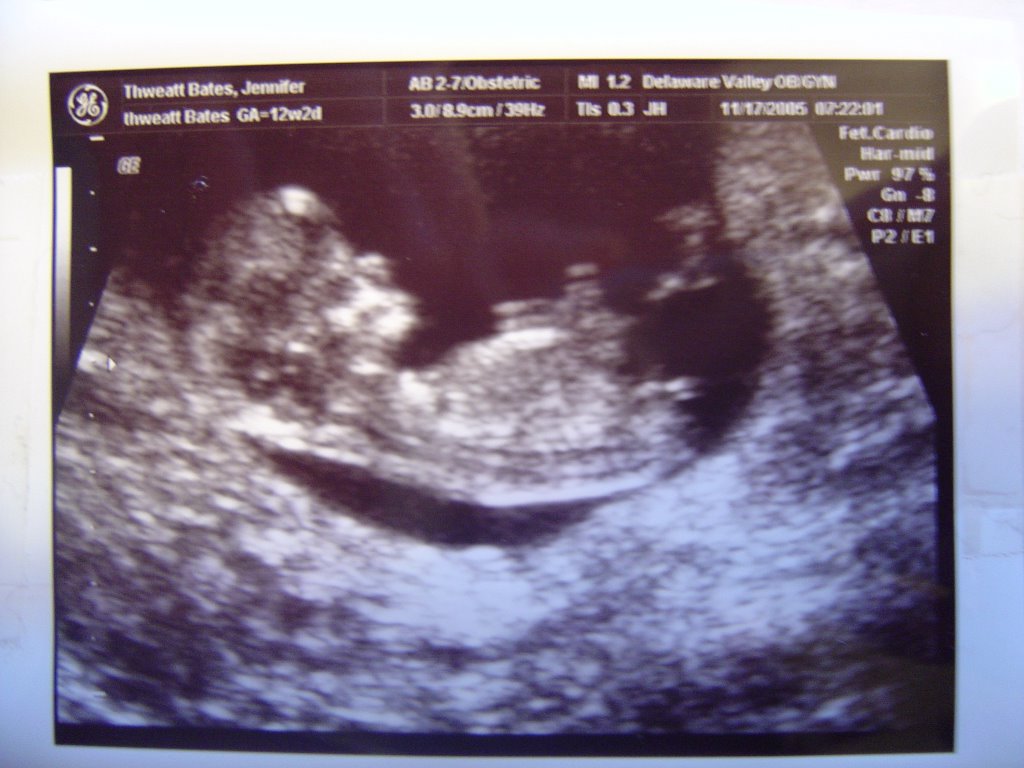
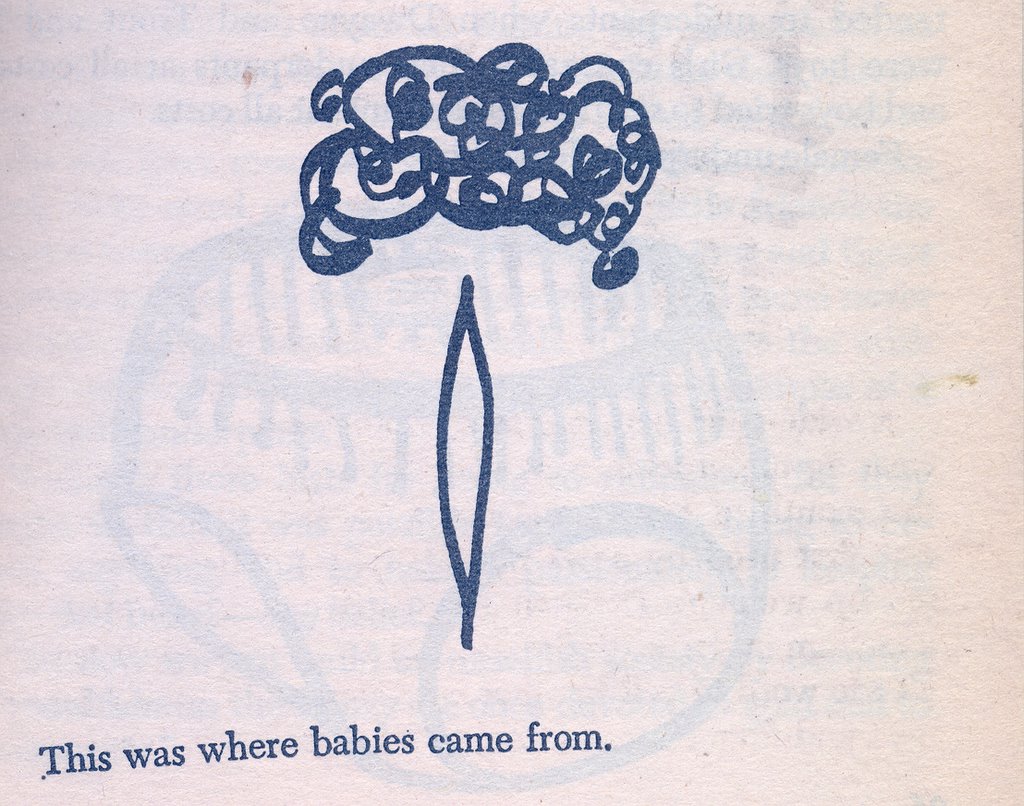
Tuesday, November 15, 2005
haircut
Haircuts are a source of stress for me. I have short hair. It grows fast. It requires a cut about once a month, and that's because I let it get all long and unwieldy before I give up and admit to myself that once again it's time to get it cut. When you have to get it cut that often, you can't afford the kind of hairdresser with whom you forge a warm and understanding relationship. You go to a place where you can get out for under $15 bucks, sit down in a stranger's chair, take off your glasses, cross your fingers, and hope for the best.
So this morning once again I faced the truth: I could no longer avoid the haircut. My hair was not "a halo of mouse-brown fire," but an untidy haystack of mouse-brown that no amount of magical product could tease into a semblance of style. So with a sigh off I went.
And it could be worse. It's short, like I asked, but somehow, I just feel like this haircut screams "dork." And I have realized that the whole process is so stressful to me that the reason why I periodically am tempted to grow my hair out is simply to avoid the painful process of getting it cut, again and again and again.
Of course, growing it out means going through that horrible haystack hair stage again. It'll be great for my ego when I'm all big and pregnant, have grody hair, and have to try to "look nice" for baby sis's wedding.
So this morning once again I faced the truth: I could no longer avoid the haircut. My hair was not "a halo of mouse-brown fire," but an untidy haystack of mouse-brown that no amount of magical product could tease into a semblance of style. So with a sigh off I went.
And it could be worse. It's short, like I asked, but somehow, I just feel like this haircut screams "dork." And I have realized that the whole process is so stressful to me that the reason why I periodically am tempted to grow my hair out is simply to avoid the painful process of getting it cut, again and again and again.
Of course, growing it out means going through that horrible haystack hair stage again. It'll be great for my ego when I'm all big and pregnant, have grody hair, and have to try to "look nice" for baby sis's wedding.
Monday, November 07, 2005
Cat Knows

She knows. I don't know how she knows, but she knows. She mysteriously somehow knew even before I set her down for The Talk, so the talk ended up something like this:
[cat insistent on establishing ownership of lap]
[I intent on establishing lines of communiation]: Kitty, you know you're my favorite cat in the whole wide world. You're even as good as Christopher (even though Mom won't say so).
[cat blinks, begins to purr]
Me: So, kitty, you really don't have to worry. No matter what happens, you'll always be the most important cat in this household.
[cat lazily closes eyes in recognition of unarguable fact]
Me: And even though I'm no longer changing your litter, you know you're better off 'cause Brent remembers to do it more often than I did, anyway.
[no discernible response from cat]
Me: So, kitty, this whole I-have-to-be-in-your-lap-all-the-time thing, you don't have to do that just to make sure I still love you. Besides, pretty soon this lap is gonna disappear, so you're going to have to find another way to reassure yourself that you still have my loyal and undivided feline affection.
[cat ignores me, appears to be asleep]
Me [to self]: Okay, this is clearly going to be an issue.
Thursday, October 27, 2005
EUREKA!
I've found it: the Food that Doesn't Make Me Want to Vomit at the Thought of It.
Any guesses? Okay, forget the guessing. Blogs aren't quite that interactive. Cream o' Wheat. Yes, I have reverted back to my childhood completely. I ate two bowls today. And for a short blessed while after, felt great.
Now I feel like crap again, but that's to be expected. I could eat another bowl of creamy wheaty yummy goodness, mmmmm so bland, so completely nondescript and unobjectionable, but I'm afraid to lean on my food crutch too hard lest it break before its time. I need this solution to last as long as possible.
Other news: I am on the way to successfully finding myself a place to give birth. It's been quite the daunting task, but I finally whined at Brent and things got taken care of. Now, don't fret, I'm still a feminist and everything, but it is soooooooooooooo nice to have a husband who will make phone calls for you when you don't feel like making them yourself.
I even hate ordering pizza. It always makes me feel stupid. I really hate calling business type places.
So, other than sleeping a great deal and finishing off a new sci fi novel per day, I haven't accomplished much this Reading Week. But after catching up on all this sleep I should be able to jump back in to the ol' routine with some enthusiasm. That's good.
The bad news? I discovered I no longer like the smell of coffee...Yes, you can expect Jesus any second now.
Any guesses? Okay, forget the guessing. Blogs aren't quite that interactive. Cream o' Wheat. Yes, I have reverted back to my childhood completely. I ate two bowls today. And for a short blessed while after, felt great.
Now I feel like crap again, but that's to be expected. I could eat another bowl of creamy wheaty yummy goodness, mmmmm so bland, so completely nondescript and unobjectionable, but I'm afraid to lean on my food crutch too hard lest it break before its time. I need this solution to last as long as possible.
Other news: I am on the way to successfully finding myself a place to give birth. It's been quite the daunting task, but I finally whined at Brent and things got taken care of. Now, don't fret, I'm still a feminist and everything, but it is soooooooooooooo nice to have a husband who will make phone calls for you when you don't feel like making them yourself.
I even hate ordering pizza. It always makes me feel stupid. I really hate calling business type places.
So, other than sleeping a great deal and finishing off a new sci fi novel per day, I haven't accomplished much this Reading Week. But after catching up on all this sleep I should be able to jump back in to the ol' routine with some enthusiasm. That's good.
The bad news? I discovered I no longer like the smell of coffee...Yes, you can expect Jesus any second now.
Sunday, October 16, 2005
new things to be rudely truthful about
The kiwi hat isn't the only thing I've been doing around here. Sure, you say, there's that mysterious and awful process known as "comps" you keep bitching about, we get it already, so shut up.
No, that's not it. My newest latest accomplishment (sorry, no picture), is a baby.
Yep, people of the blogosphere, I'm pregnant.
I was determined to hold off on announcing this until comps were over. I thought maybe if I didn't tell announce it, it would make it easier to temporarily shove the fact aside and concentrate on comps. Despite the fact that I can still work myself up into a snit about the injustice, inefficient pedagogy, and downright cruelty of the whole comps process, my mind's just not really been on it. This week I tried dutifully to read Diogenes Allen as a review for the upcoming philosophy comp, and put it down in favor of The Girlfriend's Guide to Pregnancy. And nearly had a weeping fit while reading about morning sickness over breakfast.
That's not my first weeping fit, either. Last week I was trying to review for History of Doctrine, and since Brent was gone and the apartment was eerily quiet I turned the TV on for background noise and got sucked into a rerun of the movie The Other Sister. Brent came home just at the moment when the marching band shows up at their wedding. He peeked into the living room, said hi and asked what I was doing, and I promptly burst into tears. My first excuse for behavior that shocked and surprised me as much as it did him: "I love this movie. It's so...cheesy...and beautiful..." Then I tried blaming it on anxiety about my History of Doctrine comp, but he wasn't fooled. He had a sort of freaked look that he tried to hide, valiantly, but unsuccessfully. I myself was freaked because honestly, I had no idea it was about to happen, and while it was happening, I found it so hilarious that I could be sobbing without feeling sad that I started giggling. The whole thing devolved very quickly a scene of individual random hormone-induced hysteria.
At least at that point I already knew I was pregnant and didn't have to worry that I was losing my mind. Before I peed on the little stick--twice, just in case I did it wrong, although honestly, it's not that complicated--I was chalking up all the fatigue, despondency and muscle soreness to existential dread of comprehensive exams. It was such a relief to know that there was a physiological basis for waking up feeling like someone had been beating me with a baseball bat in my sleep every night, and being unable to concentrate on the utterly riveting things I was supposed to be frantically studying, and unable to keep myself from taking a nap no matter how worried I was or felt like I should be about the upcoming exams. In a way, it was a great stress-reliever, too: clearly, comprehensive exams do not constitute the entirety of my world. There Are More Important Things Going On.
Of course, the only possibility for getting through these exams with any hope of comporting myself with any credit was to ignore the fact that I'm pregnant until they're over--at least this round. I made it through 2 exams but, oops, kindof lost it this week and started thinking about pregnancy instead of philosophy. I think it's that the queasiness has started to kick in, and at that point, it's no use pretending anymore.
So, there it is. Some of you knew already, most of you related to me, so the rest of you, don't get your panties in a wad. Maybe you think this wasn't the proper fanfare for announcing the scary fact that Brent and I have decided to doom your progeny to share the world with ours, but you get to announce your procreation any old cutesy way you want to.
So, look forward (or dread) a new theme to this blog: rude truth about being pregnant while doing a doctorate. Have I mentioned I'm now cursed with terrible gas, and at the same time I'm horribly constipated? Oh yes. That doesn't have anything to do with the doctorate but it's very uncomfortable to take an 8-hour exam feeling constipated the whole time, plus horrible back pain from the non-ergonomic chair, plus getting up to pee every ten minutes. And even worse, for my second exam they provided a hotel room in Eerdman Hall--which had a bed. Cruel, really.
No, that's not it. My newest latest accomplishment (sorry, no picture), is a baby.
Yep, people of the blogosphere, I'm pregnant.
I was determined to hold off on announcing this until comps were over. I thought maybe if I didn't tell announce it, it would make it easier to temporarily shove the fact aside and concentrate on comps. Despite the fact that I can still work myself up into a snit about the injustice, inefficient pedagogy, and downright cruelty of the whole comps process, my mind's just not really been on it. This week I tried dutifully to read Diogenes Allen as a review for the upcoming philosophy comp, and put it down in favor of The Girlfriend's Guide to Pregnancy. And nearly had a weeping fit while reading about morning sickness over breakfast.
That's not my first weeping fit, either. Last week I was trying to review for History of Doctrine, and since Brent was gone and the apartment was eerily quiet I turned the TV on for background noise and got sucked into a rerun of the movie The Other Sister. Brent came home just at the moment when the marching band shows up at their wedding. He peeked into the living room, said hi and asked what I was doing, and I promptly burst into tears. My first excuse for behavior that shocked and surprised me as much as it did him: "I love this movie. It's so...cheesy...and beautiful..." Then I tried blaming it on anxiety about my History of Doctrine comp, but he wasn't fooled. He had a sort of freaked look that he tried to hide, valiantly, but unsuccessfully. I myself was freaked because honestly, I had no idea it was about to happen, and while it was happening, I found it so hilarious that I could be sobbing without feeling sad that I started giggling. The whole thing devolved very quickly a scene of individual random hormone-induced hysteria.
At least at that point I already knew I was pregnant and didn't have to worry that I was losing my mind. Before I peed on the little stick--twice, just in case I did it wrong, although honestly, it's not that complicated--I was chalking up all the fatigue, despondency and muscle soreness to existential dread of comprehensive exams. It was such a relief to know that there was a physiological basis for waking up feeling like someone had been beating me with a baseball bat in my sleep every night, and being unable to concentrate on the utterly riveting things I was supposed to be frantically studying, and unable to keep myself from taking a nap no matter how worried I was or felt like I should be about the upcoming exams. In a way, it was a great stress-reliever, too: clearly, comprehensive exams do not constitute the entirety of my world. There Are More Important Things Going On.
Of course, the only possibility for getting through these exams with any hope of comporting myself with any credit was to ignore the fact that I'm pregnant until they're over--at least this round. I made it through 2 exams but, oops, kindof lost it this week and started thinking about pregnancy instead of philosophy. I think it's that the queasiness has started to kick in, and at that point, it's no use pretending anymore.
So, there it is. Some of you knew already, most of you related to me, so the rest of you, don't get your panties in a wad. Maybe you think this wasn't the proper fanfare for announcing the scary fact that Brent and I have decided to doom your progeny to share the world with ours, but you get to announce your procreation any old cutesy way you want to.
So, look forward (or dread) a new theme to this blog: rude truth about being pregnant while doing a doctorate. Have I mentioned I'm now cursed with terrible gas, and at the same time I'm horribly constipated? Oh yes. That doesn't have anything to do with the doctorate but it's very uncomfortable to take an 8-hour exam feeling constipated the whole time, plus horrible back pain from the non-ergonomic chair, plus getting up to pee every ten minutes. And even worse, for my second exam they provided a hotel room in Eerdman Hall--which had a bed. Cruel, really.
Sunday, October 09, 2005
blues
Well, week 1 of Comps Hell Month is gone.
When Brent took his first comp, he called me on his way home, energized and jubilant. He even said the words "kicked ass." When I finished my comp last week, I felt like I was the one who'd been kicked. Down a couple flights of stairs. Repeatedly. By someone with big hobnailed boots on. What are hobnailed boots? It doesn't matter. It sounds scary and painful and that fits.
I just wasn't prepared enough. I don't know if it's possible that I could have been prepared enough. But I could have done better than I did. My answers were disorganized, rambly, and probably not so intelligent. I find it hard to believe that I did so bad that I would fail, but I certainly didn't do well. I think I pulled a very solid mediocre. I should have done better.
Of course everyone wants to know how it went. I find it hard to be honest and say, "rotten." These are people I go to school with after all and I have to keep up a facade of intelligence and bravado. But the truth is, I feel rotten and I'm scared to even review the crap I wrote because it'll confirm my worst fears...or even worse, tell me I wasn't feeling bad enough already 'cause it's even worse than I thought.
There's no relief in sight, folks. I don't get to know how I did (officially) on any of this until February sometime, and even then, I don't think you get feedback on an individual exam. You just pass, or not. That can be a little comforting when I'm in the mood of "I've never failed anything in my life (well, except for that physics test in high school, but that doesn't count because my 22 was the 2nd highest grade in the class) so I can't possibly fail this either"--then I can feel justified in a little dark optimism because, mediocre is all you need in an overall pass/fail scenario.
But I just should have been able to articulate this stuff a little better. I know what I think about stem cells. I know what I think about the moral status of animals. I don't know why I couldn't present my thoughts in a little more creditable way.
So, now that I'm feeling so good about myself and all, Exam #2 is up this Wednesday: History of Doctrine. Unlike the Ethics comp I just took in spectacularly mediocre fashion, I don't know what my possible questions are. I know nothing, in fact, other than my topics: patristic Christology, St. Augustine on "moral psychology," and medieval women mystics on the same. I have 3 days to frantically review the reading that I have frantically done previously, and to sit and fret about trying to guess what my questions might be so I can adequately prepare. I don't even know how many questions there might be.
Some of you might remind me that I should realize now that Life is Bigger than Comps. Fine, I know it. But right now that's a liability. Look at what just happened when I walked into Ethics all relaxed and "I can handle it" and "Life is Bigger than Comps"-ish. I sucked, that's what happened. So right now I have to pretend that Life=Comps, and don't try to talk me out of it.
Someday soon there will be a happy post but I wouldn't look for it until after October 19. That's Exam #3, Philosophy. That one is "friendlier" than History of Doctrine but still...I didn't manage to read the whole history of human thought listed on the bibliography, so I'm underprepared for that one as well.
I really wish I could recover the academic confidence I had as a 1st grader, back when I was best at everything and I never even had to try.
When Brent took his first comp, he called me on his way home, energized and jubilant. He even said the words "kicked ass." When I finished my comp last week, I felt like I was the one who'd been kicked. Down a couple flights of stairs. Repeatedly. By someone with big hobnailed boots on. What are hobnailed boots? It doesn't matter. It sounds scary and painful and that fits.
I just wasn't prepared enough. I don't know if it's possible that I could have been prepared enough. But I could have done better than I did. My answers were disorganized, rambly, and probably not so intelligent. I find it hard to believe that I did so bad that I would fail, but I certainly didn't do well. I think I pulled a very solid mediocre. I should have done better.
Of course everyone wants to know how it went. I find it hard to be honest and say, "rotten." These are people I go to school with after all and I have to keep up a facade of intelligence and bravado. But the truth is, I feel rotten and I'm scared to even review the crap I wrote because it'll confirm my worst fears...or even worse, tell me I wasn't feeling bad enough already 'cause it's even worse than I thought.
There's no relief in sight, folks. I don't get to know how I did (officially) on any of this until February sometime, and even then, I don't think you get feedback on an individual exam. You just pass, or not. That can be a little comforting when I'm in the mood of "I've never failed anything in my life (well, except for that physics test in high school, but that doesn't count because my 22 was the 2nd highest grade in the class) so I can't possibly fail this either"--then I can feel justified in a little dark optimism because, mediocre is all you need in an overall pass/fail scenario.
But I just should have been able to articulate this stuff a little better. I know what I think about stem cells. I know what I think about the moral status of animals. I don't know why I couldn't present my thoughts in a little more creditable way.
So, now that I'm feeling so good about myself and all, Exam #2 is up this Wednesday: History of Doctrine. Unlike the Ethics comp I just took in spectacularly mediocre fashion, I don't know what my possible questions are. I know nothing, in fact, other than my topics: patristic Christology, St. Augustine on "moral psychology," and medieval women mystics on the same. I have 3 days to frantically review the reading that I have frantically done previously, and to sit and fret about trying to guess what my questions might be so I can adequately prepare. I don't even know how many questions there might be.
Some of you might remind me that I should realize now that Life is Bigger than Comps. Fine, I know it. But right now that's a liability. Look at what just happened when I walked into Ethics all relaxed and "I can handle it" and "Life is Bigger than Comps"-ish. I sucked, that's what happened. So right now I have to pretend that Life=Comps, and don't try to talk me out of it.
Someday soon there will be a happy post but I wouldn't look for it until after October 19. That's Exam #3, Philosophy. That one is "friendlier" than History of Doctrine but still...I didn't manage to read the whole history of human thought listed on the bibliography, so I'm underprepared for that one as well.
I really wish I could recover the academic confidence I had as a 1st grader, back when I was best at everything and I never even had to try.
Subscribe to:
Posts (Atom)