Monday, August 30, 2010


Saturday, August 28, 2010
Glenn Beck: about as good a preacher as you'd expect
HuffPo characterizes Beck's rally at the Lincon Memorial as "more like a revival."
Yeah, I get it. There's a lot of artless God-talk in it (so far, I'm only 5 minutes in, and he doesn't seem to be slowing down any. Oh wait, a prayer break. Excellent. There's nothing more inspiring than hearing the name of Jesus invoked in tones of wroth. I can almost feel the spittle, and I'm not even there, and this thing was over hours ago.)
Beck begins with, "America today begins to turn back to God." What is this, performative speech? He says it and it is so? (Like, say, "let there be light?") Or perhaps, let's be generous, it's a declarative, a simple description of what he sees happening. Alrighty then, what's the evidence of such a felicitous occurence?
Beck: "For too long this country has wandered in darkness...[here Beck's sentence seems to wander about in darkness a bit too, thank God for ellipses]...this country has spent far too long worried about scars, and thinking about the scars and concentrating on the scars. Today, we are going to concentrate on the good things in America, the things that we have accomplished, and the things that we can do tomorrow."
Um, okay. Well, first of all let's play along and pretend that direct speech about America and American history and American people and America's future is not, ahem, political, because Beck assures us that this rally is not political. Whatever. But I'll play along, and treat this as a purely theological sentiment.
This theology SUCKS. (Sorry, Mom. It sucks so hard that not only do I have to say it, I have to capitalize it.) This is cheap grace in an American uniform, Glenn. Or how about another phrase, from an article I just read recently, about the reason why American young people are leaving churches in droves: "moralistic therapeutic deism," a "mutant form of Christianity" that "portrays God as a 'divine therapist' whose chief goal is to boost people's self-esteem." We've spent too long thinking about our "scars" and now it's time to stop all that half-hearted repenting and just think about the good stuff, so we can feel good about being Americans?! Turning back to God=being proud of our American selves. WTF? Glenn, I'd've rather heard a Jimmy-Allen-style hellfire-and-brimstone bit. I'm serious.
Worse, here's a quote from an attendee, from the HuffPo article: "This country was created by God, our creator. The problem is, the country is becoming Godless," said Greg Rinehart. "[Beck] said that a lot of people have lost Christ. The country is on the verge of becoming chaotic."
Religious message? Certainly. But apolitical? Hardly. In an atmosphere of hostility toward people of other faiths, by which I mean Muslims, which seems only to be increasing, how is this religious sentiment NOT an incendiary, divisive, politically laden sentiment? People without Christ are making this country chaotic. They must be stopped. Hey, let's go torch the mosque site. That'll show 'em Jesus is the Way. Then we can forget the scars and go on being proud of our badass American selves.
Yeah, I get it. There's a lot of artless God-talk in it (so far, I'm only 5 minutes in, and he doesn't seem to be slowing down any. Oh wait, a prayer break. Excellent. There's nothing more inspiring than hearing the name of Jesus invoked in tones of wroth. I can almost feel the spittle, and I'm not even there, and this thing was over hours ago.)
Beck begins with, "America today begins to turn back to God." What is this, performative speech? He says it and it is so? (Like, say, "let there be light?") Or perhaps, let's be generous, it's a declarative, a simple description of what he sees happening. Alrighty then, what's the evidence of such a felicitous occurence?
Beck: "For too long this country has wandered in darkness...[here Beck's sentence seems to wander about in darkness a bit too, thank God for ellipses]...this country has spent far too long worried about scars, and thinking about the scars and concentrating on the scars. Today, we are going to concentrate on the good things in America, the things that we have accomplished, and the things that we can do tomorrow."
Um, okay. Well, first of all let's play along and pretend that direct speech about America and American history and American people and America's future is not, ahem, political, because Beck assures us that this rally is not political. Whatever. But I'll play along, and treat this as a purely theological sentiment.
This theology SUCKS. (Sorry, Mom. It sucks so hard that not only do I have to say it, I have to capitalize it.) This is cheap grace in an American uniform, Glenn. Or how about another phrase, from an article I just read recently, about the reason why American young people are leaving churches in droves: "moralistic therapeutic deism," a "mutant form of Christianity" that "portrays God as a 'divine therapist' whose chief goal is to boost people's self-esteem." We've spent too long thinking about our "scars" and now it's time to stop all that half-hearted repenting and just think about the good stuff, so we can feel good about being Americans?! Turning back to God=being proud of our American selves. WTF? Glenn, I'd've rather heard a Jimmy-Allen-style hellfire-and-brimstone bit. I'm serious.
Worse, here's a quote from an attendee, from the HuffPo article: "This country was created by God, our creator. The problem is, the country is becoming Godless," said Greg Rinehart. "[Beck] said that a lot of people have lost Christ. The country is on the verge of becoming chaotic."
Religious message? Certainly. But apolitical? Hardly. In an atmosphere of hostility toward people of other faiths, by which I mean Muslims, which seems only to be increasing, how is this religious sentiment NOT an incendiary, divisive, politically laden sentiment? People without Christ are making this country chaotic. They must be stopped. Hey, let's go torch the mosque site. That'll show 'em Jesus is the Way. Then we can forget the scars and go on being proud of our badass American selves.
despicable me
So, I'm on the train coming home from CCfB brunching and this family of four settles in 3 seats down from me. The older kid, a girl, between 2 and 3 is my guess, reminded me of Clare--all garrulous and girly, she was. And at first, for say, a good three minutes or so, I really enjoyed getting a sense of the family dynamic. A sorta crunchy mom, with a bag full of farmer's market produce and 7 mo. old babe, a quiet dad, a curious toddler. The first thought I had was, wow, that mom interacts with her daughter like I do with Clare--on a good day. Encouraging curiosity, conversing with her, lots of teachable moments, lots of silly wordplay, even, yes, silly impromptu song-singing.
Then I thought, okay, that mom is like me--if I were really extroverted, loud, and on speed.
Then I thought, okay, this lady is annoying.
But the thing is, she really was like me. I mean, eerily like. As in, even our favorite colors are apparently the same. And her pet peeves about punctuation misuse. And her penchant for using outsized vocabulary with her toddler ("I'm a pedant," she says. Pedant?!)
So I spent the rest of the train ride home pondering how I could recognize both this woman's similarity to me and her annoyingness. Do I annoy myself? Do I secretly think that I'm an annoying person? Is there a kernel of self-hate buried deep within my psyche?
This didn't seem quite right. Sure, I'm as screwed up as any GRITS but I do love myself pretty sincerely.
So finally it hit me: what annoyed me about this woman is the same thing that annoys me about any group of obnoxious teens on the subway--that pseudo-unself-conscious performance of the idealized self for the benefit of the audience within earshot. I'm not part of her family. I'm not supposed to be the target audience for the performance of super-smart-crunchy-mommyness. But me and everyone else around me were co-opted into it, just like you are when giggly gaggles of teenagers are oh-so-nonchalantly proving to everyone who can hear how cool they are. Blurg.
Anyway, that's my best guess. And I suppose the take-away for me is to make sure I don't over-perform my own pedantic-ecofriendly-breastfeeding-feminist-super-PhD-mommy self in public places for people who would really like to be able to sleep on their train.
Then I thought, okay, that mom is like me--if I were really extroverted, loud, and on speed.
Then I thought, okay, this lady is annoying.
But the thing is, she really was like me. I mean, eerily like. As in, even our favorite colors are apparently the same. And her pet peeves about punctuation misuse. And her penchant for using outsized vocabulary with her toddler ("I'm a pedant," she says. Pedant?!)
So I spent the rest of the train ride home pondering how I could recognize both this woman's similarity to me and her annoyingness. Do I annoy myself? Do I secretly think that I'm an annoying person? Is there a kernel of self-hate buried deep within my psyche?
This didn't seem quite right. Sure, I'm as screwed up as any GRITS but I do love myself pretty sincerely.
So finally it hit me: what annoyed me about this woman is the same thing that annoys me about any group of obnoxious teens on the subway--that pseudo-unself-conscious performance of the idealized self for the benefit of the audience within earshot. I'm not part of her family. I'm not supposed to be the target audience for the performance of super-smart-crunchy-mommyness. But me and everyone else around me were co-opted into it, just like you are when giggly gaggles of teenagers are oh-so-nonchalantly proving to everyone who can hear how cool they are. Blurg.
Anyway, that's my best guess. And I suppose the take-away for me is to make sure I don't over-perform my own pedantic-ecofriendly-breastfeeding-feminist-super-PhD-mommy self in public places for people who would really like to be able to sleep on their train.
Wednesday, August 25, 2010
from Pigtail Pals: The Congresswomen, Stripper Barbie and Myself
Obviously, Stripper Barbie needs some modifications. Or, at the very least, a maternity dress just in case the inevitable happens.
Obviously, Stripper Barbie needs some modifications. Or, at the very least, a maternity dress just in case the inevitable happens.
Tuesday, August 24, 2010
iftar
(In case you don't already know, iftar is the evening meal during Ramadan when Muslims break fast.)
I don't have a lot to say about our evening, in part because I've scarcely had any time to sit and think--about anything at all--over the last few days. St. Stephen's doesn't begin for Clare till the 31st, and until then, she's got Mommy's 100% attention and energy, until it runs out (typically, at about 10:00 a.m., sigh). But I am determined to share something about it, since it is a rather nifty idea on the part of the IDC to organize these "cultural exchange" type opportunities for people.
It was a bit awkward (how could it be otherwise) to just go to someone's house when you've never met them before and share a dinner, especially such an important (and lavish!) one as this, but awkwardness is a small price to pay. And it's kind of a crazy thing to do, sign yourselves up to entertain total strangers in your home, so I reckon if you're going to do it, then you're ready to welcome whatever crazy lot shows up on your doorstep. And we were probably an intimidating crew: me with my visible tattoos and bare arms, my husband with his priest collar, our wild-eyed 4-year-old in tow. And we were, absolutely, welcomed without reserve.
Our hosts took their teaching role very seriously, offered a lot of information and answered all sorts of questions. Wikipedia can now teach me nothing about iftar I didn't learn firsthand. :)
It occurred to me while talking about the Quran, and the translations of it for personal use and study versus the use of liturgical Arabic for prayer, that there must be some really sophisticated and interesting discussions on hermeneutics in Islam, and in interfaith or comparative religion discussions drawing in an Islamic perspective on the notion of interpretation. Something to look into. I said something about it before I could stop myself--the sort of theology-nerdy thing I do. :)
I didn't, however, talk much religion or theology (whether Christian or Muslim) with the women. Mostly, we talked about kids (our hosts had a daughter slightly younger than Clare), teaching (one of the women was a high school science teacher in Turkey), travel (wish I remembered more about my long-ago trip to Turkey), and whatnot. It didn't feel any more awkward, to me, than trying to get to know people outside my teensy nerdworld of theological acedemia generally does. Brent wondered--asked me on the way home--if the general silence of the women (not total) during the general conversation at the dinner table and during dessert bugged me. To be truthful (should I tag this #badfeminist?) it didn't, particularly, because 1) I wasn't given signals that I shouldn't contribute, and 2) I more or less assumed that the women's unease with conversing in English had more to do with it than anything else. I could be wrong, of course. But these men were proud of their wives, spoke of their accomplishments and (former) careers in Turkey with respect, and showed a lot of regret that relocating meant starting over and a lot of social isolation for them.
And frankly, as I said to Brent, I have a hard time faulting another religion for its symbolic manifestations of patriarchy (modest dress, hijab, possibly, silence) when I grew up in a tradition no less patriarchal, only our signals of it are so culturally acceptable to us that they are invisible. We'll call it a problem when we see it in a hijab, but we'll gloss right over it when it comes to women speaking with a mic from a pulpit. What's the difference? Who gets to throw the stone, here? I'm certainly not going to generically condemn a whole religion as hopeless and evilly sexist...because I'd have to condemn my own right along with it, just to be consistent.
[aside: I'm bracketing violence against women here. but again, I suspect it's easier to see and condemn violent acts against women when they confront you in unfamiliar forms. and, of course, Christianity is not blameless in this respect either--the stats on battered woman seeking shelter and advice from pastors, for example, are dismal, and the advice they often get justifies why.]
Anyhow. That's not much of a description of the evening as a cultural experience, I mean, I haven't bothered with talking about the food (delicious, unbelievably delicious) and whatever. But the whole point, as far as I can see, is less all of that than just the act of "breaking bread together in peace" (Abilene Interfaith Council's motto, and I've never heard a better).
I don't have a lot to say about our evening, in part because I've scarcely had any time to sit and think--about anything at all--over the last few days. St. Stephen's doesn't begin for Clare till the 31st, and until then, she's got Mommy's 100% attention and energy, until it runs out (typically, at about 10:00 a.m., sigh). But I am determined to share something about it, since it is a rather nifty idea on the part of the IDC to organize these "cultural exchange" type opportunities for people.
It was a bit awkward (how could it be otherwise) to just go to someone's house when you've never met them before and share a dinner, especially such an important (and lavish!) one as this, but awkwardness is a small price to pay. And it's kind of a crazy thing to do, sign yourselves up to entertain total strangers in your home, so I reckon if you're going to do it, then you're ready to welcome whatever crazy lot shows up on your doorstep. And we were probably an intimidating crew: me with my visible tattoos and bare arms, my husband with his priest collar, our wild-eyed 4-year-old in tow. And we were, absolutely, welcomed without reserve.
Our hosts took their teaching role very seriously, offered a lot of information and answered all sorts of questions. Wikipedia can now teach me nothing about iftar I didn't learn firsthand. :)
It occurred to me while talking about the Quran, and the translations of it for personal use and study versus the use of liturgical Arabic for prayer, that there must be some really sophisticated and interesting discussions on hermeneutics in Islam, and in interfaith or comparative religion discussions drawing in an Islamic perspective on the notion of interpretation. Something to look into. I said something about it before I could stop myself--the sort of theology-nerdy thing I do. :)
I didn't, however, talk much religion or theology (whether Christian or Muslim) with the women. Mostly, we talked about kids (our hosts had a daughter slightly younger than Clare), teaching (one of the women was a high school science teacher in Turkey), travel (wish I remembered more about my long-ago trip to Turkey), and whatnot. It didn't feel any more awkward, to me, than trying to get to know people outside my teensy nerdworld of theological acedemia generally does. Brent wondered--asked me on the way home--if the general silence of the women (not total) during the general conversation at the dinner table and during dessert bugged me. To be truthful (should I tag this #badfeminist?) it didn't, particularly, because 1) I wasn't given signals that I shouldn't contribute, and 2) I more or less assumed that the women's unease with conversing in English had more to do with it than anything else. I could be wrong, of course. But these men were proud of their wives, spoke of their accomplishments and (former) careers in Turkey with respect, and showed a lot of regret that relocating meant starting over and a lot of social isolation for them.
And frankly, as I said to Brent, I have a hard time faulting another religion for its symbolic manifestations of patriarchy (modest dress, hijab, possibly, silence) when I grew up in a tradition no less patriarchal, only our signals of it are so culturally acceptable to us that they are invisible. We'll call it a problem when we see it in a hijab, but we'll gloss right over it when it comes to women speaking with a mic from a pulpit. What's the difference? Who gets to throw the stone, here? I'm certainly not going to generically condemn a whole religion as hopeless and evilly sexist...because I'd have to condemn my own right along with it, just to be consistent.
[aside: I'm bracketing violence against women here. but again, I suspect it's easier to see and condemn violent acts against women when they confront you in unfamiliar forms. and, of course, Christianity is not blameless in this respect either--the stats on battered woman seeking shelter and advice from pastors, for example, are dismal, and the advice they often get justifies why.]
Anyhow. That's not much of a description of the evening as a cultural experience, I mean, I haven't bothered with talking about the food (delicious, unbelievably delicious) and whatever. But the whole point, as far as I can see, is less all of that than just the act of "breaking bread together in peace" (Abilene Interfaith Council's motto, and I've never heard a better).
Wednesday, August 18, 2010
the pattern

needle size: 2
yarn: sport or baby sport weight
gauge: about 7-8 sts/inch
CO 36 sts, divide across 3 dpns, join and knit in rd.
Begin with stockinette st for a rolled hem, or if you prefer, a few rows on 3 X 3 rib for a ribbed hem.
Knit in stockinette till 2", or desired length of skirt (measured from inseam, not ridiculous teensy waist).
Designate needles 1, 2 & 3, with needle 1 as the front.
Begin increases for baby bump as follows:
needle 1: k3, m1 (right slanting*), k6, m1 (left slanting*), k3; needles 2 & 3, k to end.
k 1 row
needle 1: k3, m1*, k8, m1**, k3; needles 2 & 3, k to end
k 1 row
needle 1: k3, m1*, k10, m1**, k3; needles 2 & 3, k to end
needle 1: k3, m1*, k12, m1**, k3; needles 2 & 3, k to end
needle 1: k3, m1*, k14, m1**, k3; needles 2 & 3, k to end
(if you're going for Octomom proportions, you can keep going, but this is enough for a decent size baby bump, for a six-month-ish-along Barbie)
k 3 rows
Begin decrease rows:
needle 1: k3, ssk, k to 5 rem sts, k2tog, k3; needles 2 & 3, k to end
repeat until 12 sts remain on needle 1.
knit in rd a few rows until you are ready to divide for armholes (I didn't count rows here, so give your Barbie a fitting or two to determine this.
needle 1 (front): 18 sts; needle 2 (back): 9 sts; needle 3 (back): 9 sts. If needles 2 & 3 are in your way, place those sts on a holder temporarily.
needle 1: knit 10 rows stockinette
row 11: k4, BO 10, k4
rows 12-14 (knit each strap separately): stockinette st, then place sts on holder for 3-needle BO later.
needles 2 & 3: knit 14 rows stockinette, then 3-needle BO with the front strap sts. leave a long tail after BO to use as a string tie closure. Or if you're fussy, sew on a snap. I can't be bothered with that myself.
Finally, pick up some sts on the inside of the dress where the bottom of the baby bump begins, and knit a square flap. Anchor the top and side of the flap on the inside, stuff with some extra yarn or whatever you've got on hand, then stitch closed.
Congratulations, you've knocked up Barbie!
m1* : right slanting increase. Insert left needle into horizontal strand btw sts from back to front. Knit this through the front loop to twist the st and avoid a hole.
m1**: left slanting increase. Insert left needle into horizontal strand btw sts from front to back. Knit through the back loop. (from Vogue Knitting Quick Reference)
Tuesday, August 17, 2010
Monday, August 16, 2010
by Rachel Wylie
I had my first child, a daughter, in September of 2003. Shortly thereafter, my dear friend had her first, a son. One evening, I was babysitting her son, and he was asleep in my daughter's swing. I sat there that night, watching him swing back and forth, sleeping in that blissed out way babies do, and I started ruminating on what his future might be like. Knowing he would be raised in a strong Christian home, I remember thinking about all the wonderful, powerful things he might do as a man-- it was thrilling to think of all the great things he could accomplish for the Kingdom of God. In the same second that thought formed itself in my mind, I was struck cold by a second, sobering thought. In the 6 months I had been mothering my daughter, I had imagined a lot of things for her, but I had never considered that she might do “great work” for God. I allowed the distress of this realization to bother me for about five minutes, before I shoved it out of my consciousness by soothing myself with platitudes about all the “great work” women can do for the Kingdom – teach sunday school, bake casseroles, vist nursing homes, and clean the church building.
The uneasy feeling I first faced that evening of Maya's infancy surfaced now and again over the next five years, but I always rationalized it away – I know all the words about “separate but equal” when it comes to men and women in the Church of Christ.
And then, in August of 2009, a few things happened. I read through rude truth, I read a couple of Mike Cope’s blog posts on the subject, and then I read the statement Jimmy Carter released when he separated from the Southern Baptist church, and instead of hearing all of the proper responses in my head (too heavily influenced by evil feminism, doesn't take the bible seriously, etc), I began to hear the hum of truth. It was nearly like a switch.
Here is what I wrote to Jennifer a year ago this month:
It occurred to me that I had better make dang sure that I believed what I have grown up believing about women in the church…traditional gender roles in the church is not an issue I spent much time considering. My spiritual gifts are such that I have never felt constrained (mostly relieved) that I would never be expected to teach or pray or lead singing in an assembly.
But I have these 2 daughters, and they are beautiful and created in the image of God…and if that God did not intend for them to remain silent in church, if he has not determined that it is a bad idea for them to publicly share from their knowledge and wisdom about him…if this is not his design…then teaching them that He did, and it is…well it breaks my heart.
And so, for the first time in 28 years, I gave myself permission to consider that I might have it wrong.
And I did. I had it wrong. And even though I never consciously felt damaged or belittled by this tradition that I was raised in, I cannot describe the relief and the gratitude and freedom that has washed over me. It absolutely brings me to tears to think that I will not have to think of a way to explain to my children, whom I love more than life, why, even though they are all created in the image of God, who also loves them more than life, God only wants to hear one of their voices in Church.
As I grapple with this and unpack it a little bit more I expect to find the implications of growing up with the set of assumptions that I did has been damaging and stunting in more ways than I have considered. It is very strange to realize that one of the basic things I have always understood about myself and my place in the body of Christ was just plain wrong.
I was right. As I unravel all of my previous understanding of “Women in the Church” I am continually stunned to find how far reaching the effects have been. I have been moved to tears more times than once this past year, realizing for the first time that I am not less valuable (to the world, or to God) because I am a woman.
I cried just last week, when I really really let it sink in that not only is God not male (or female)--which I have always believed, in theory-- but God is not even *more* male than he is female. I cried reading Women in the Church: Reclaiming the Ideal when Carol Osburn explains Marrs’s proposal that “the actual “order of creation" (man first, woman last) intends not a move from superiority to inferiority, but through inclusio (man/woman) a move from incompleteness to completeness.”
I know all of the appropriate arguments used to oppress women in our Tradition. I know the scriptures, the “proper” interpretation, I know all of the “flawed” arguments of the “other side.” For the longest time, I was so afraid of being wrong, of being ungrateful for the role I had been given, of endangering my eternal soul, to even honestly examine scripture and consider the “other side.” Nearly 7 months after my email to Jennifer, it occurred to me that the things I had been taught about myself and women in general in Churches of Christ are are not compatible with the character of God revealed throughout scripture. It was this realization that has finally allowed me to step away from the “party line” about women in the church, timidly at first, and with more boldness as time goes on and some of the twisted places in my faith sort themselves out in the light of my new understanding.
My family finds ourselves in a strange place these days. I cannot raise my girls in a church environment that implicitly surrounds them with the lie that they are “less than” and that the list of spiritual gifts that God got to pick from when he assigned theirs is shorter than it would be if they were boys. But where to go? Churches of Christ, from birth until now is all that I know.
Sunday, August 15, 2010
okay, it was me. I knocked up Barbie.
 |
| profile view |
 |
| full frontal |
 |
| view of back closure & goring |
And Clare seems to like it.
Pattern to be posted shortly, I promise.
Saturday, August 14, 2010
the lessons
Gail Collins' op-ed in the NYT on the suffragist movement has some lessons for us c'sofC'ers: organization, persistence, and the importance of men.
Why Language for God Matters, by Naomi Walters
Naomi's article in New Wineskins is available in full here.
Friday, August 13, 2010
the maternal is not an element of the Barbie collective
Last night, after researching free knitting patterns for the off-brand "Barbies" I got for 75 cents at the Thrift Store (I got three of them: one with green hair, one with pink hair, and one blondie whom I'm going to shear and suit up a la' Rachel Maddow), I was drifting off to sleep, still thinking about all the wonderful morphological transformations I was going to make to these dolls in my subversive initiative to to render Clare's Barbie fascination innocuous (a la' Kim Toffoletti), and it struck me: the one thing I had not seen, anywhere, was a Barbie MOM. And for damn sure, no preggo Barbies. Sure: there's "Skipper," but she's like, a younger sister or niece or cousin or something, and like a pre-teen anyhow. Barbie's not her mom, she's more like the cool single aunt type.
So this morning I sat down and googled "Barbie mother" and whaddaya know...there's more out there than you would have thought. There's the Barbie Happy Family collection--which'll cost you about $250 for the whole happy family. However, you can buy Barbie's pregnant friend Midge Hadley separately, for only $80. She's got a magnetic detachable belly with a teensy little baby inside. At this point, rumor has it, this is her second.
Now, don't get excited, like all of a sudden Barbie's problematic body image issues are benefiting from some long-overdue therapy. When preggers Midge first hit the market, there was an uproar. Rather than rejoicing that skinny bitch Barbie had finally allowed some real female bodily reality into her ranks, we were frightened. Frightened! OMG, what will this teach our children? How could they possibly look up to their Barbie as a role model if she's pregnant!? Oh, the horror!
So, nowadays, having learned that actual motherhood is totally off-limits if you're going to retain your plastic yet rigid fantasy girlish figure, we're back to Barbie and Kelly. There is just no damn way that Barbie's gonna be a mom.
Which is weird, right? Because Barbie is the projection of quintessential American womanhood--and no matter what color they paint her universal face, no matter what professional outfits she may put on and off, she is still the impossibly long-limbed and big-breasted fantasy girl of the American Dream. And it seems to me that an important piece of this cultural message of essential American womanhood is the get-married-settle-down-and-take-care-of-your-family piece. That's why our country doesn't have "working women," it has "working moms." No matter professional outfit you may put on, at the end of the day, you're supposed to take it back off and come home and take care of your family.
The only explanation I can come up with for why Barbie can display maternal tendencies but not maternal bodily realities is simply that, in the end, a Barbie without the perfect Barbie figure is no Barbie at all. It's a Barbie face on top of some monstrously distended body, and we can't have that.
So, definitely adding a preggers Barbie to my subversive plan, along with: zombie Barbie, crossdressing Ken, prosthetic cheetah sprinting legs Barbie, and of course, cyborg Barbie.
More suggestions welcome...
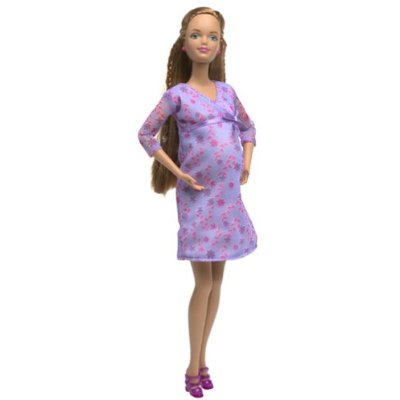 |
| Barbie's married friend, pregnant Midge |
Now, don't get excited, like all of a sudden Barbie's problematic body image issues are benefiting from some long-overdue therapy. When preggers Midge first hit the market, there was an uproar. Rather than rejoicing that skinny bitch Barbie had finally allowed some real female bodily reality into her ranks, we were frightened. Frightened! OMG, what will this teach our children? How could they possibly look up to their Barbie as a role model if she's pregnant!? Oh, the horror!
 |
| Barbie and youngest sister Kelly |
Which is weird, right? Because Barbie is the projection of quintessential American womanhood--and no matter what color they paint her universal face, no matter what professional outfits she may put on and off, she is still the impossibly long-limbed and big-breasted fantasy girl of the American Dream. And it seems to me that an important piece of this cultural message of essential American womanhood is the get-married-settle-down-and-take-care-of-your-family piece. That's why our country doesn't have "working women," it has "working moms." No matter professional outfit you may put on, at the end of the day, you're supposed to take it back off and come home and take care of your family.
The only explanation I can come up with for why Barbie can display maternal tendencies but not maternal bodily realities is simply that, in the end, a Barbie without the perfect Barbie figure is no Barbie at all. It's a Barbie face on top of some monstrously distended body, and we can't have that.
So, definitely adding a preggers Barbie to my subversive plan, along with: zombie Barbie, crossdressing Ken, prosthetic cheetah sprinting legs Barbie, and of course, cyborg Barbie.
More suggestions welcome...
Thursday, August 12, 2010
things I have learned this week
- you can't assume the people on the sidewalks talking to themselves are crazy anymore.
- there is such a thing as too much whipped cream in an espresso con panna.
- you can find free knitting patterns for Barbies on the internet (don't worry, I have a subversive master plan at work here. and when I get my hands on a Ken, s/he's getting a makeover for sure).
- the new name of the Childlike Empress in NeverEnding Story? "Moon Child."
- Einstein was a mad genius at baby-killing rationalizations.
Tuesday, August 10, 2010
irony
I will never understand why people running for public office choose to do so by badmouthing the guvmint. If it's so dang horrible, wouldn't it be more consistent to, say, picket buildings and protest, start eliminating political offices, or, say, work toward making all government work unpaid and pro bono, you know--actually dismantle the institution that is so dang horrible--since by joining, all you're doing is putting your own self on the dole and making the problem one person bigger? But apparently, the only person we can trust not to "vote themselves entitlements from the largesse of the government" is someone seeking public office...
Sharron Angle: "We’re right to that point in the graph where it says, “government dependency.” And we know that once we have a majority that are dependent upon the government, we will lose our freedom; it says we go into bondage. That’s the next stage. Our Founders warned against this. They said don’t… that your liberty is only as secure as the people are. Because once they, um, get the ability to vote themselves entitlements from the largesse of the government, liberty is done; freedom is over with. We were warned. We are there. We’re right on the cusp of it, and you’ve identified those numbers. That’s the war that we’re in. You know, when I talk about a war and a battle and soldiers we have to take up our…our cry for freedom. And we can do it right now at the battle box… I mean at the ballot box. I’m not sure what continues on after 2010. I know people are very frightened about what’s going on in this country. And these programs that you mentioned -- that Obama has going with Reid and Pelosi pushing them forward -- are all entitlement programs built to make government our God. And that’s really what’s happening in this country is a violation of the First Commandment. We have become a country entrenched in idolatry, and that idolatry is the dependency upon our government. We’re supposed to depend upon God for our protection and our provision and for our daily bread, not for our government. And you’ve just identified the real crux of the problem. I’ve also been endorsed by a PAC out of Washington D.C. and the name of that PAC is Government is not God. And I thought that that was so appropriate because that is really what’s happening in our society and we need to take our country back." (source: Las Vegas Sun)
Oh! Irony, no no no, we don't get that here...
Saturday, July 31, 2010
vampires, cyborgs, Christians
So, Anne Rice quits, because people suck? What did she expect, anyway?
That was my first gut-check response to the statement she made this week on Facebook, subsequently picked up by Huffington Post: 'I Quit Being a Christian.' Why? Well, like I said, people suck--and apparently Christian people are the suckiest: "It's simply impossible for me to 'belong' to this quarrelsome, hostile, disputatious and deservedly infamous group. For ten years, I've tried. I've failed. I'm an outsider. My conscience will allow nothing else. ...I refuse to be anti-gay. I refuse to be anti-feminist. I refuse to be anti-artificial birth control. I refuse to be anti-Democrat. I refuse to be anti-secular humanism. I refuse to be anti-science. I refuse to be anti-life. In the name of …Christ, I quit Christianity and being Christian. Amen."
Okay, granted: Christian people really are the suckiest, if only because they suck just as bad as everyone else and claim to be doing God's will or loving Jesus the whole time they suck. And I hate just as much as anyone the fact that goofy Ted Haggards and odious Fred Phelpses and you-name-hims are the media face of Christianity. In fact, I hate it so much I refuse to accept it. Which is exactly NOT what giving up and publicly quitting being a Christian does. I get that she wants to indict these sucky Christians for their suckiness. But in the meantime, she grants that this is what Christianity really is, and must be, and all right-minded people must quit it because it will only ever be a religion of haters and that's what Jesus would do.
Actually I think Jesus stuck around and got crucified for it, but hey, that's a theological quibble for another day, right.
On my own Facebook page I groused, "why sell out and let the haters define Christianity? all she's doing is legitimizing the perception that this is in fact what Xny has to be. Lame."
Maybe that was a bit harsh. Susan Campbell's reaction is better: "Come sit by me, Sis. Anne. One can be a Christian and cling to none of those antis, I believe." (Amen and amen and amen!) Usually, I'm much more level-headed; I stick it out in my little corner of Christendom, but I have said (so often now it's practically become a mantra) that we need some people to go and some people to stay, and everyone should do what they do loudly. Well, you can't beat an Anne Rice Facebook statement picked up by HuffPo as a megaphone, so it seems like I am actually pissed off at someone conforming to my own advice. Which puts me in a bind. Mea culpa. So why is it that I still feel like what she is doing is misguided in some fundamental way? Why am I still pissed about it?
What makes Susan's reaction better and different from mine is that, I got pissed off at the idea of quitting--because I have chosen to not quit, despite the fact that I too feel very much an outsider in my own Christian tradition. I've decided not to quit because I am an outsider. It's the outsiders--the vampires and the cyborgs if you will--within the church that have the prophetic potential for changing the antis into pros. It's not so much that I'm angry that Anne Rice wants to publicly indict Christians for the unforgiveable anti-stances that have been so publicly and politically taken up by a very vocal some. I agree. It's that her chosen response to it indicts my chosen response to it as wrong: useless, hopeless, and worse, complicit rather than prophetic. As she sees it, her conscience cannot allow association with the horrors she sees perpetrated by those claiming Christianity. But me--I'm just not that interested in preserving the purity of my conscience. I'd rather spend my time trying to preserve other things.
Susan seems to agree with me that it's hasty generalization to conclude that all of Christianity is defined by the haters, but instead of getting pissed off and calling Anne "lame," she says "come sit by me." That's ever so much better.
[So, pssst, Sis. Anne, have you heard of The Episcopal Church? It officially welcomes you. Also, should you ever find yourself in Brooklyn, why not check out this awesome pro-gay, pro-feminist, pro-birth control (well, except for that one couple that doesn't seem to bother, and yeah, you know who I'm talkin bout, but hey, you make great babies), pro-Democrat, pro-secular-humanist, pro-science, pro-life church, CCfB...]
But in the meantime, use your megaphone while you exit--because we need this witness too. But I hope you decide to stick around. And, sorry for calling you "lame."
That was my first gut-check response to the statement she made this week on Facebook, subsequently picked up by Huffington Post: 'I Quit Being a Christian.' Why? Well, like I said, people suck--and apparently Christian people are the suckiest: "It's simply impossible for me to 'belong' to this quarrelsome, hostile, disputatious and deservedly infamous group. For ten years, I've tried. I've failed. I'm an outsider. My conscience will allow nothing else. ...I refuse to be anti-gay. I refuse to be anti-feminist. I refuse to be anti-artificial birth control. I refuse to be anti-Democrat. I refuse to be anti-secular humanism. I refuse to be anti-science. I refuse to be anti-life. In the name of …Christ, I quit Christianity and being Christian. Amen."
Okay, granted: Christian people really are the suckiest, if only because they suck just as bad as everyone else and claim to be doing God's will or loving Jesus the whole time they suck. And I hate just as much as anyone the fact that goofy Ted Haggards and odious Fred Phelpses and you-name-hims are the media face of Christianity. In fact, I hate it so much I refuse to accept it. Which is exactly NOT what giving up and publicly quitting being a Christian does. I get that she wants to indict these sucky Christians for their suckiness. But in the meantime, she grants that this is what Christianity really is, and must be, and all right-minded people must quit it because it will only ever be a religion of haters and that's what Jesus would do.
Actually I think Jesus stuck around and got crucified for it, but hey, that's a theological quibble for another day, right.
On my own Facebook page I groused, "why sell out and let the haters define Christianity? all she's doing is legitimizing the perception that this is in fact what Xny has to be. Lame."
Maybe that was a bit harsh. Susan Campbell's reaction is better: "Come sit by me, Sis. Anne. One can be a Christian and cling to none of those antis, I believe." (Amen and amen and amen!) Usually, I'm much more level-headed; I stick it out in my little corner of Christendom, but I have said (so often now it's practically become a mantra) that we need some people to go and some people to stay, and everyone should do what they do loudly. Well, you can't beat an Anne Rice Facebook statement picked up by HuffPo as a megaphone, so it seems like I am actually pissed off at someone conforming to my own advice. Which puts me in a bind. Mea culpa. So why is it that I still feel like what she is doing is misguided in some fundamental way? Why am I still pissed about it?
What makes Susan's reaction better and different from mine is that, I got pissed off at the idea of quitting--because I have chosen to not quit, despite the fact that I too feel very much an outsider in my own Christian tradition. I've decided not to quit because I am an outsider. It's the outsiders--the vampires and the cyborgs if you will--within the church that have the prophetic potential for changing the antis into pros. It's not so much that I'm angry that Anne Rice wants to publicly indict Christians for the unforgiveable anti-stances that have been so publicly and politically taken up by a very vocal some. I agree. It's that her chosen response to it indicts my chosen response to it as wrong: useless, hopeless, and worse, complicit rather than prophetic. As she sees it, her conscience cannot allow association with the horrors she sees perpetrated by those claiming Christianity. But me--I'm just not that interested in preserving the purity of my conscience. I'd rather spend my time trying to preserve other things.
Susan seems to agree with me that it's hasty generalization to conclude that all of Christianity is defined by the haters, but instead of getting pissed off and calling Anne "lame," she says "come sit by me." That's ever so much better.
[So, pssst, Sis. Anne, have you heard of The Episcopal Church? It officially welcomes you. Also, should you ever find yourself in Brooklyn, why not check out this awesome pro-gay, pro-feminist, pro-birth control (well, except for that one couple that doesn't seem to bother, and yeah, you know who I'm talkin bout, but hey, you make great babies), pro-Democrat, pro-secular-humanist, pro-science, pro-life church, CCfB...]
But in the meantime, use your megaphone while you exit--because we need this witness too. But I hope you decide to stick around. And, sorry for calling you "lame."
Thursday, July 29, 2010
Philadelphia 11
How long, O Lord? Will c's-of-C ever get to look back and celebrate a date like this?
http://www.episcopalchurch.org/41685_3311_ENG_HTM.htm
http://www.episcopalchurch.org/41685_3311_ENG_HTM.htm
Wednesday, July 28, 2010
summer: a busy of monotony
So, it's summer. And I like summer: I like hot weather, I like being outside, I like the idea of "vacation," I like hanging out with Clare (mostly) (and this mostly reciprocated). But arrrrrrrgh.
Because "vacation" is theoretical, it's been hellishly hot here just like it has everywhere else, and it seems like I've been on my own more the past two months than any stretch of time so far in a decade of marriage. It's a big deal just to extricate myself from Clare's proximity long enough to go pee, and generally, she scouts me out while I'm still mid-stream.
In an hour and a half, I will have some much-needed time to do some pressing and important work--my Science for Ministry elective course, "The Human Person in a Technological Age," starts Monday. I am counting the minutes. This blog post is happening only because I am delaying the inevitable trip to the playground while my iPhone rewrites itself from scratch (no idea why this is necessary but it is taking forever).
In other news, I remain a theologian-at-large and heretic-for-hire, so if there's anyone you know in need of faithfully irreverent God-talk...well, I could use some word-of-mouth buzz. It would be so nice, and not just for practicalities like paying student loans, to do work I actually get paid for.
Time for the playground!
Because "vacation" is theoretical, it's been hellishly hot here just like it has everywhere else, and it seems like I've been on my own more the past two months than any stretch of time so far in a decade of marriage. It's a big deal just to extricate myself from Clare's proximity long enough to go pee, and generally, she scouts me out while I'm still mid-stream.
In an hour and a half, I will have some much-needed time to do some pressing and important work--my Science for Ministry elective course, "The Human Person in a Technological Age," starts Monday. I am counting the minutes. This blog post is happening only because I am delaying the inevitable trip to the playground while my iPhone rewrites itself from scratch (no idea why this is necessary but it is taking forever).
In other news, I remain a theologian-at-large and heretic-for-hire, so if there's anyone you know in need of faithfully irreverent God-talk...well, I could use some word-of-mouth buzz. It would be so nice, and not just for practicalities like paying student loans, to do work I actually get paid for.
Time for the playground!
Wednesday, June 30, 2010
informal review of Susan Campbell's Dating Jesus
[from Christian Scholars Conference 2010]
Reviewing a book such as this, when your experience reading it has been as emotionally intimate as this has been, is a bit terrifying—knowing that whatever I say about it, I am saying much more about myself, in many ways, than I am about this text. But to say this is in some ways offering the highest tribute possible to Susan Campbell’s memoir of growing up in the [small] c’s-of-C: her journey precedes mine chronologically, is distanced from mine geographically, and differs in personal particulars, but nonetheless describes what it means to come of age as a girl in our denomination in words so honest that not only does my narrative echo hers at certain points, but the contributed bits of the many guest bloggers’ narratives at “rude truth” do, as well.
Campbell Campbell
Reviewing a book such as this, when your experience reading it has been as emotionally intimate as this has been, is a bit terrifying—knowing that whatever I say about it, I am saying much more about myself, in many ways, than I am about this text. But to say this is in some ways offering the highest tribute possible to Susan Campbell’s memoir of growing up in the [small] c’s-of-C: her journey precedes mine chronologically, is distanced from mine geographically, and differs in personal particulars, but nonetheless describes what it means to come of age as a girl in our denomination in words so honest that not only does my narrative echo hers at certain points, but the contributed bits of the many guest bloggers’ narratives at “rude truth” do, as well.
This is not actually a very happy thing to observe. One would have hoped, after all, that the church which Campbell describes as “frontier revivalism frozen in amber” (38) might have unstuck itself from its fossilized convictions about gender in the years that separate my coming of age from hers. But, as she rightly observes, anachronism can become a veritable badge of righteousness, and on this issue, there is still no quicker and more effective rebuttal to the attempt to voice women’s experiences as relevant than “we cannot let culture dictate the practice of the church.”
That is, we might, if we read, and read with ears ready to hear a narrative that is both heartbreakingly funny and gut-wrenchingly sad, with some moments of prophetic pissed-off-ness in between. Not everyone is, still. Like the comment I received from a first-year seminary student’s first encounter with James Cone, “I feel like he’s yelling at me through the pages,” there are moments of, say, “snark”—not least of which is Campbell’s habit of footnoting scriptural references for the c’s-of-C practices she describes, and it’s not an aspect of the memoir designed to court a reluctant audience.
In my opinion, to consider this a weakness of the book is to entirely miss the point. It is not the memoir’s only strength, but it is one of its strengths, and without the “snark” it would not be the honest narrative that it is. As one blog commenter observes, “it made me feel like I was sitting at the table with her”—and what better observation could there be of the profound, dare I say, sacramental even, intimacy made possible by the disarming honesty of an author, reciprocated in the receptive honesty of a reader?
Moreover, it misses the point—never articulated directly by Campbell
It seems that Campbell
And, fantastically, the reasons are not all bad. You have to willfully ignore Campbell
Unfortunately, the reasons aren’t all good either, and the double bind which Campbell sketches from early childhood on, the message that 1) you must do everything you can to make yourself ready and 2) a woman can’t [fill the blank], becomes a message she describes as an adult as “hardwired” (149). “I was hardwired to understand that I don’t belong in the pulpit”—a dreadful perversion in modern metaphor of Jeremiah’s experience of the fire shut up in his bones. “As big a feminist as I am,” she writes, “I have on some level embraced the limitations set before me. And I fear bucking them. And that makes me both sad and angry” (149). Yeah. Me too. And how many, many others.
Unlike Campbell
Tuesday, June 29, 2010
no more time-outs
Clare: "what if I had no more time-outs ever? could we send all the timeouts all the way into outer space?"
me: "there's a way you could have no more time-outs ever for reals. wanna know how?"
Clare, eyes wide: "how?"
me: "You could always listen and then you would have no more time-outs."
Clare, excited: "Mommy, I GET IT!"
me: "there's a way you could have no more time-outs ever for reals. wanna know how?"
Clare, eyes wide: "how?"
me: "You could always listen and then you would have no more time-outs."
Clare, excited: "Mommy, I GET IT!"
Subscribe to:
Posts (Atom)