Wednesday, October 30, 2013
TecnaMonsterFairyTaleHigh and the Future of the Female Body
I won't recap everything here, but suffice to say, I find these two discourses on gender and sexuality to be in opposition to each other in important ways, and the contrasts between the two ultimately rest on their divergent views of the human body, and in this instance, the female body particularly. [If you want to know more, well hey, take that $100 you've got lying around just waiting to be spent and click the link on the sidebar and get yourself a copy of the book! :)]
One of the assumptions in Hughes and Dvorsky's analysis of transhumanism and gender is that technological interventions on the human body are the ultimate means of addressing the social injustices surrounding gender. They anticipate a future where, by means of various technologies, people will be able to consciously select certain "gendered" traits, according to personal preference, thus dismantling the "gender binary" that we have (presumably) inherited from our unaltered biology. The vision is one of liberation from that restrictive binary by altering our bodies at will.
There are a lot of things here to take issue with, from my point of view, but again--read the book.
What I want to focus on here is a new wrinkle of worry about this approach to gender and biotechnology and the posthuman future, prompted by my latest brush with the rampant sexualization and body distortion and stereotyping and reduction and limitation in children's media and the toy industry.
This past week Clare asked me to please rethink my ban on Winx Club. The girls at her school play "Winx" at recess, and while she joins in, she always feels a bit lost because she doesn't watch the show and has to figure out who is who and what is happening. I get that. And she was super thoughtful about asking me to rethink, and suggested I watch an episode. And promised that if I did let her watch it she would ignore all the inappropriate stuff (oh how I wish it worked that way). Of course it also turns out that she had been illicitly bingewatching on the iPad after Netflix put temptation right in front of her face. Sigh. #parentfail.
So, I watched an episode. And it basically made my brain explode and dribble out my ears. It was beyond the horrible I had braced myself for.
Then I saw the newest toy to come down the corporate pike for my daughter: Fairy Tale High.
Great! They're like Bratz, only not Bratz because they're, like, fairy-tale-ish. They're like Monster High, only not, 'cuz they're fairy-tale-ish. They're like Winx and _____ and _____ and ______ only not, 'cuz they're fairy tale princesses in their secret life instead of fairies and _____ and ______. Wow! That's what we call OPTIONS!
Pigtail Pals member Bailey Shoemaker Richards says it:
I mean, just look at them. You literally cannot tell these things apart.
What does the above picture have to do with transhumanist aspirations to postgenderism, I bet you're wondering.
That's great, because I'm about to tell you.
First, there's the basic question that Melissa Atkins Wardy at Pigtail Pals puts to us, which is, what are our girls (and boys!) learning from these distorted representations of the female body, and limited, frivolous representations of girlhood?
Yes, that's rhetorical. We know what they're learning, and it is false, and it is harmful.
My question is, what happens when these internalized false and harmful notions of what girls and women's bodies are supposed to look like collide with the ever-more-inventive technologies we use on those bodies?
Will we get the transhumanist utopian vision of technologically mediated gender equity, and human bodies that, again via technological mediation, defy the presumed biological gender binary?
Or will we get women who seek to sculpt their bodies into the distorted representations we've been handing them as the ideal and norm ever since they were born, and men who expect that?
Sunday, August 14, 2011
a gospel for cyborgs and other unnatural creatures. (that is, everyone.)
Clones?
Artificial intelligence, robots, androids?
Gay sex?
Would the Incarnation even make your list? Because seriously, what could be more unnatural than divinity assuming human flesh?
The gospel is good news because it is unnatural. It defies the "natural" opposition of Creator and created, of God versus humanity. We are not doomed to forever relate to God as God's opposition. The unnatural act of reconciliation has taken place, initiated by a God who doesn't care about pretentious and ignorant human categories of the natural.
Friday, December 10, 2010
toward a zombie cyborg theology
But also because zombies, as cultural figures, are inherently anthropologically dualistic. Think about it: you take a human person, give'em a zombie bite, and the person dies but their dead body, who is not the person you used to know, becomes reanimated by an external force of some kind and then tries to eat your brains. This is precisely why, of course, we can kill zombies with impunity and without remorse: they are not human anymore. They are not the person they were; that essential self is gone, and the body that looks like the person you used to know is just a dead vehicle being driven by something else. --You just don't get more dualistic than that!
So it's curious to me that the read of The Walking Dead in the blog post from religiondispatches.org, "Toward a Zombie Theology," is that the working anthropology is materialistic:
"But even with Christian overtones the writers of Walking Dead end up coming down in favor of brain-based consciousness. In death, including the death of the brain, Dr. Jenner says, “Everything you ever were, or will be…[is] gone.”Note: I haven't been watching this show, so the interpretation of the show may well be right on target...which means that the writers of the show should be wrestling with how to reconcile the inherent dualism of zombies with their attempt at materialism. In any case, my point is that zombies, as a symbolic monstrous posthuman figure in our cultural landscape, are much more at home with garden-variety dualism of body/soul than they are with materialism of any sort, reductive or non-reductive.
Whereas cyborgs, on the other hand, are resolutely materialistic. What makes a cyborg? Some sort of bodily merging of biology and technology--flesh and machine. Now, we think of human persons and machines as categorically different, not least because machines don't have "souls"--which we can just define here very loosely as that essential inner thing which animates a creature. Machines are not animated; humans are--basic categorical difference. So, what the cyborg does, conceptually, is render that categorical difference highly questionable. If a single creature is part human and part machine--then what is the difference between human and machine? And if we can create (and we regularly do, let's note) humans that actually are to some degree "part machine" and they are much better off thus--that is to say, able to flourish as humans because of their part-machine-ness--then, part of being human includes the potential of interfacing and merging with technology and making it a functional part of ourselves. Here, then, the definition of human shifts into one with an emphasis on embodiment, and the surprising ways our bodies are configurable. That's moving away from dualism with a vengeance.
So the question posed in response to zombies is actually much better posed in response to cyborgs:
"So does this leave theology out in the cold? The dominant theological understanding for anthropology in Christianity is still dualistic, a synthesis of the physical body and an immaterial spirit or soul, but in recent years those advocating a monistic view of human nature have arisen, articulating a perspective they call “nonreductive physicalism.” This view, advocated by scholars like Fuller Seminary’s Nancey Murphy, recognizes the significance of the cognitive neurosciences that have cast doubt on philosophical and theological concepts of the soul, but argues for human significance and the divine as opposed to materialist interpretations in the field."Do we need a concept of the soul in order to faithfully interpret the biblical canon and the Christian tradition? I would argue, rather, we would probably do better to dump it in order to better understand both our own scripture and Christian tradition and the best available (and constantly evolving) scientific witness on the anthropological question.
Friday, September 24, 2010
haaaaaaaaappy anniversary, cy-boys and cyber-girls!
Friday, August 13, 2010
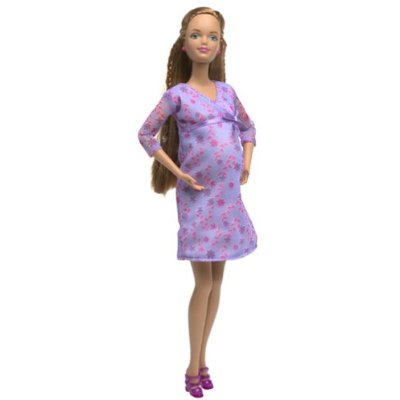
the maternal is not an element of the Barbie collective
![]() |
| Barbie's married friend, pregnant Midge |
Now, don't get excited, like all of a sudden Barbie's problematic body image issues are benefiting from some long-overdue therapy. When preggers Midge first hit the market, there was an uproar. Rather than rejoicing that skinny bitch Barbie had finally allowed some real female bodily reality into her ranks, we were frightened. Frightened! OMG, what will this teach our children? How could they possibly look up to their Barbie as a role model if she's pregnant!? Oh, the horror!
![]() |
| Barbie and youngest sister Kelly |
Which is weird, right? Because Barbie is the projection of quintessential American womanhood--and no matter what color they paint her universal face, no matter what professional outfits she may put on and off, she is still the impossibly long-limbed and big-breasted fantasy girl of the American Dream. And it seems to me that an important piece of this cultural message of essential American womanhood is the get-married-settle-down-and-take-care-of-your-family piece. That's why our country doesn't have "working women," it has "working moms." No matter professional outfit you may put on, at the end of the day, you're supposed to take it back off and come home and take care of your family.
The only explanation I can come up with for why Barbie can display maternal tendencies but not maternal bodily realities is simply that, in the end, a Barbie without the perfect Barbie figure is no Barbie at all. It's a Barbie face on top of some monstrously distended body, and we can't have that.
So, definitely adding a preggers Barbie to my subversive plan, along with: zombie Barbie, crossdressing Ken, prosthetic cheetah sprinting legs Barbie, and of course, cyborg Barbie.
More suggestions welcome...
Wednesday, July 28, 2010
Monday, May 17, 2010
"Barbie in comfy shoes"
Monday, August 24, 2009
Conclusion: Cyborgs for Earthly Survival
CYBORGS FOR EARTHLY SURVIVAL
The concluding scene of the SciFi Channel’s revival of the short-lived 70’s TV series Battlestar Galactica shows a line of defeated but indomitable human beings, shouldering packs and trudging slowly but determinedly into a wilderness, away from their spaceships, their computers, their technologies. The scene visually tropes an earlier one, in which these spacefaring refugees from a nuked planet observe a primitive hominid family group moving single file across the plain in much the same way, unknowingly the objects of a technologically mediated, curious vision of alien kindred.
What could prompt such a dramatic and counterintuitive conclusion to a narrative of remnant humanity’s exodus from ruin, led by a faithless Moses and a dying Miriam, whose existence had depended so intimately for so long on the technologies now being decisively repudiated? What message lies in this conclusion for us, as we ponder the various possibilities, both frightening and liberatory, of the posthuman future?
The complexity of the narrative universe of Battlestar Galactica belies such a simplistic ending. For these human beings, the posthuman future has already arrived, and with a vengeance—literally. The opening scene of the series gives us a question posed by a sexy blonde machine to a middle aged, befuddled soldier/diplomat: “are you alive?” she asks. Yes, is the stuttered answer, but the machine doesn’t care, or perhaps, does not believe this answer—after all, this must have been the very question put to it, in the years that sowed the seeds of the conflict that would shortly destroy not only this man, but his whole civilization as well, in a retributive genocidal impulse.
The problem goes far beyond the pragmatic difficulties caused by the fact that “the Cylons look like us now.” The problem, in short, is that the Cylons are us: down to our very blood. And not just “us” in biological facsimile, but in nature. Violent, retributive, obsessive, sinful, human nature.
This is where the story begins: with an ontological confusion, a question of humanness not simply in terms of status but fundamental nature, and a question of what constitutes the difference between person and machine, when machines can also think and feel. The only difference seems to be, frankly, that the machines are determined to kill the humans. One can only speculate why; but, after all, machines made in imago hominis are likely to be pretty dangerously untrustworthy.
Things get more complicated when it turns out you can have sex with those machines, and get them pregnant. Beyond begging the question of the definition of species, interbreeding produces a more obvious hybrid, a child who is simultaneously threat and promise. Named for a goddess and literally a savior, this miracle child becomes blood sisters with the dying Miriam and saves the prophet’s life; revived, the leader of the human remnant rescinds the savior’s imminent execution but fakes a death to remove her from her Cylon mother’s care—machines can’t be trusted.
Things get more complicated still when it turns out that the Cylons themselves are a stratified society: Cylon fighters are bred like animals, “toasters” take orders from “skin jobs,” and everyone alike is conveyed through space by sentient ships piloted by those whom the Cylons themselves refer to as hybrids—human brains hardwired into their ships, simultaneously pilot and vehicle.
But things only get really weird when it turns out that there really are angels walking among us.
How to make sense of this strange, unsystematic, non-taxonomy of unclassifiable creatures, none of them natural, and all of them, somehow, kin? There’s no certain path through this wilderness, no telos, no heaven, and no real Earth; the only thing certain, in this narrative, is that it has all happened before, and it will all happen again. The final, looming question is, simply, will it happen the same way? Or will we, somehow, construct a path through the wilderness that aims toward making that new world a liveable world, in which anthropoids, humans, Cylons, hybrids, and angels alike, dwell?
Saturday, August 08, 2009
(almost) done, done, done!
The outline form didn't paste in very well, so the structure of my sections and sub-sections is a little unclear, sorry. But I'm assuming no one will really care. I'm just posting this as a little bit of unashamed self-congratulation.
Introduction
Part One: The Posthuman: Two Manifestos
Chapter One: The Cyborg Manifesto
Of This and/or That: the cyborg as transgressor of boundaries
Human/animal
Organism/machine
Physical/nonphysical
Of (Mother?) Nature: nature and the posthuman
Of God the Father: religion and the posthuman
Of Mice and Men: politics and the posthuman
Chapter Two: The Transhumanist Manifesto
On Being Better than Well: Transhumanism
Extropianism
Democratic Transhumanism
The Hedonistic Imperative
Singularitarianism
On God the Father: transhumanism and religion
On (Mother?) Nature: transhumanism and nature
On Mice and Men: transhumanism and politics
Part Two: Theological Anthropology and the Posthuman
Chapter Three: Post-anthropologies
Heart & Soul: materialism/dualism
All Heart?
No Soul?
FemaleMan: gender
Know Thyself: epistemology
Thy Sister’s Keeper: kinship
Chapter Four: Theological anthropologies
Imago Dei: the plastic image of God
The Bible tells me so
Thing, Action, Relation?
Human Nature, Mind, and Soul: substantive interpretations
We are what we do: functional interpretations
Not I, but We: relational interpretations
Human Uniqueness: Alone in the World?
Human Agency: Sin and Redemption
Chapter Five: Transversing: theologians engaging posthumans
Cyborg and theology
Anne Kull: TechnoNature
Elaine Graham: Theological Anthropology On the Edge
H+ and theology
Elaine Graham: Transcendence into an ‘Imaginary of Death’
Brent Waters: Just Say No
Ted Peters: Techno-optimism and the Doctrine of Sin
Steven Garner: The Hopeful Posthuman
Chapter Six: Constructing a Theological Post-anthropology
Relational, Embodied, Hybrid
The Turn to Relationality
(Post)Human Embodiment
Hybridity
“Medical Cyborg” Theologies
Queer Cyborg Theologies
Postcolonial Cyborg Theologies
Everybody Counts
Part Three: Christology and the Posthuman
Chapter Seven: Christology and the Posthuman
The Cyborg Christ
A Little Talk about Jesus
Trickster Figure and Hybrid Creature
Quest for the Hybridized Jesus
The Mestizo Future
The FemaleMan and the GodMan
The Ultimate Human
Conclusion
Tuesday, July 28, 2009
the ultimate Others: dare we love them?
from K's blog: "Dr. Aronson recounts the numerous phone calls and emails that she has received from families whose adopted children have merely seen the trailer for this movie. One child asked her parent, ‘Is this what I am? Is this what other people think about me?’ and that kid was 5 years old."
Check out the rest of K's thoughts here, and follow the link to the NPR story as well.
Tuesday, April 28, 2009
the Beatles on scientific epistemology
"Nowhere Man"
He's a real nowhere Man,
Sitting in his Nowhere Land,
Making all his nowhere plans
for nobody.
Doesn't have a point of view,
Knows not where he's going to,
Isn't he a bit like you and me?
Nowhere Man, just listen,
You don't know what you're missin',
All the world's at your command.
He's as blind as he can be,
Just sees what he wants to see,
Nowhere Man can you see me at all?
Nowhere Man, don't worry,
Take your time, don't hurry,
Leave it all 'till somebody else
lends you a hand.
Doesn't have a point of view,
Knows not where he's going to,
Isn't he a bit like you and me?
Nowhere man please listen,
you don't know what you're missin'
Nowhere Man, the world is at your command
He's a real Nowhere Man,
Sitting in his Nowhere Land,
Making all his nowhere plans
for nobody.
Making all his nowhere plans
for nobody.
Making all his nowhere plans
for nobody.
Wednesday, November 05, 2008
and so it begins
But for me personally, the major achievement represented by the election of a man named Barack Hussein Obama is somewhat different than the above. I just heard an exchange on MSNBC with some guy named Tucker Carlson who kept insisting that celebrating the election as "historic" (meaning, it's important that we have elected our first African-American president) tends toward the implication that all those who didn't vote for Obama now find themselves on "the wrong side of history" (an interesting new euphemism employed in this conversation to avoid using the blunt label, "racist"--because despite it all, we still cannot discuss race and racism in this country without euphemisms). Carlson insisted on also at the same time interpreting the election in pragmatic terms--that many people did not self-consciously cast "a historic vote" but simply a vote for the candidate that they agreed with, whose policies they judged to be right for the country, so that people "on the wrong side of history" aren't made to feel like racists.
I think he's right at the same time that he's wrong.
The real achievement of this election is that people did cast a pragmatic vote for the candidate they agreed with, whose policies they judged to be better for the country--and that this judgment could be made across multiple demographics without necessary reference to the identity category of "African-American." To separate the pragmatic from the historic vote is a mistake, because it misses the point that up till now, a black man was always black first, and then whatever else second. Now we have proven--not just to the world, but to ourselves as a country--that we can put aside the category, the label, the box, and make a judgment based on more than that.
This is the real achievement of the campaign itself, and it would have stood as monumental even with a loss at the end of it, though it would have been harder to see, and harder to celebrate, without the final vindication of a win.
I'm not saying that it doesn't matter that Obama is the son of a black Kenyan and a white Kansan. It does--but it doesn't matter in the same way that it would matter in the old, constricting framework of identity politics as usual. He didn't win because he was black. Neither did he win despite being black. I think enough Americans experienced the breakthrough that this fact of his biography did not preclude a common vision, did not mean that he could never see from a white person's point of view, that a white person could never see from a black, or Hispanic-, or Asian-American, or even international point of view. We can, at least in part, if we choose to try. We can relocate our gaze, in a gesture of kinship. This is the change that has become real, because we finally believed enough in the possibility to choose it.
Wednesday, October 29, 2008
Identities, Cyborgs, Children's Books and Politics
Clare and I sometimes read a book before bedtime titled, Only You. It's a little love poem from a parent to a child, with lovely illustrations of waking up, playing, bathtime, bedtime--the daily routines which are the stuff of life lived together. Some of the pictures are of mommies and babies. Some are of daddies and little kids. Some are white. Some are black. Clare will often point to the mommy and say "mama." She used to point to the baby and say "baby"--now she points and says, "Clare." And then you turn the page, and see the illustration of a black man holding his little boy's hand as they walk through autumn leaves. And Clare points and says, "that's Daddy." And "that's Clare."
What I love about this is that she either doesn't notice at all, or doesn't know that it matters, that these pictures don't look like her or her Daddy. What defines the correspondence is not the identity of the people--it's the relationship depicted between them.
Clare is already beyond identity politics. I wish to God the rest of us really were, and I pray to God that somehow, I can mother her in a way that protects her from being dragged into them.
You're probably tired of hearing about cyborgs and transgressed, permeable, blurred boundaries from me. But all that ontological talk, while sometimes useful, obscures the real motivation for introducing cyborg discourse. The cyborg is, always was, a political figure. The cyborg is meant to signal the hope of breakdown of identity politics. After all, when you have no stable, categorical identity with which to label yourself, you can't really engage in the Us vs. Them of identity politicking. When you know you are both Us and Them...who do you pick a fight with? How do you choose sides?
Haraway writes, “With the hard-won recognition of their social and historical construction, gender, class, and race cannot provide the basis for belief in ‘essential’ unity…Gender, race or class consciousness is an achievement forced on us by the terrible historical experience of the contradictory social realities of patriarchy, colonialism, and capitalism. And who counts as ‘us’ in my own rhetoric? Which identities are available to ground such a potent political myth called ‘us,’ and what could motivate enlistment in this collectivity?” ("Cyborg Manifesto," in Simians, Cyborgs, and Women, 155). To decode: when you realize that there's nothing essential about the identity of Woman, Blacks, The Poor--a realization easy to come by when you fit into multiple categories at once, since essential identity is presumably a coherent unity, who you really are--then you also realize that there's nothing automatically binding you together with other women, blacks, poor people in some mystical, magical, transcendent understanding. If there's understanding, it's forged through the difficulties of navigating similar social/historical circumstance--the same thing that categorizes you in a lump to begin with. But that understanding must be actively constructed, not assumed. Assuming those essential identities as the political starting point not only accepts the -ism spawned systems which birthed them, it opens the door to what Haraway describes as "endless splitting and searches for a new essential identity" (155).
The cyborg sidesteps this dizzying circle of identity politics with its tautological reasoning and categorical essentialism, because the cyborg knows from the beginning that its identity doesn't fit in the available identity boxes. So: "From the perspective of cyborgs, freed of the need to ground politics in 'our' privileged position of the oppression that incorporates all other dominations, the innocence of the merely violated, the ground of those closer to nature, we can see powerful possibilities... To recognize 'oneself' as fully implicated in the world, frees us of the need to root politics in identification, vanguard parties" (176).
I don't need to be like you to work together with you. I don't need to have the same categorical identity as you to have the same goals. I don't need to feel like we are, in some deep way, the same.
Andrew Sullivan sees Barack Obama as having skipped the dialectics of racial identity politics in this campaign. I said it long ago: he's the cyborg candidate.
But Sullivan says something else, too, something that I've been noticing more and more as the campaigns drag on and on. Identity politics may not be a part of Obama's campaign. But they have become a part of the McCain/Palin campaign.
When I blogged about Joe the Plumber's mythological existence--he's right up there with dragons, ghosties, Tinkerbell, and Santa Claus--this is what I was trying to express. Somehow, Joe the Plumber became the representative of Real America. Imagine--I mean, wow, the unprecedented move of choosing a white man to represent all American citizens. But beyond my knee-jerk gag reflex...the more terrible truth is that Joe the Plumber wasn't really meant to represent all American citizens. Joe the Plumber represents Real America, not all America. The America inside America: the small town values, the pro-America areas of America, the hard-working America, the patriotic America. We will fight for you, Real America. We understand you. We are just like you. As for Barack Obama, we don't know who he is. He has a weird middle name and lived overseas and his black preacher seems pretty pissed about stuff we don't want to talk about and there's that Weather Underground dude back in his hood in Chicago, also. So we are pretty sure he's not like you. And that means he won't be fighting for you.
How effective is it? Well, it's what we're used to. It's what we know: Us vs. Them is a game we get, a language we speak fluently. Tina Graham gets it: "'I never really thought about whether or not that I was racist, or however you want to put it,' said Tina Graham. She fears Obama would focus on African-Americans at the expense of poor white people like herself. 'It's just the fact that I think that he will represent them, and what they want, and what they need. ... They're his people, they're his race.'" (You can listen to the NPR story here.)
Is it racism? Maybe not. Maybe having a black friend saves you from having to claim that shameful label. Maybe it's just, as Sullivan puts it, "the reductio ad absurdum of political appeals based purely on cultural or ethnic identity." It's absurd all right. But it's also powerful.
Don't get me wrong. This sort of divisive identity politicking happens everywhere. Bill Maher trades in it every time he says there are two Americas, one progressive, European country trapped inside this backwards conservative evangelical country (I've heard this statement twice, once on Charlie Rose and once to Jon Stewart, who, to his credit, didn't seem to buy it). The simplistic antagonistic atheism of Maher meets its religious mirror image in the FotF 2012 letter. Despite the ideological gulf, they are indeed mirror images of the Same, mimicking each other in an endless recursion of self- and other-defeating suspicion.
In a presidential campaign that contains both the defeat and the revivification of identity politics, we have a choice. Do we, as a nation, succumb to the tempting, security-blanket familiarity of voting our Identity? Or do we take the huge step of recognizing that we don't need to have the same categorical identity to have the same goal of building together a liveable world, for everyone who lives in it? Can we follow the lead of a politician whose own personal identity, bridging the categories we like to think within, provides a starting point that sidesteps the necessity of Identification for political cooperation, whose campaign has steadily resisted drawing the boundaries between our various American identities that we all wish weren't there?
Thursday, October 23, 2008
some undisciplined musings on feminism, abortion, and politics: or, why Obama is not a baby-killer
Nowadays I like to own the f-word, feminist, in contrast to my early post-Harding days when I still found that word too divisive and scary to use. What I discovered, once I began actually reading some feminists, is that feminism isn't what I had been trained to think it was. But what I stumbled into, with my late entry into the game, is what I've since learned to label "third-wave feminism." To grossly oversimplify, think of first-wave feminists as proclaiming the message "hey dudes, we have brains too--that makes us real people with real rights, so give us the damn vote already and quit staring at our boobs." Second-wave feminists realized, after awhile, that making personhood all-head and no-body was defaulting to the male anthropological paradigm and said, "Look, we don't want your penes. Boobs and wombs are great. We can do and see and know things you poor slobs never will. We are earthy and natural and love it--you want to live in your head, fine; we're happy with our bodies. Long live the goddess!" Third-wave feminism comes along and says, "Um, girls? Look around a sec and notice that we're not identical--not all of us are privileged white chicks who have the luxury of making an epistemological privilege out of having wombs. Yeah, our bodies are different from males and that difference is awesome--but we're also all different from each other, and that's important too."
How does this relate to the topic at hand? I think that the assumptions built into the current, tired abortion discourse are first-wave assumptions: talk of the body as property, talk of the right to privacy to that 'property.' I think that's rubbish philosophically, no matter what kind of traction it gets legally. As I understand it, and actual lawyers who might happen to read this post can elaborate or correct if necessary, the basic legal underpinning to Roe v. Wade: an (at least) implicit right to privacy in the Constitution, applied to one's body parts. The problem for me is simply that I think it's wrongheaded to think of one's body as property--an anthropological assumption built into the legal argument. It's an inherited anthropology that assumes that Mind/Soul is the "I" and body is just the thing the "I" uses to get around in, everyone has one and everyone is entitled to do with it and treat it as he sees fit. In the R v. W. application, the important point is that as long as the fetus is attached to the mother's body, the fetal body is an extension of the maternal body and therefore the "property" of the mother in the same sense her own body originally is and always was. But if our bodies are ourselves (second wave talk, there), dualistic anthropology and body-as-property are rejected.
But what would it mean to be pregnant, if bodies are not property and fetal bodies are not the extension of maternal body-as-property? It's an interesting question and one that preoccupied me quite a bit during my own pregnancy. Not conceiving my own body as my ontological and legal property, I did not conceive Clare's developing body as my property. But was that developing body an extension of my own, or was that body always Clare? Or when and where does the transformation from part-of-me to being-her take place? Notice these are the same questions that always get asked--but asked from a slightly different perspective, the perspective of embodied but bound together creatures, whose ontological boundaries are permeable, blurred and confusing. Yes: are you hearing it? That's cyborg talk. Yes: I am claiming pregnant women are cyborgs.
But what's the point? Well, for one thing, if we could admit that pregnancy is an ontologically confusing category, and stop trying to draw undrawable boundaries about when/how a baby becomes its own person (=when a baby has enough of a brain to justify postulating its own consciousness/self-awareness/personhood???), we might be able to stop wasting time and energy and breath about something that we'll never figure out because we set the terms wrong to begin with. Everyone who wants to draw that line is ignoring the obvious fact that--whether you put it at conception on the basis of potential consciousness/self-awareness/personhood, or at some late stage of fetal development on the basis of postulated consciousness/self-awareness/personhood--that the bodies in question remain bound together and this is important. Not secondary. Not a question of correctly drawing property lines. A matter of survival.
Secondly, I think we could benefit from being forced to admit that if we care about the baby, we also care about the mother, because they are embodied together. Everyone knows that what the mom does, eats, drinks affects the developing body bound to her own in utero. In my experience, this embodied-togetherness lasted quite awhile after Clare's birth as well: we were synched bodily for a year, most obviously through breastfeeding though I suspect there were other manifestations as well.
So hear me on this: I don't think abortions are the kind of decision one makes when deciding how to dispose of personal property. You don't clean out your womb like you clean out your closet. That's not the moral prescription it sounds like in the second person--let me try again. No one cleans out her womb like she cleans out a closet. It's not the same. It's not even a good parallel. The fact that it's the paradigm enshrined in our legal precedent is, IMO, harmful to the discourse. It does not reflect reality. It is not cognizant of what it means to be a human being, of the embodied reality of being human. It is not cognizant of what it means to be a pregnant woman, a special case of bound-together human embodiments.
One way in which direct harm is done to our discourse in in the different paradigms of the woman who chooses abortion at work on each side of the debate. Pro-lifers tend to view the paradigmatic woman as one who chooses abortion for the sake of convenience: my closet is full, I don't like this dress, I'll get rid of it. The language of Roe v. Wade, with its view of human bodies as property, aids the contruction of this rhetorically effective, distorted paradigm. I have written before that I think this is utterly false.
If I am right--and I am at least being true to my own experience--and pregnancy is best considered a bound-together embodied cyborg existence, then the choice to abort is a choice that is best spelled out in double terms: choosing to terminate self and other, because in this strange cyborg existence they are not truly separable. To call this tragedy is to light-heartedly understate the case. I hope this gives some sense of how serious I am when I insist that I do not consider this moral decision-making a matter of abstract "choice" and "rights." It don't even think it's an issue of "equality." It's a matter of living and dying.
But more than being a false construct, a straw (wo)man, I think this paradigm of the convenient abortion is hurtful in that it gives people permission to consider woman as less than reliable moral agents in this situation. This is the basis, I think, of the impulse to legislate--take away this choice because these woman are going to choose wrong and "we" (=the capable moral agents) can't allow that. If we make abortion illegal (and presumably therefore unavailable), then we don't have to just trust and pray that these untrustworthy moral agents will somehow make the right decision. We can coerce the moral decision by making a law about it.
Again, hear me on this: I am not offering a version of right-to-choose based on right-to-privacy. But beyond the question of whether morality can be coerced, and beyond the pragmatic point, often made, that making abortion illegal will not magically make it unavailable but simply more dangerous and unregulated, what's wrong with this position is that it demeans women. It refuses to recognize the embodied fact of the bound-together state of pregnancy, and the undeniable consequence that the mother is the moral decision maker who matters in this strange bound-together cyborg existence of pregnancy. We can recognize this and honor it, or we can deny it, and with our denial, tell women that the cyborg existence of pregnancy makes them temporarily not fully human and therefore not capable moral agents like everyone else. (And ignore the fact that she has 9 months in which to continue, daily, making the moral decisions that are a part of the cyborg fact of pregnancy. Each one is its own affirmation or denial of the other within.)
This is what I hear Obama saying--though of course, without the cyborg rhetoric. Still, what I heard at the Saddleback Forum was a recognition that a pregnant woman is a human being in an extraordinary, singular, ontologically confusing state of human existence ("above his pay grade" to suss out when a baby becomes a distinct person). She is herself, she is another; another is within, another is part, another is her. Our laws can recognize that no one but the cyborg mother is in a position to make the decision about how to respond to this other, or our laws can deny it. But legally denying reality does not change this moral reality. Stephen Colbert can choose to reside in Fantasyland for ideological reasons; the rest of us don't have the luxury.
The articles which raise alarms about Obama as on record as extremist pro-choice miss this basic fact just as surely as Roe v. Wade does. We can legislate "no" till we're blue in the face; it doesn't change the fact that it is a woman who lives in the constant, strange cyborg existence of pregnancy, and who faces a million daily decisions about her cyborg body(ies) as a result. Supporting laws which recognize this de facto reality get him labeled extremist. I think a better label would be realist. A woman determined to terminate a pregnancy can do so with an abortion--or she can go through 9 months of legally coerced pregnant cyborg existence, undermining the developing other within, consciously or unconsciously, through the millions of daily decisions that can never be coerced no matter how many laws are passed, because truly nurturing this other requires pro-active, affirming behaviors that one can only assume a woman wanting an abortion is unwilling/unable to provide. And that's just during pregnancy; who knows--and who cares???--what happens to this vulnerable human other after the formal but incomplete separation of childbirth.
And here, despite all the critique he gets as some kind of 'naive idealist,' is where Obama's pragmatism comes into play. We need a law that recognizes the incontrovertible moral agency of women in this situation. And if we're truly interested in promoting an outcome of life for these cyborg humans known as pregnant woman/fetuses, then we need to make it possible, desirable, and beneficial for these cyborgs to choose it--to celebrate their cyborg existence. This is the argument you'll find on the Pro-Life, Pro-Obama site of the Matthew 25 Network.
My apologies for the unruly aspects of this post. I know my prose is unpolished and my argument a little unorganized and I truly wish that I could do more justice to a topic that I've put off for so long precisely because it is so important. But this is here and now, and this is the best I can do for today.
Please be kind.
Tuesday, October 07, 2008
Thursday, April 03, 2008
the cyborg candidate
- This is not a post about the governor of California.
- I'm no conspiracy theorist. Calling Obama the cyborg candidate doesn't mean I think he's remote controlled through a chip in his brain by extremists. (Although I expect that rumor's already circulating somewhere; last week I received a forward that Obama is the Anti-Christ. Which, as Scott Freeman points out, doesn't really tell you whether the Left Behind-ists will vote for or against him...)
So, now that the crazy options are out of the way you may be wondering just what the heck I do mean. Well, while I sincerely try to avoid discussing my dissertation topic when in polite company, I do occasionally vent my enthusiasm for the posthuman here on the blog.
But this cyborg stuff isn't all academic. In the beginning, the cyborg was political, not academic. And while this aspect of the cyborg may indeed have gotten "lost" along the way, it's not been lost on me; and the bottom line, evident in Haraway's Cyborg Manifesto, (or you may prefer the comic version), is that the cyborg is about dropping essentialisms and identity politics so we can get together and finally get some things done.
Now, does that sound familiar, anyone?
Before I go any further, let me unpack a bit. What is a cyborg? A cyborg is a creature that breaks down the ontological boundary between organism and machine: part organic, part mechanical. The word was coined in 1960 by a couple of scientists dreaming up ways to explore space; it seemed like a lot of trouble to engineer a mobile life-sustaining environment to meet all of the needs of the earth-bound human body...so they thought, why not engineer the body to dispense with those needs, or meet them some other way? Of course we haven't quite achieved this yet, although the cutting edge technology in things like prostheses and silicon chips that allow quadriplegics to manipulate computer cursors is pretty damn amazing. But that's not really the point. The point is, the cyborg represents a form of life that refuses to fit neatly into our conceptual categories: person/thing, alive/inanimate, human/machine, etc. The cyborg has a foot in both worlds, and to ignore that fact means pretending it doesn't exist, refusing to see it as it is.
Writers in postcolonial theology muse on cultural/social/racial hybridity in a parallel way: neither one category or the other, they forge identity out of between-ness, the both/and, the neither/nor. And this brings us to Obama, who is hybrid in a way similar to these postcolonial theorists: the son of a white mother and a black father.
The disappointing thing to me about the Rev. Wright stuff is not really in what the man said, or even how what he said was twisted around and used against, not him, but someone else...as if, should Joe Hays ever do/say something crazy prophetic, it would somehow reflect on me personally. (Joe, I know you're crazy prophetic all the time. Keep on.) No, what's disappointing to me is that this in effect reintroduces, with a vengeance, into the campaign discourse the very thing Obama has been seeking to transcend: identity politics. If he stands with Rev. Wright, then he's too black and scary for comfortable white folks, too revolutionary, too angry to be trusted...If he disowns Rev. Wright, then he's too white and scared for righteously angry black folks who understand the truth in the Reverend's prophetic utterances. It's all about trying to make Obama declare himself: are you white, or are you black? Are you or aren't you running as a black candidate, to become the first black President?
The fact that Obama's response to this provocation was a speech on race in America indicates to me that he gets it. It's not really enough to claim a hybrid pedigree personally, although I think it's evident that growing up with a sense of not knowing to which category you belong--and constantly being recategorized as the Other by everyone you come across--shapes your experience in a way that makes the limitations of those categories painfully obvious. Obama's not simply the cyborg candidate because he's the offspring of a black-white hybrid family. He's the cyborg candidate because, like Haraway, he realizes that it's not desirable or even possible to dream of uniting people on the basis of common identity anymore. That's not what we want. That's not the goal. It doesn't work. Haraway's point about the cyborg is that there's nothing basic, essential, on which we can unite. Haraway realized this in 1985, reflecting on the fragmentation of the feminist movement in the U.S. Even white women in America, who briefly came together and united on the basis of a fabricated common identity as Woman, found out the hard way that oops, we're actually a bunch of women who are all different...and that was before we learned the even harder lesson that we shouldn't have left out the black women, the Latina women, the Chinese- and Japanese- and Korean-American women (not Asian-American! Asia's a continent not an ethnicity!), all the women in other global contexts who have something to tell us about their own experiences and needs and hopes.
Obama articulates the same realization when he urges us to unite in order to work towards common goals despite differences in color, creed, and experience. What's so impressive about his candidacy is that he has somehow managed to do this--every CNN retrospective breakdown of every primary, you see votes busted up: the white vote, the black vote, the Hispanic vote, the women vote, the white male vote. And despite the fact that these categories are so taken for granted in America today that we receive this kind of categorical analysis as normal and coherent, what we see is that Obama's candidacy makes these taken-for-granted lines, drawn and redrawn in every political analysis, obsolete. Perhaps a better word than "unity," which seems to indicate a seamless whole, is Haraway's "coalition," a word Obama also employs; coalition doesn't imply melting into one another and merging into a whole that obliterates the differences between us that are real and important--those differences that make us, for better or worse, who we are. Instead it's through those differences, the recognition and communication and comprehension of them, that we come together; that is coalition. Haraway talks about it as chosen affinity, a matter of conscious alignment with one another; sometimes she talks about it as kinship--but not the kinship of blood relation, more like the kinship of adoption. A chosen affinity, a coalition of difference...but not, for that reason, any less real or potent.
In fact, for that very reason, all the more so. This is what I, very hopefully, see in Obama's candidacy. An option for coming together that skips the necessity of me being like you.
Now, if we could just learn this lesson theologically and ecclesially, maybe Jesus could come back already. Because Obama's right on something else, too: the most segregated hour in this nation happens on Sunday mornings. But if Jesus' speaking to adulterous women and traitorous tax collectors and dirty Samaritans hasn't somehow hammered the lesson that "me being like you" is not a prereq for unity, then the reiteration of that message from a political candidate, even a cyborg candidate, may fall on deaf ears; those who have ears to hear, let them hear.
Friday, September 28, 2007
eschewing our gender, yet again
Hayles begins her story with a prologue on the Turing test. What everyone knows about this test is that it has become the litmus test for identifying the moment when machines become "intelligent" (intelligent=ability to fool human beings, which, all things considered, is a pretty poor benchmark but, zenme ban). What no one remembers is that there were two versions of the test in Turing's proposal, the first being that one would interact via computer terminal with two unseen entities, and depending solely on the electronically transmitted responses to your questions, you would determine--not which was human, and which machine--but which one was a woman, and which a man.
"If your failure to distinguish correctly between human and machine proves that machines can think," Hayles asks, "what does it prove if you fail to distinguish woman from man?"
Andrew Hodges, a biographer of Turing, argues that the intent for inclusion of gender test is to show that gender, unlike intelligence, is in fact dependent upon unalterable physical reality. Hayles disagrees; the cases as presented are parallel, and point to a willingness to define gender in terms of symbolic manipulation similar to intelligence.
All of this reminds me of the hermits' marvelous diversion, the “gender genie” test, a kind of variation of the Turing gender test. What does this say about gender and identity? I fooled it successfully, and rather grandly—now I am a man? No; but it does tell you something interesting about my identity, that is, I am a woman who can successfully represent myself through verbal/semiotic markers as a man. And perhaps that is interesting.
The crucial move, as Hayles points out, is “distinguishing between the enacted body, present in the flesh on one side of the computer screen, and the represented body, produced through verbal and semiotic markers constituting it in an electronic environment.” And this, BTW, is the advent of the cyborg... Why? Because technology is the bridge connecting the physical and represented body/ies. The test requires disjunction, therefore: “What the Turing test 'proves' is that the overlay between the enacted and represented bodies is no longer natural inevitability but a contingent production, mediated by a technology that has become so intertwined with the production of identity that it can no longer meaningfully be separated from the human subject.”
And, of course, Gender Genie's verdict on the above:
Female Score: 428/Male Score: 701
The Gender Genie thinks the author of this passage is: male! (and in any case, definitely cyborg)