I used to spend down time during first year Greek at Harding making up alternative meanings for the WWJD acronym. Wild Women Joke Dirty was one. Wet Willies Jiggle Dangerously. Willie Wonka Jives Deliciously. I think MTR was implicated in this as well but now that it's nearly a whole screaming decade ago, my memory's a little fuzzy. Or maybe it's just that my little gray cells are already multitasking to capacity these days and have no spare energy for frivolity.
Anyhow, my mom's been blogging lately on the shortcomings of the WWJD impulse. This week as I was reviewing Tillich in preparation for Friday morning's precept I came across a lovely passage which speaks directly to the concerns my mom is expressing. Full of joy that reading old dead German guys can still be relevant to the task of theologizing today, I include the passage below:
"Imitatio Christi is often understood as the attempt to transform one's life into a copy of the life of Jesus, including the concrete traits of the biblical picture. But this contradicts the meaning of those traits as parts of his being within the picture of Jesus the Christ. These traits are supposed to make translucent the New Being, which is his being. As such, they point beyond their contingent character and are not instances to imitate. If they are used this way, they lose their transparency and become ritualistic or ascetic prescriptions. If the word "imitation" is used at all in this context, it should indicate that we, in our concreteness, are asked to participate in the New Being and to be transformed by it, not beyond, but within, the contingencies of our life." Systematic Theology II, 122-3.
Saturday, October 07, 2006


Wednesday, October 04, 2006
Thursday, September 28, 2006
did Jesus have a penis, II
Over on the newly resurrected kendallball (does this make .com the virtual heavenly body as compared to the old earthly .net?) there is an interesting post entitled "did Jesus have a penis?"
In the midst of quite a lot of male discussion about masturbation (how surprising) I commented that the interesting angle to this question was soteriological. I was asked to explain myself and rather lamely put the clarification as "can women relate to a male savior?"
Now, that's just not at all what I really meant to say, so it's been bugging me. And the conversation at that point seemed to flag and I thought that no one was interested in pursuing the female point of view on the Jesus' penis question. Except for me, so I decided to blog about it here.
But lo and behold, the newly appellated Hermit Scott did ask me to elaborate, perhaps even in my own blog post. Which makes me feel happy. Especially since I intend to at least partially make good on a promise I made months ago over on Gay Restorationist, and talk about whether men and women are ontologically different (in my opinion).
What I really meant to say was, if Gregory of Nazianzus is right, and "what is not assumed cannot be healed," does it matter that the human flesh Jesus assumed was male and not female? Are women left out of the significance of the Incarnation? (Luckily for me, as an aside in the Wednesday TH 222 lecture, this point was phrased exactly thus, and I shamelessly borrow it here.)
Because the answer to the question is, yes, of course Jesus had a penis. The real question is how does this matter.
John Calvin dispenses with this with a curt, "Why, even children know that women are included under the term 'men'!" (Institutes, vol. I, 479. The immediate question Calvin is addressing is why Jesus can be accounted the Son of David when Matthew's genealogy is the line of Joseph rather than Mary...but his reasoning in answering this little dilemma is clearly germane to our question here).
This of course is less than satisfactory for me.
Whether or not it matters that Jesus had a penis and not a vagina, theologically speaking, depends on whether or not you consider men and women to be ontologically different beings. If you do, then the fact that Jesus was male means that he assumed maleness but not femaleness, and the question of whether Jesus can save women becomes critical. This might explain why, in the Christian tradition, women were often considered partial, or defective, males; and the gnostic Gospel of Thomas deals with this problem by teaching that women who are saved will actually become men.
This of course is less than satisfactory for me.
But the idea that men and women are ontologically distinct is a pretty common one. It is at the basis of all forms of "complementarianism," whether explicitly heirarchical or not. It is one of the bedrock convictions that goes unexamined in all churches that teach that women have a different (silent, invisible) role in the church than men.
I used to argue this with Brent a lot when we were first married; he has always held a much more "unisex" version of feminism than I have. But in the course of these discussions I have come to realize that what I really think is that the difference between male and female is not ontological, but simply biological. And while that biological difference is clearly formative, and perhaps could be called foundational to one's identity, it lies in the plane of physical contingency and not ontological being.
So, did Jesus have a penis? Sure. (Otherwise, how could we possibly have the relic of the Holy Prepuce?) Does it mean that he only assumed maleness, instead of assuming humanity? It all depends on whether you consider male and female to be so different that being one means completely excluding the other.
In the midst of quite a lot of male discussion about masturbation (how surprising) I commented that the interesting angle to this question was soteriological. I was asked to explain myself and rather lamely put the clarification as "can women relate to a male savior?"
Now, that's just not at all what I really meant to say, so it's been bugging me. And the conversation at that point seemed to flag and I thought that no one was interested in pursuing the female point of view on the Jesus' penis question. Except for me, so I decided to blog about it here.
But lo and behold, the newly appellated Hermit Scott did ask me to elaborate, perhaps even in my own blog post. Which makes me feel happy. Especially since I intend to at least partially make good on a promise I made months ago over on Gay Restorationist, and talk about whether men and women are ontologically different (in my opinion).
What I really meant to say was, if Gregory of Nazianzus is right, and "what is not assumed cannot be healed," does it matter that the human flesh Jesus assumed was male and not female? Are women left out of the significance of the Incarnation? (Luckily for me, as an aside in the Wednesday TH 222 lecture, this point was phrased exactly thus, and I shamelessly borrow it here.)
Because the answer to the question is, yes, of course Jesus had a penis. The real question is how does this matter.
John Calvin dispenses with this with a curt, "Why, even children know that women are included under the term 'men'!" (Institutes, vol. I, 479. The immediate question Calvin is addressing is why Jesus can be accounted the Son of David when Matthew's genealogy is the line of Joseph rather than Mary...but his reasoning in answering this little dilemma is clearly germane to our question here).
This of course is less than satisfactory for me.
Whether or not it matters that Jesus had a penis and not a vagina, theologically speaking, depends on whether or not you consider men and women to be ontologically different beings. If you do, then the fact that Jesus was male means that he assumed maleness but not femaleness, and the question of whether Jesus can save women becomes critical. This might explain why, in the Christian tradition, women were often considered partial, or defective, males; and the gnostic Gospel of Thomas deals with this problem by teaching that women who are saved will actually become men.
This of course is less than satisfactory for me.
But the idea that men and women are ontologically distinct is a pretty common one. It is at the basis of all forms of "complementarianism," whether explicitly heirarchical or not. It is one of the bedrock convictions that goes unexamined in all churches that teach that women have a different (silent, invisible) role in the church than men.
I used to argue this with Brent a lot when we were first married; he has always held a much more "unisex" version of feminism than I have. But in the course of these discussions I have come to realize that what I really think is that the difference between male and female is not ontological, but simply biological. And while that biological difference is clearly formative, and perhaps could be called foundational to one's identity, it lies in the plane of physical contingency and not ontological being.
So, did Jesus have a penis? Sure. (Otherwise, how could we possibly have the relic of the Holy Prepuce?) Does it mean that he only assumed maleness, instead of assuming humanity? It all depends on whether you consider male and female to be so different that being one means completely excluding the other.
Saturday, September 23, 2006
Wednesday, September 20, 2006
Saturday, September 16, 2006
things Clare is doing now, or "dangerously maternal" post

- Stringing more vowels together than Robert Plant. Oooooooo-ya-ee-ya-ee-yeah.
- Sleeping like a princess in a fairy tale...all night long.
- Creating masterpieces in her favorite modern art medium, mostly untitled, but some, particularly memorable, with titles like "that time there was so much it came up the front and the back" and "time to wash the bouncy chair again" and "wow! it hit the wall!"
- Initiating a long-term scientific investigation into determining exactly which objects in the universe are soluble in human saliva.
- Turning into a real milk junkie--looks like Homer Simpson eating a donut when she nurses.
- Growing and growing and growing so much...like a bad hundred-year bloom. But in "the good way."
Wednesday, September 13, 2006
do I, really
For the last decade or so of my life this question has periodically resurged. I expect it will for however many decades remain to me. Every so often the absurdity of the things I’ve staked my life on overshadows the ordinariness that belief takes on in the lived-out day-to-day. And when that happens I am forced to confront it. To stop and ask, do I really believe this stuff? Do I, really?
Sometimes this is just a flash of feeling, and sometimes it lasts for a day or so and then subsides. Madeleine L’Engle wrote of “days of disbelief.” Sometimes it lingers for a while longer. I’ve gone for long periods of time, years probably, without really knowing or daring to hazard an answer to the question, because the answer might honestly be no. I’ve known those who, finally, did have to answer no. I find it brave, even admirable, though not at all enviable.
I don’t know what “blessed are the poor in spirit” is really supposed to mean. But when I hear those words I think of those who struggle to believe, who want to believe, and just aren’t sure they can.
Does this bug anybody? That an aspiring professor of theology must admit to periods of recurrent if temporary suspended belief? Because it’s just how it is. Maybe other people don’t experience this. Perhaps some believers remain confident and unshakeable from the moment of their baptisms, or whatever marks the beginning of their certain belief, to the end of their days. I imagine George W. Bush is one of these people. Maybe some people can pass through this world, so marked by tragedy and suffering and evil, and smile serenely and continue unruffled to bet on everything coming out right in the end and assert that that’s all that matters anyway. I am not one of these people.
Quite frankly—oh, let’s just go ahead and be rude—these people really fucking bother me.
I find that I cannot respect a faith that hasn’t questioned itself. Repeatedly. Because once you face the necessity of that questioning, you see that the question is never settled with any sort of finality. At least, not on this side of death. I can’t respect a faith that doesn’t recognize the very real possibility that it could become unfaith.
Faith is not measured by intensity of fervor, or even unshakeableness of resolve. Faith is simply flinging yourself forward into life—sometimes an abyss, sometimes a mountaintop. Sometimes you don’t know why you go on. And that, even at its most unreasonable, is faith at its purest.
postscript: go read Theoblogia today too.
Sometimes this is just a flash of feeling, and sometimes it lasts for a day or so and then subsides. Madeleine L’Engle wrote of “days of disbelief.” Sometimes it lingers for a while longer. I’ve gone for long periods of time, years probably, without really knowing or daring to hazard an answer to the question, because the answer might honestly be no. I’ve known those who, finally, did have to answer no. I find it brave, even admirable, though not at all enviable.
I don’t know what “blessed are the poor in spirit” is really supposed to mean. But when I hear those words I think of those who struggle to believe, who want to believe, and just aren’t sure they can.
Does this bug anybody? That an aspiring professor of theology must admit to periods of recurrent if temporary suspended belief? Because it’s just how it is. Maybe other people don’t experience this. Perhaps some believers remain confident and unshakeable from the moment of their baptisms, or whatever marks the beginning of their certain belief, to the end of their days. I imagine George W. Bush is one of these people. Maybe some people can pass through this world, so marked by tragedy and suffering and evil, and smile serenely and continue unruffled to bet on everything coming out right in the end and assert that that’s all that matters anyway. I am not one of these people.
Quite frankly—oh, let’s just go ahead and be rude—these people really fucking bother me.
I find that I cannot respect a faith that hasn’t questioned itself. Repeatedly. Because once you face the necessity of that questioning, you see that the question is never settled with any sort of finality. At least, not on this side of death. I can’t respect a faith that doesn’t recognize the very real possibility that it could become unfaith.
Faith is not measured by intensity of fervor, or even unshakeableness of resolve. Faith is simply flinging yourself forward into life—sometimes an abyss, sometimes a mountaintop. Sometimes you don’t know why you go on. And that, even at its most unreasonable, is faith at its purest.
postscript: go read Theoblogia today too.
Monday, September 11, 2006
Tuesday, September 05, 2006
my good samaritans
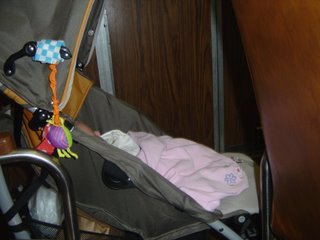
This Sunday Clare and I made our first trip to church by train. You can't really tell, but that's Clare in the stroller on the train.
Ah, the stroller. I took it because in addition to Clare and the requisite diaper bag, I was carrying my contribution to our monthly meal together: Thweatt rolls, a full Thanksgiving-sized double batch. I figured being able to put them down under the stroller seat and push Clare along would make things a great deal easier.
But in a city strollers are like cars--really convenient and helpful when you're actually moving and covering some distance, and really sucky to deal with all the rest of the time. I knew I had some stairs to contend with, but I also knew other people in NYC used strollers--I've seen them on the subway, I know it's possible to get your stroller down there. But this was my first stroller management experience. So I didn't know (till I asked for advice and received an extremely helpful tip from Laura) how to really handle the get-the-damn-stroller-up-(or down)-the-stairs hurdle.
But at every flight of stairs and at every elevator, train, and subway door, someone was ready to help. 12 people in all ready to hold the door or grab the bottom of the stroller to help lift it and carry it up or down the stairs. And it wasn't until I got to church and started thinking about it that I realized every single person who stopped to help me was a person of color.
Maybe it's a fluke but it seems astonishing to me. I'm no social scientist and this of course is not any kind of well-designed social experiment: this is just me not being able to handle my baby vehicle. And one trip is hardly representative, I'm sure. But I'm keeping my eyes open the next time I take the thing to NYC (not anytime soon--Clare may be heavy but at least in a sling stairs present no major obstacle) and we'll see if the experience repeats itself. Even though I now know the easiest way to get a stroller up or down the stairs is to pick it up and carry it myself.
Tuesday, August 29, 2006
when, and why
One of the things Brent and I are asked fairly often by people is when (or whether) Clare will be baptized. A couple of semesters ago, when I was precepting for TH 222 and just a few months pregnant, Clare became my class illustration (oh, the dangers of being a preacher's kid) on the subject during discussion of infant baptism and believer's baptism. It personalized it, made it a little less abstract--and unfortunately, a little less overtly theological for the students as well, I think. It's hard to theologize when all of a sudden, you're no longer talking about an issue, but a person. Thus, "unfortunately," because really, theology is ultimately about people, for it is always about relationship: to God and each other. Nothing is ever just an issue, floating around unattached to people, and doing theology as if there were such abstract, unattached and impersonal objects of investigation is (in my opinion) pretty much inevitably bad theology.
We've discussed this at least half a dozen times already since learning I was pregnant, and probably will discuss it that many more times in the next year or so. It's not that we disagree about it; it's not that Brent is for baptizing Clare now, and I'm not, or vice versa. It's more like, now that we have this decision in front of us, there are reasons on both sides and it takes a lot of back and forth discussion to negotiate it all, and in the end, when we're fatigued and the subject itself is exhausted, we know that we will revisit everything again in a little while.
Really, the question is, what is baptism, anyway? Is it something we do, or something God does? Do we have to be old enough to stand on our own two feet and speak for ourselves in order for baptism to be what it is? Or even further, do we have to be able to stand up and speak for ourselves as autonomous, responsible individuals--alone, as it were, before the throne of God, in order for baptism to be what it is?
I have my doubts about this, even though this is the assumption I grew up with. I wasn't baptized until I was 16 years old, mainly because at the ever-impressionable junior-high age, I watched a bunch of kids from the youth group I was nominally a part of go tripping down the aisle like lemmings and jumping into the baptistry. I was hugely cynical, because the kids I watched make heartfelt confessions of faith up at the front were the same kids who were, for the most part, casually cruel to me week in and week out (or at least, as my memory may have exaggerated, completely indifferent). What could baptism possibly mean, I felt, if it was just some maudlin show that left no imprint on the remainder of someone's life? Later, after my family's move to NC, I resisted because I was determined that, whatever I eventually decided, it would be a real decision, something that would mark which way I was choosing to go with my life. Not being baptized would have been quite as much a decision as being baptized: it was one way, or the other. Very Gospel of John, light and dark, sort of thing. So I put it off, because for a long time I didn't want to come to that point of decision-making. I wanted to float, live in both worlds, for as long as I could. Eventually, of course, this quit working for me. I had to choose. So baptism was, for me, the paradigmatic autonomous individual squaring up to take the responsibility of choosing or rejecting God. Baptism, for me, was saying "yes" to God. For a long time this was all that baptism was for me. I understood in some kind of intellectual way that baptism was participation in Christ's death, was a washing away of sins, was the reception of the gift of the Holy Spirit, was incorporation into the body of Christ. But these were just words. What baptism was, experientially, was an existential decision that marked a direction for my life.
I'm not saying this is a bad understanding. I, in fact, treasure the memory of my baptism and am grateful that I have this moment in my life that does stand as a marker of saying "yes" to God. There is something firm and unshakeable about that, something that cannot be undone, that I can reach for in moments of doubt and regret. Baptism is still this for me, but what I now understand is that it is also a great deal more. It is, in a way that goes deeper than words, participation, cleansing, renewal, incorporation; and it was these things even when I myself thought of it merely as a moment of definitive spiritual decision-making in my life.
The World Council of Churches document, "Baptism, Eucharist and Ministry," has this to say:
I quote this at length because I figure most people won't bother to follow the link to read all that (and probably a lot of you skipped to the end here as well so if I caught you cheating go back and read it). For some people, it is very significant that "the most clearly attested pattern in the NT" is believer's baptism. With very few exceptions, the stories of baptism in the NT are adults choosing to make a confession of belief. The exceptions seem to be those places where it is indicated that whole households are baptized, households including people without direct volition such as children and possibly even servants or slaves. But this "most clearly attested pattern," as any CofCer knows, is not as clearcut as that simple phrase makes it sound. Think of all the headscratching we've done on the question of the Holy Spirit, and trying to figure why sometimes it comes before, and sometimes after, and sometimes as a result of, baptism.
It is also clear that the baptism of infants is a reasonable answer to the development of the church, to that first generation of children born to parents who were baptized as believers. Theological arguments of original sin as justification for the practice came after the practice itself, and are dispensable; you don't have to believe little babies are going to hell to practice infant baptism. You are, rather, affirming the fact that this baby is also a fellow human being both in need of and deserving of grace, and part of a community which knows this and will teach this. Clare can't articulate this truth (although she's doing great with oohs, aahs, and various gurgly noises), but it is true of her nonetheless.
So...when will we do it? And why? Right now our answer is to wait. Primarily because of my own experiential argument, and not because I "won" with a theological or biblical case for believer's baptism. I value my own baptismal experience so much that I can't shake the conviction that this should be possible for Clare, too. But I am highly aware that this is a personal preference, and not a theological stance.
BEM concludes:
Clare has been welcomed into the Episcopal church (see Brent's post for the really beautiful liturgy for this service). Sometime soon she will be welcomed into my church, too. And someday--perhaps sooner than any believer's baptist tradition considers proper, and later than any pedobaptist considers proper--she will be baptized. I bet if we took bets on it, she would pick some day nobody bet on, just to be her own self.
We've discussed this at least half a dozen times already since learning I was pregnant, and probably will discuss it that many more times in the next year or so. It's not that we disagree about it; it's not that Brent is for baptizing Clare now, and I'm not, or vice versa. It's more like, now that we have this decision in front of us, there are reasons on both sides and it takes a lot of back and forth discussion to negotiate it all, and in the end, when we're fatigued and the subject itself is exhausted, we know that we will revisit everything again in a little while.
Really, the question is, what is baptism, anyway? Is it something we do, or something God does? Do we have to be old enough to stand on our own two feet and speak for ourselves in order for baptism to be what it is? Or even further, do we have to be able to stand up and speak for ourselves as autonomous, responsible individuals--alone, as it were, before the throne of God, in order for baptism to be what it is?
I have my doubts about this, even though this is the assumption I grew up with. I wasn't baptized until I was 16 years old, mainly because at the ever-impressionable junior-high age, I watched a bunch of kids from the youth group I was nominally a part of go tripping down the aisle like lemmings and jumping into the baptistry. I was hugely cynical, because the kids I watched make heartfelt confessions of faith up at the front were the same kids who were, for the most part, casually cruel to me week in and week out (or at least, as my memory may have exaggerated, completely indifferent). What could baptism possibly mean, I felt, if it was just some maudlin show that left no imprint on the remainder of someone's life? Later, after my family's move to NC, I resisted because I was determined that, whatever I eventually decided, it would be a real decision, something that would mark which way I was choosing to go with my life. Not being baptized would have been quite as much a decision as being baptized: it was one way, or the other. Very Gospel of John, light and dark, sort of thing. So I put it off, because for a long time I didn't want to come to that point of decision-making. I wanted to float, live in both worlds, for as long as I could. Eventually, of course, this quit working for me. I had to choose. So baptism was, for me, the paradigmatic autonomous individual squaring up to take the responsibility of choosing or rejecting God. Baptism, for me, was saying "yes" to God. For a long time this was all that baptism was for me. I understood in some kind of intellectual way that baptism was participation in Christ's death, was a washing away of sins, was the reception of the gift of the Holy Spirit, was incorporation into the body of Christ. But these were just words. What baptism was, experientially, was an existential decision that marked a direction for my life.
I'm not saying this is a bad understanding. I, in fact, treasure the memory of my baptism and am grateful that I have this moment in my life that does stand as a marker of saying "yes" to God. There is something firm and unshakeable about that, something that cannot be undone, that I can reach for in moments of doubt and regret. Baptism is still this for me, but what I now understand is that it is also a great deal more. It is, in a way that goes deeper than words, participation, cleansing, renewal, incorporation; and it was these things even when I myself thought of it merely as a moment of definitive spiritual decision-making in my life.
The World Council of Churches document, "Baptism, Eucharist and Ministry," has this to say:
While the possibility that infant baptism was also practised in the apostolic age cannot be excluded, baptism upon personal profession of faith is the most clearly attested pattern in the New Testament documents.
In the course of history, the practice of baptism has developed in a variety of forms. Some churches baptize infants brought by parents or guardians who are ready, in and with the Church, to bring up the children in the Christian faith. Other churches practise exclusively the baptism of believers who are able to make a personal confession of faith. Some of these churches encourage infants or children to be presented and blessed in a service which usually involves thanksgiving for the gift of the child and also the commitment of the mother and father to Christian parenthood.
All churches baptize believers coming from other religions or from unbelief who accept the Christian faith and participate in catechetical instruction.
Both the baptism of believers and the baptism of infants take place in the Church as the community of faith. When one who can answer for himself or herself is baptized, a personal confession of faith will be an integral part of the baptismal service. When an infant is baptized, the personal response will be offered at a later moment in life. In both cases, the baptized person will have to grow in the understanding of faith. For those baptized upon their own confession of faith, there is always the constant requirement of a continuing growth of personal response in faith. In the case of infants, personal confession is expected later, and Christian nurture is directed to the eliciting of this confession. All baptism is rooted in and declares Christ's faithfulness unto death. It has its setting within the life and faith of the Church and, through the witness of the whole Church, points to the faithfulness of God, the ground of all life in faith. At every baptism the whole congregation reaffirms its faith in God and pledges itself to provide an environment of witness and service. Baptism should, therefore, always be celebrated and developed in the
setting of the Christian community.
I quote this at length because I figure most people won't bother to follow the link to read all that (and probably a lot of you skipped to the end here as well so if I caught you cheating go back and read it). For some people, it is very significant that "the most clearly attested pattern in the NT" is believer's baptism. With very few exceptions, the stories of baptism in the NT are adults choosing to make a confession of belief. The exceptions seem to be those places where it is indicated that whole households are baptized, households including people without direct volition such as children and possibly even servants or slaves. But this "most clearly attested pattern," as any CofCer knows, is not as clearcut as that simple phrase makes it sound. Think of all the headscratching we've done on the question of the Holy Spirit, and trying to figure why sometimes it comes before, and sometimes after, and sometimes as a result of, baptism.
It is also clear that the baptism of infants is a reasonable answer to the development of the church, to that first generation of children born to parents who were baptized as believers. Theological arguments of original sin as justification for the practice came after the practice itself, and are dispensable; you don't have to believe little babies are going to hell to practice infant baptism. You are, rather, affirming the fact that this baby is also a fellow human being both in need of and deserving of grace, and part of a community which knows this and will teach this. Clare can't articulate this truth (although she's doing great with oohs, aahs, and various gurgly noises), but it is true of her nonetheless.
So...when will we do it? And why? Right now our answer is to wait. Primarily because of my own experiential argument, and not because I "won" with a theological or biblical case for believer's baptism. I value my own baptismal experience so much that I can't shake the conviction that this should be possible for Clare, too. But I am highly aware that this is a personal preference, and not a theological stance.
BEM concludes:
In some churches which unite both infant-baptist and believer-baptist
traditions, it has been possible to regard as equivalent alternatives for entry
into the Church both a pattern whereby baptism in infancy is followed by later
profession of faith and a pattern whereby believers' baptism follows upon a
presentation and blessing in infancy. This example invites other churches to
decide whether they, too, could not recognize equivalent alternatives in their
reciprocal relationships and in church union negotiations.
Clare has been welcomed into the Episcopal church (see Brent's post for the really beautiful liturgy for this service). Sometime soon she will be welcomed into my church, too. And someday--perhaps sooner than any believer's baptist tradition considers proper, and later than any pedobaptist considers proper--she will be baptized. I bet if we took bets on it, she would pick some day nobody bet on, just to be her own self.
Monday, August 28, 2006
Saturday, August 26, 2006
birthday
Yesterday was Brent's birthday. He too has now reached the hallowed age of 30, and since he's teased me for a month about enjoying his youth (with the implication that mine was officially over July 20 at 9:34) I think his should be celebrated with a vengeance.
So yesterday I planned a day full of Brent's favorite things. Favorite foods, favorite drink, favorite activities, favorite kind of cake-from-a-box and favorite ice cream (well, as good as I could do, anyway--Ben and Jerry's is an acceptable substitute for Bluebell, which you can special order for delivery, but only at $89 a pop).
And I started a scrapbook--not of Clare, but of us. Turns out we have a pile of pictures from random times and places from the last 6 1/2 years, and someday Clare will want to know how Daddy met Mommy and now we'll have a little picture book to go along with our admittedly insane love story. We'll tell it as a cautionary tale, obviously.
So, happy birthday to Brent! Feel free to leave your mean, over-the-hill-themed comments below. Or your nice congratulatory ones too.
So yesterday I planned a day full of Brent's favorite things. Favorite foods, favorite drink, favorite activities, favorite kind of cake-from-a-box and favorite ice cream (well, as good as I could do, anyway--Ben and Jerry's is an acceptable substitute for Bluebell, which you can special order for delivery, but only at $89 a pop).
And I started a scrapbook--not of Clare, but of us. Turns out we have a pile of pictures from random times and places from the last 6 1/2 years, and someday Clare will want to know how Daddy met Mommy and now we'll have a little picture book to go along with our admittedly insane love story. We'll tell it as a cautionary tale, obviously.
So, happy birthday to Brent! Feel free to leave your mean, over-the-hill-themed comments below. Or your nice congratulatory ones too.
Wednesday, August 23, 2006
pissed!
So, I've been watching the Today Show in the mornings while breastfeeding Clare. This morning, an exceptionally fine morning as Clare slept through the night!!!, was soured for me as I happened to see a segment entitled, "Power Girls: has empowerment gone too far?" I am, in fact, incensed. Enough so that I decided it was worth a bit of time to express my outrage in an email that will never be read. Which is why I post it below, so that at least YOU, my small band of loyal readers, can be equally pissed off and admire my nice turn of wicked phrase here and there.
Dear Today Show,
I am writing to express my disappointment with a segment of this morning's show, entitled "Power Girls: has empowerment gone too far?" The premise of this segment, that empowering girls with the message that "they can do anything," has backfired and produced heightened reckless and irresponsible behaviors in girls (such as drinking, smoking, and drug use) is flawed and indeed damaging. The assumption that empowerment equals immature adolescent hedonism is never questioned in this segment, but quite the opposite: it is assumed to be true, and then lamented. The suggested solution is a return to "feminity," with the statement that in this way women will once again take their proper place as the moralizing force in general society. What an incredibly backward suggestion.
I find it hard to believe that anyone would present this as serious "reporting," or that any professional woman would be able to state such things on national TV with a straight face. Those two women could take on Steven Colbert anytime.
As a side note, I also found it odd that Seventeen magazine is now considered a legitimate source for parental advice. I'm certain my parents never consulted it while dealing with my difficult teen years, and as a parent myself I have not had occasion to seek advice about raising my daughter from a magazine whose major audience is the apparently over-empowered teen girl it purports to lament.
Now that the feminist "mountain has been climbed," as was claimed in the segment, are we to believe that achieving a semblance of equality and respect has actually damaged girls? Is the solution really to silently slink back down that mountain into our kitchens, don the aprons and kick off the shoes? And let's not forget that even here at "the top" of this mountain, women are still earning only about 60% of the income that men do for the same work. Have we really achieved what is being claimed here? I think not.
Please, do not air any more segments which undermine the true empowerment of girls and women. There are too many mountains that remain to be climbed.
Sincerely outraged,
Jennifer J. Thweatt-Bates
Dear Today Show,
I am writing to express my disappointment with a segment of this morning's show, entitled "Power Girls: has empowerment gone too far?" The premise of this segment, that empowering girls with the message that "they can do anything," has backfired and produced heightened reckless and irresponsible behaviors in girls (such as drinking, smoking, and drug use) is flawed and indeed damaging. The assumption that empowerment equals immature adolescent hedonism is never questioned in this segment, but quite the opposite: it is assumed to be true, and then lamented. The suggested solution is a return to "feminity," with the statement that in this way women will once again take their proper place as the moralizing force in general society. What an incredibly backward suggestion.
I find it hard to believe that anyone would present this as serious "reporting," or that any professional woman would be able to state such things on national TV with a straight face. Those two women could take on Steven Colbert anytime.
As a side note, I also found it odd that Seventeen magazine is now considered a legitimate source for parental advice. I'm certain my parents never consulted it while dealing with my difficult teen years, and as a parent myself I have not had occasion to seek advice about raising my daughter from a magazine whose major audience is the apparently over-empowered teen girl it purports to lament.
Now that the feminist "mountain has been climbed," as was claimed in the segment, are we to believe that achieving a semblance of equality and respect has actually damaged girls? Is the solution really to silently slink back down that mountain into our kitchens, don the aprons and kick off the shoes? And let's not forget that even here at "the top" of this mountain, women are still earning only about 60% of the income that men do for the same work. Have we really achieved what is being claimed here? I think not.
Please, do not air any more segments which undermine the true empowerment of girls and women. There are too many mountains that remain to be climbed.
Sincerely outraged,
Jennifer J. Thweatt-Bates
Thursday, August 17, 2006
be a cowboy. or girl.
This is from an email that my sister and bro-in-law sent out a couple weeks ago. I'm trying to think of creative ways my church can help. Brent came up with a great idea but if anyone wants to brainstorm and share your ideas are welcome. Or hey, just go buy your own cow. Those of you with real jobs and that mysterious thing called "income" ought to consider it. The rest of us who haven't grown up yet, let's apply that creativity and imagination to coming up with ways to get those other people with income to buy cows.
Cows for Kids
You have a unique opportunity to help children in Honduras in a real and tangible way. As most of you know, we are about to open a new children's home, Las Palmas Refuge, in southern Honduras and along with this comes the responsibility of providing physical nourishment for these children. So we are building the agricultural component of Las Palmas Refuge to provide for the nutritional needs of the kids. Fresh milk, cheese and other dairy products are vital for healthy children and thus we are focusing our initial efforts on the dairy herd. We really need your help in purchasing young cows so we can better provide for the children of Las Palmas.
Jesus spoke often about caring for little children. Mark 9 reads: "Then he put a little child among them. Taking the child in his arms, he said to them, "Anyone who welcomes a little child like this on my behalf welcomes me, and anyone who welcomes me welcomes my Father who sent me."
Our initial plan is to purchase a small herd of composite dairy cows. These cows have relatively low milk production but are fairly cheap compared to traditional milking breeds. As we grow our herd, we will improve the quality of our cows by using pure bred Holstein, Jersey and Brown Swiss bulls.The cost of each cow ranges from $500 to $1000 depending on the quality of the animal and her condition of sale (lactating, pregnant, cow-calf pair, etc). We would love for you to purchase your own cow. You can get to know your cow personally by giving her a name and receiving a picture of her detailing her personality.
First Fruits
Just this week we started supplying our school in San Marcos with fresh milk from our first few cows. To see the smiles and contentment on the children's faces is indescribable. The feeling of love and gratitude is really overwhelming. This is the first fruits of our labor on this dairy project. With your help, we can continue to grow this effort and give these children the physical and spiritual nourishment they need.
We want to invite you to partner with us in welcoming the children to Las Palmas. Please consider helping us in the purchase of cows so that the table will be full when they arrive. If you would like to help purchase a cow, the whole thing or just part of her, please mail your donation to:
Mission Lazarus
47 W. Irving Park Rd.
Roselle, IL 60172.
Please note "Cow" on your check. You can also donate online at:
ML Donate. All Donations are tax deductible.Thanks for your help.
Friday, August 11, 2006
welcome to the world
Sylva Mercedes Bohannon was born yesterday morning: 8 lbs. 14 oz., 20 " long and lots of hair.
Wednesday, August 09, 2006
anticipation
Today is all about anticipation. I am waiting for a phone call from NC to announce the arrival of Clare's destined best friend. I thought the anticipation was unbearable when I went 15 days postdate, but this little baby has outwaited even Clare's record. So today, in defiance of all expectation, mom & baby are in a hospital for possible induction.
So much of giving birth is waiting and anticipation! I didn't know that before--TV makes it look like it's all about labor and contractions and pushing. That is just a tiny bit of it, in my experience. Far worse is the long, long uncertain period of waiting for it all to start and not knowing what it will be like when it does.
Hopefully, though, today will be Baby Bohannon's birthday and the birth will be gentle, unforgettable, empowering, and...SOON!
Say this quick prayer for mom & baby today:
God, it is time for this new life to enter the world. Let this entrance be peaceful and powerful. Strengthen mother and child for the labor ahead. Make this time holy and blessed. Amen.
Anticipating joyful news anytime now...
So much of giving birth is waiting and anticipation! I didn't know that before--TV makes it look like it's all about labor and contractions and pushing. That is just a tiny bit of it, in my experience. Far worse is the long, long uncertain period of waiting for it all to start and not knowing what it will be like when it does.
Hopefully, though, today will be Baby Bohannon's birthday and the birth will be gentle, unforgettable, empowering, and...SOON!
Say this quick prayer for mom & baby today:
God, it is time for this new life to enter the world. Let this entrance be peaceful and powerful. Strengthen mother and child for the labor ahead. Make this time holy and blessed. Amen.
Anticipating joyful news anytime now...
Tuesday, August 08, 2006
AWAD
Today's word was especially intriguing. Plus, I need to get that disturbing post about sex off of the top of the page before my mother sees it. Oops, too late. Before mei-mei sees it. Oops, too late. Before Hilary takes my dare seriously. Oops, too late.
This week's theme: words related to forecasting and divination.
bibliomancy (BIB-lee-o-man-see) noun
Divination by interpreting a passage picked at random from a book,
especially from a religious book such as the Bible.
[From Greek biblio- (book) + -mancy (divination).]
If you are having a hard time deciding between turning groupie and following
your favorite band around or to stay put in your accounting job, help is at
hand. Try bibliomancy. Here's the step-by-step method:
1. Pick a book you trust a lot.
2. Put it on its spine, and let it fall open.
3. With your eyes closed, trace your finger to a passage.
4. Interpret the passage as your lifemap to the future.
You could even add more randomness to the process. To do that at the macro
level, visit a library and pick a book at random from the shelves. At the
micro level, instead of interpreting a passage, pick a single word and let
it point you to your path.
Then you could try awadmancy -- divination based on words from AWAD. Focus
on the question in your mind and then click here to get a random word from
our archives: http://wordsmith.org/words/random.cgi
-Anu Garg (garg AT wordsmith.org)
"It was Margaret Drabble's new The Oxford Companion to English Literature,
which I'd been sent, to review. I'd been picking through it idly, looking
at this and that, seeing who was in and who was out, when, by a kind of
obscure bibliomancy, the book fell open at page 471, and there I was,
laid out drily between Robert Henryson, the 15th-century Scottish poet,
and Philip Henslowe, the Elizabethan theatrical diarist."
Philip Hensher; Brought to Book by the Literary Establishment;
The Independent (London, UK); Sep 6, 2000.
Sponsors' messages:
Always find the right word with the Visual Thesaurus. Wordsmith readers
save 10%. Try it free! http://www.visualthesaurus.com/?code=qt4&ad=aw
Subscribe to http://delanceyplace.com -- a carefully selected non-fiction book
excerpt free to your email each day. It's the thinking person's daily quote.
............................................................................
There is no coming to consciousness without pain. -Carl Jung, psychiatrist
(1875-1961)
Share the magic of words. Send a gift sub: http://wordsmith.org/awad/gift.html
Remove, change, or subscribe address: http://wordsmith.org/awad/subscriber.html
Pronunciation:
http://wordsmith.org/words/bibliomancy.wav
http://wordsmith.org/words/bibliomancy.ram
Permalink: http://wordsmith.org/words/bibliomancy.html
This week's theme: words related to forecasting and divination.
bibliomancy (BIB-lee-o-man-see) noun
Divination by interpreting a passage picked at random from a book,
especially from a religious book such as the Bible.
[From Greek biblio- (book) + -mancy (divination).]
If you are having a hard time deciding between turning groupie and following
your favorite band around or to stay put in your accounting job, help is at
hand. Try bibliomancy. Here's the step-by-step method:
1. Pick a book you trust a lot.
2. Put it on its spine, and let it fall open.
3. With your eyes closed, trace your finger to a passage.
4. Interpret the passage as your lifemap to the future.
You could even add more randomness to the process. To do that at the macro
level, visit a library and pick a book at random from the shelves. At the
micro level, instead of interpreting a passage, pick a single word and let
it point you to your path.
Then you could try awadmancy -- divination based on words from AWAD. Focus
on the question in your mind and then click here to get a random word from
our archives: http://wordsmith.org/words/random.cgi
-Anu Garg (garg AT wordsmith.org)
"It was Margaret Drabble's new The Oxford Companion to English Literature,
which I'd been sent, to review. I'd been picking through it idly, looking
at this and that, seeing who was in and who was out, when, by a kind of
obscure bibliomancy, the book fell open at page 471, and there I was,
laid out drily between Robert Henryson, the 15th-century Scottish poet,
and Philip Henslowe, the Elizabethan theatrical diarist."
Philip Hensher; Brought to Book by the Literary Establishment;
The Independent (London, UK); Sep 6, 2000.
Sponsors' messages:
Always find the right word with the Visual Thesaurus. Wordsmith readers
save 10%. Try it free! http://www.visualthesaurus.com/?code=qt4&ad=aw
Subscribe to http://delanceyplace.com -- a carefully selected non-fiction book
excerpt free to your email each day. It's the thinking person's daily quote.
............................................................................
There is no coming to consciousness without pain. -Carl Jung, psychiatrist
(1875-1961)
Share the magic of words. Send a gift sub: http://wordsmith.org/awad/gift.html
Remove, change, or subscribe address: http://wordsmith.org/awad/subscriber.html
Pronunciation:
http://wordsmith.org/words/bibliomancy.wav
http://wordsmith.org/words/bibliomancy.ram
Permalink: http://wordsmith.org/words/bibliomancy.html
Saturday, August 05, 2006
sex is good
Don't get all squiffy. You know I've had sex before because you know we have a bee-yoo-tee-full baby. So it's not like I'm telling you anything not already at least implicitly known.
But this post is a celebration! Because sex is good and people shouldn't be ashamed to say so. And because I just had my postpartum followup appointment and was pronounced perfectly fine and we went straight from the office to buy condoms.
Yay!
But this post is a celebration! Because sex is good and people shouldn't be ashamed to say so. And because I just had my postpartum followup appointment and was pronounced perfectly fine and we went straight from the office to buy condoms.
Yay!
Tuesday, August 01, 2006
Subscribe to:
Posts (Atom)